The Handmaid’s Tale, by Margaret Atwood

handmaids-taleSpoilers.

Better never means better for everyone, he says. It always means worse, for some.

This book comes so highly recommended that I feel bad saying the dreaded words: I didn’t like it. I wanted to like it. But I didn’t. I couldn’t help it. I just didn’t like it. No need for a plot outline here – what I didn’t like didn’t have to do with the plot. The plot was interesting. It was a neat setup – a dystopian society based on skewed scriptural interpretation. The dangers of organized religion as government. I just don’t think Atwood pulled it off well. Let the attacks begin.

In my defense, I will offer up the reasons that this book didn’t sit well with me.

First, there was so much in it that a lot of the meaning got lost, mixed up, jumbled around. Originally, one of the reasons I didn’t like it was because the strain of feminism so popular in the 70s and 80s (and which I can’t stand) was so prevalent in the narrative. There was so much “look at how bad women are treated” that I wanted to gag. Then I read some analysis about the book and discovered that this was actually a critique of feminism, a warning that the direction feminism was going could lead easily to this type of society. I didn’t catch that when I read this. I was more focused on the critique of theocracy, of organized religion, of televangelism, of repression of women, etc. I think Atwood had so many things she wanted to talk about, and she needed to prune her topics a little bit, because some of them were lost and counterproductive.

Second, this falls victim to the 80s writing pitfalls that I’ve discussed in the past. In general, I don’t like 80s writing, the same way I don’t like country music or soap operas. They aren’t my taste. 80s writing is really heavy to me, dry, and a total turn-off. Not to mention there’s a lot of “shock” moments that feel very juvenile – ooh, I said a bad word! Yeah. This book isn’t as bad as some, but it definitely feels tainted with the style of that decade. I don’t expect anyone else to feel the same way as I do about 80s writing – this is a purely stylistic preference.

Third, and most important, I was irritated the entire book by the writing. I’m a writer. I can’t help noticing things from a writing perspective. That’s how I see books. This one had several problems that stood out and ruined the plot – which I admit was good – for me. First, the whole past tense/present tense variation kept throwing me off. At first, I thought the pattern made sense, but after awhile, there stopped being a pattern. Memories came out as present tense; current events as past. The present tense has to be well-written in order to become convincing, seamless, invisible, and it never got to that point in The Handmaid’s Tale. But even that was a small irritation in comparison to the point of view.

Atwood chose first person POV for this book. I understand why she did – first person is oftentimes more intimate, more immediate. Authors choose first person in order to help the reader feel like they are right there with the character. You can say more about the internal conflict in a first person narration. I think it was a bad choice in this book, however. I think third person limited could have been just as effective in the intimacy and immediacy departments – more so, perhaps – and then there wouldn’t have been the trapping this book fell into. Whole paragraphs, pages, chapters, devoted to working out a plothole. The women are not allowed to read or write in this society. This diary-like book, from first person pov, could not have been written at the time the events took place. They must have been written (or recorded in some other way) at a later time. Offred’s story ends ambiguously. It was a good ending. But it was not a possible ending in first person point of view. There had to be something more. There had to be an epilogue of scholars to explain why this book exists.

The fact that there had to be an explanation for why the book exists is the biggest flaw in the book for me. It was irritating to have Offred suddenly say, “I don’t want to write this story now, I’ll write another” or “things didn’t happen that way, I just wanted to write that, now let me tell you the real story.” It detracted from the book, this focus on why/how the book was written. I could even forgive the first person pov if Atwood had let the reader suspend their disbelief and create their own ideas about how such a narrative might have been written/recorded/published. The book was far more powerful keeping it within the confines of itself, not going outwards to concentrate on the why’s and how’s. I wanted this book to be good, and I could have forgiven all else, but this unnecessary rationalization – that was the end for me. I couldn’t take it. I felt like Atwood had taken a wonderful idea and flattened it with self-justification.

Not that there weren’t some things I did like. The quote above was my favorite in the book, and it does a good job summing up their lives. Quite a powerful statement, that quote. And then I loved the fact that the Quakers ran an “underground femaleroad.” The Quakers are my favorite Christian religion – if I was Christian, that’s where I’d be going – and their tiny placement in the book was just so perfectly accurate. There were also multiple scenes that were powerfully written, and the book was, in places, very chilling.

I really did want to like this book. I’m sorry I couldn’t. I’ll just have to hang my head in shame for my dissenting voice here.

Posted in 2008, Adult, Prose | Tagged , , , | 1 Comment

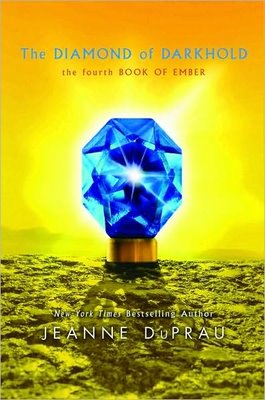
The Diamond of Darkhold, by Jeanne DuPrau

darkholdThe Diamond of Darkhold is the fourth and final book of the Ember series by Jeanne DuPrau. The book takes the people of Ember, joined with the people of Sparks from book 2, through their first winter together. It’s a hard winter, with very little food and a lot of problems as this tiny post-apocalyptic village tries to accommodate double its previous inhabitants. Lina and Doon, heroes from books 1 and 2, travel back to Ember without telling anyone in order to see if they can find a way back into their old city. There, they hope to find supplies, food that was left behind, medicine, and anything else that’s useful. When they get there, however, they find some arrogant, ignorant trespassers living in the old city, which puts a damper on their plans.

I liked this book. It was well written, well paced, and the end satisfied me. It was hopeful – a very almost-happily-ever-after sort of ending – without being unrealistic or childish. All the ends were tied up.

After reading this whole series, I get the impression that DuPrau knew a lot more about Ember than her Sparks civilization. The parts that take place in Sparks feel much like book 2 felt – a little forced and shallow. Contrived. But as soon as Lina and Doon return to Ember, the tone of the book transforms into the grace that was so appealing in book 1. I enjoyed the return to Ember a lot, and thought those parts were written better than the rest.

Overall, I liked the series. The first book is by far the best, but the others aren’t bad.

Reviews of the first three in the series:
The City of Ember
The People of Sparks
The Prophet of Yonwood

Posted in 2008, Children's, Prose | Tagged | Leave a comment

The Giver, by Lois Lowry

giverYou know, I’d thought that, as a kid, I’d read a lot of Lois Lowry. I didn’t recall which books specifically, but I remembered her name. A quick check on Wikipedia, however, reveals to me that before Number the Stars, I’d never read a single book by Lowry. I’d seen the Anastasia series all the time in the library, but I don’t believe I ever picked one up. How could I have gone so long without reading one of the greatest children’s literature authors of all time? Because Lowry is brilliant. I thought so after reading Number the Stars, and The Giver has confirmed it.

The Giver is a dystopian novel about a community which has converted to “sameness” in order to eliminate any form of pain. Everything in their world is meticulously organized and executed. The story is told from the point of view of Jonas, a twelve year old boy who, near the beginning, finds out that his role in the community will be the new Memory Receiver. It is a highly honored but difficult job which only one member of the community can have. Jonas meets the old Receiver, who he knows as the Giver, and begins training. This basically entails a telepathic reception of the whole of history’s memories. The Receiver’s job is to hold the memories of the world, to learn wisdom from them, and to advise the community when his/her wisdom is needed. Slowly, Jonas comes to realize what Sameness has cost people – they don’t have pain, anger, or loneliness, but they also don’t have love or joy. He has to evaluate and weigh this realization – is it worth sheering away some good in order to avoid the bad? A couple major discoveries startles Jonas into action, culminating into a very ambiguous end which I won’t give away.

I wanted to read this book slowly. To savor it. I couldn’t, however. It took hold of me and, despite my efforts, I’d finished it in two days. It is masterfully written and very powerful. About halfway through, there was a reader-reveal that was so shocking to me that I literally got chills and my heart jumped. It’s really rare for me to react physically to a book, but this was just so powerful and unexpected. The Giver definitely deserved its Newbery Medal.

There were few points I didn’t like, but I suppose I should enumerate them. They are minor, trivial, compared to the rest of the book. The year Jonas passes under the Giver’s instruction felt too quick – I didn’t realize more than a couple weeks went by, so I was surprised in that respect. And then, the end was perhaps a little too ambiguous for me. That’s not it exactly, because I like ambiguity, but…I suppose I wanted to see and know more. I felt like there were a few things Lowry could have done, instead of leaving so many loose ends and questions. I suppose this book is part of a trilogy. Perhaps questions are answered later. But it was disappointing to know so little by the end. The whole story seemed to veer off its path in the last couple chapters and careen down a hill away from itself. I thought the ending could have been tighter.

Beyond those things, though, I don’t really have any complaints. Society was beautifully mapped out, with that whole perfect-but-inherently-creepy atmosphere. Reveals were precise and powerful. The language was gorgeous. Overall, highly recommended.

Posted in 2008, Children's, Prose | Tagged , , , , | 4 Comments

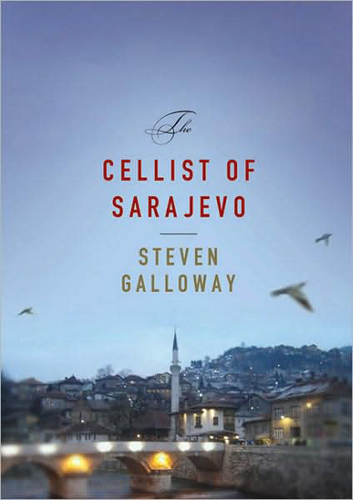
The Cellist of Sarajevo, by Steven Galloway

Cellist_0The Cellist of Sarajevo is a fictional account of four people during the siege of Sarajevo in the early ’90s. First, there is the cellist, who witnesses an attack that kills 22 people outside his window as they waited in line for bread. He decides that he will play at the spot of the attack for 22 days in honor of their deaths. Second, there is a middle-aged man named Kenan, who has to leave his house every couple days to collect water for his family. Third, an older man named Dragan wanders the streets, seeking out his daily ration of bread, and comes upon an old friend who helps him remember the city from before the war. And fourth is the story of Arrow, a countersniper who is put in charge of protecting the cellist’s life, at the same time her army turns against her. These four accounts, chapter by chapter, are woven together. The cellist himself only receives one chapter in the book, the first one, but his actions touch the lives of all the other characters.

This is a war book, but not like any other war book I’ve ever been exposed to. I don’t know who is fighting who. I don’t know anything about the Siege of Sarajevo. Even after reading the wikipedia article on it, I know very little. And this book does nothing in the way of enlightening me on who was on what side. Not that that’s a bad thing – actually, it was rather refreshing to keep politics, religion, etc out of the narrative. In the end, does it really matter who thought what and why they were fighting? No, it only matters that they fought, that people died, that innocent people died. This is a personal tale. It shows the horrors of war but also speaks to humanity. In the end, humanity is more important. War has this tendency to make everything grey and flat – there’s even a passage in the book that discusses this – but this book made people and places come alive again. Not through horror. This isn’t a book that is trying to use horror to get you to wake up to the evils of war. Not at all. There is more inspiration and hope in this book than in any other war book I’ve ever read, I believe.

I enjoyed it. I really did. I liked some sections more than others – I thought Arrow was fascinating, for example, while at one point I confused Kenan and Dragan’s stories for a moment and temporarily lost track of who was who – but overall, this was a far better book than I anticipated. It is precisely written, without narrative meant to shock; clear, descriptive, fast enough to want to keep reading but slow enough that you can take your time over it and think things out. I’ve compared modern thriller genres to eating fast food – I just feel sick afterwards – and using that metaphor, this was like a hot winter soup. Refreshing, fulfilling, not the most tasty thing I’ve ever eaten but certainly satisfying, and in the end, fortifying.

This is a story about people. Not heroes, not villains, just people, behaving like people behave, surviving how they can – both physically and emotionally. Keeping a balance between spiritual/emotional survival and staying physically alive. And while this wasn’t the most powerful thing I’ve ever read, it will certainly stick in my mind and stay there a long time. Highly recommended for anyone who would like to read something about war that doesn’t fall into any of the war genre categories out there.

Posted in 2008, Adult, Prose | Tagged | 3 Comments

The House of Mirth, by Edith Wharton

thehouseofmirthI remember reading something by Edith Wharton in 11th grade. Ethan Frome, I believe. I don’t remember particularly liking her style, which is why, when my book club at the library chose House of Mirth for our October selection, I was a little worried. I didn’t really want to delve into this one, and I hoped it would be like The Grapes of Wrath, which I loved despite my original hesitance. Well, this wasn’t quite the same as The Grapes of Wrath – I didn’t love this book, but I didn’t dislike it either. I’ll go so far as to say that, for the most part, I actually liked this book, though it might be awhile before I delve into anything else by Wharton. Kind of like how I feel about Thomas Hardy after reading Tess of the D’Urbervilles in 2006.

When I was about 125 pages into this book, I turned to Jason and said, “So here’s the set up. Lily Bart has grown up in upper class NY society. Her parents died and left her with very little, but she’s still trying to make her way in the only part of the world she’s ever known. She’s in love with a man named Lawrence Selden, who lives on the periphery of society (thereby making him ineligible for marriage to her) and who also loves her. Another man, a rich guy who isn’t very admirable, named Rosedale, is trying to court her. What do you think will happen by the end?” So we discussed it, and had fun making up guesses of the ending based on what other authors might have done. If this were Jane Austen, Lily would learn to be satisfied living on the periphery of society, and she and Selden would marry. Thomas Hardy, on the other hand, would have Lily disgraced (rightfully or not) in Selden’s eyes, have her turn to Rosedale in desperation, and once Selden comes around to loving her again, it’d be too late and she’d be with the bad match. Hemingway would have a thoroughly-ruined Lily standing on the edge of the Brooklyn Bridge, leaning over, admiring the calm of the water at night before she jumped.

I won’t tell you what Edith Wharton does. If you know the ending of Ethan Frome then you might have an inkling of Wharton’s style. I will say this is no Jane Austen.

So, what did I like and dislike about the book? What gives me that very neutral opinion stated above? Well, my primary issue with this book takes place within the first 150 pages. Wharton is tediously longwinded in places. I don’t mind so much the minute descriptions. I personally find them redundant and superfluous, but in general I just don’t like that style. It doesn’t bother me, though. I can skim through details that I don’t find worth conjuring up visually – I prefer to see the big picture. But I understand that many authors write in that style, and I respect them for it even if it’s not my favorite. What did bother me was the excessive amount of telling instead of showing, and the incredibly heavy-handedness with which it was done. Wharton’s sections where her characters were moving, speaking, etc were superb, and I could see the characters perfectly. However, the pages-long passages of narrative no more informative than ‘when this happens to Lily, she feels this; and then when that happens, she feels that; and then another thing happens and it makes her feel this, and so on, and so on.’ Not a direct quote, obviously. But when we pulled out of the narrative and Wharton stopped trying to tell us directly what lessons she wanted us to learn, I learned naturally from the characters, and that was very well done.

The first 150 pages or so were extremely tedious in this way. There’s very little movement, and I think a lot of it could have been stripped out. By the time I’d almost finished Book 1 (it’s split into two books), I was really to proclaim serious dislike for this book. But then suddenly, in the last 30 or 40 pages of Book 1, Wharton left behind all that heavy-handedness and suddenly the book came alive. I read the last 180 pages or so this afternoon. Partly that’s because I’m sick and confined to laying or sitting, but I could have chosen a movie or taken a nap. Instead, I got wrapped up in the book and didn’t want to put it down for anything. The plot engaged me, the language engaged me, and the characters engaged me, right down to the poetic, ironic, and oddly romantic (in an aesthetic sense) end.

Some people have compared Lily Bart to Emma Bovary in Flaubert’s Madame Bovary. I don’t agree with the comparison. While the women meet somewhat similar fates, their journeys, motivations, and lives are very different. I don’t find Emma a pitiable character at all. She’s selfish and creates all her own problems out of boredom and greed. Lily, on the other hand, I feel very sorry for. I don’t think Wharton wrote her out to be a despicable character or to say that bad things happen to bad people. Lily’s grown up in rich society and can’t take herself out of that mindset, so in some ways she’s very helpless. Her greed is naive, her motives are oftentimes quite innocent, and at several junctures of the book, she passes off easy solutions because she prefers not to sell her soul for money. I think she’s an intrinsically good person, though desperately naive and childish. I sort of think she was set up that way on purpose, that Wharton was revealing the evils of upper class society by saying that the good don’t necessarily win – that they are in fact more likely to lose the game. This is further evidenced by the fact that the characters thought of as “bad” within the circle – Carry Fisher, for example – end up being some of the nicer, more generous characters in the book.

One random point: I would have liked to see more of Gerty Farish. She plays a major role, but I feel like she was passed over more than she should have been. I think Wharton lost an opportunity there.

And then my favorite quote from the book – this is beautifully written! It’s the last line of book 1, chapter 11:

Mrs. Peniston felt as if there had been a contagious illness in the house, and she was doomed to sit shivering among her contaminated furniture.

So in the end, the last 2/3rds of the book saved this one for me. I can’t say I love it. There was just too much of that tediousness at the beginning. But I didn’t end up despising it, and I do think it deserves its place of honor in the halls of classic literature.

Posted in 2008, Adult, Prose | Tagged | 2 Comments

Johnny Panic and the Bible of Dreams, by Sylvia Plath

Johnny_Panic_Harper_00Johnny Panic and the Bible of Dreams is a collection of short stories, essays, and journal entries by Sylvia Plath. Altogether, 20 stories, 5 essays, and 5 journal collections grace this book. I must say that it’s extremely difficult to read a short story collection in a timely matter. It took quite a bit of effort to read this one in 10 days, averaging 3 pieces a day, about 32 pages. Why? Because each time I finished a story, I had the immensely satisfying “I’m finished” feeling that comes at the conclusion of a piece, and it’s difficult to just run straight into the next one, especially since Plath really makes you feel as if you are IN the story, and that’s hard to let go of to enter a new atmosphere. I had to space them out throughout the day.

What can I say about this? I don’t want to go into each individual work. I must say the journal entries were the most difficult part to read. According to the introduction, written by Plath’s husband Ted Hughes, Plath was trying to write in the “Flaubertian” style, a scary statement in itself as I couldn’t stand Madame Bovary. What that amounted to, from what I could see, was huge passages about every minor detail of a person’s clothes or home decor, and reading two pages on the pattern of wallpaper really bugs me. The essays, on the other hand, were fantastic. They were autobiographical (well, to be fair, most of Plath is transparently autobiographical, but the essays at least didn’t put on a veneer of fiction) and brilliantly written.

Which leaves the 20 stories. Wikipedia says Plath is known for “her uncanny use of metaphor” and I would have to say that’s a very accurate statement. Plath is a brilliant writer. I haven’t read her poems because I’m the most incompetent idiot when it comes to poetry, but The Bell Jar is one of my favorite novels of all time and it is superbly done. Reading through these stories and essays, I can see over and over again how great a writer she was. Every sentence is rich and powerful. Not overly done. Perfect tempo, perfect visual aid. For example, from one of her essays about public school:

…full time guidance counselors jogged our elbows at ever-diminishing intervals to discuss motives, hopes, school subjects, jobs–and colleges.

Wow. If I could write half that well, I wouldn’t have anything to worry about. That’s all I can say about that.

But in spite of the beauty in her writing, Ted Hughes’ remark in the introduction about the stories’ “obvious weaknesses” really does ring true. Many of the stories fall short of the mark. I found this extremely frustrating, knowing that every sentence was a work of art, not being able to find a single flaw, and yet feeling a letdown at the end, as if the story just didn’t quite get to the pinnacle of what it could be. Like it didn’t come together at the end. And usually the frustration was so vague and abstract that I’d never be able to put it into words. Plath would have needed one heck of an editor to help her. Like I said, the words themselves are virtually flawless.

There were several stories I didn’t like, and several I really loved. I’ll start with the bad ones. One of my two least favorites was “Stone Boy With Dolphin,” which was like a drunken splatter based on journal entries from her Cambridge years. It was an attempt at stream-of-consciousness of a drunk girl which just didn’t work for me. It made no sense, the internal narrative was disjointed, and the story wasn’t that interesting. If, perhaps, she had taken it out of the SOC style and expanded it, so we weren’t introduced to 40 characters in a short number of pages, it would have read less like a diary entry and more like a cohesive novella. The other of the two I heartily disliked was “Johnny Panic and the Bible of Dreams.” This one was apparently her most famous short story, and appeared in Atlantic Monthly. For some reason, though, I just didn’t like it. Maybe it’s because the ending felt obvious to me, because that sort of end has been redone so many times in our culture that I’m just sick of it. Perhaps it’s also because Plath feels like she’s writing almost objectively, cold, completely detached from the narrative, and the thing I like most about her writing in general is the amount of herself poured into the page. This story felt boring and pointless without that little bit of the author embedded in it.

As for the good ones, my favorites were the essay, “America! America!” (the guidance counselor quote above is from this one), “Above the Oxbow,” and “That Widow Mangada.” “Above the Oxbow” is a very tiny story that I love for its voice. I really feel like I’m reading something from an old man’s point of view, looking out over mountains and dealing with random tourists. The tourists are transient – you know there’s more to their story, but you never hear it – and it gives a great slice-of-life feel in this hour of the old man’s world. “That Widow Mangada” is based on actual events (there’s one journal entry entitled “Widow Mangada” that has almost everything from the story laid out in it) from a trip Plath and Hughes took to Spain one summer. I like this one because the characterization is done remarkably well, plus the description and irony of cross-culture clashes. The widow is a peculiar and realistic character (obviously, since she’s based on a real person) which gives so much life to the story. And the end is not too unrealistically depressing or triumphant (a trap fallen into in some of these stories). It was my favorite of all of them.

And of course, Plath does basically lay her life out in these stories and prose works, the same way she did in The Bell Jar and, from what I’ve heard other people say, her poetry. Some of these stories almost seem like earlier versions of parts of The Bell Jar, down to some lines I’m almost sure were copied over into the novel (or taken from it, I suppose, I don’t know which came first).

All in all, I really liked the book. I didn’t know Plath had written any prose other than The Bell Jar and was very happy to discover that she had, since she’s one of my favorite authors. And while these stories weren’t all perfect, I wasn’t in the least bit disappointed. She was a brilliant writer.

Posted in 2008, Adult, Prose | Tagged , | 1 Comment

Killing Mr. Griffin, by Lois Duncan

killinggriffinI first read this book fifteen or more years ago. I was on a real Lois Duncan streak then. I loved her works, especially Down a Dark Hall, which had a profound effect on me – I reread it last year and it still creeped me out. Having said that, I don’t remember what I felt about Killing Mr. Griffin in my youth. I don’t remember it being particularly memorable. That was one of the reasons I wanted to reread it. Unfortunately, in rereading it, I found it really didn’t live up to the Duncan standards I’m used to. Maybe that’s because I’m too old for it now, or maybe not. Like I said, I got real creeped out when I reread a different Duncan book last year.

The story starts with a group of stereotypes: the jock; the cute, popular cheerleader; the sensitive, good-looking class president; the shy, ugly, nerd girl; and the Mr. Cool psychopath. They are all together in Mr. Griffin’s English class, and all are struggling. Mr. Cool suggests to Cheerleader and Jock that they kidnap Mr. Griffin and rough him up a bit, threatening to kill him. They want to deflate his ego and make him a shell of a man, so he’ll go easier on everyone in class. They draw Class President and Nerd Girl into the plot, and somehow manage to pull it off, at least as far as kidnapping and taking Mr. Griffin to a secluded spot in the woods. There, however, plans go awry, as Mr. Griffin has angina and dies of heart failure while they’ve left him to stew in fear for a few hours. The rest of the book is about how the kids deal with the death.

This isn’t the best of Duncan’s books. I’ve read a lot of them, and this one is supposed to be fairly acclaimed, but I just didn’t see the development that shows in her other works. The plot was predictable (yes, I’d read it before, but didn’t remember anything), the characters were cardboard, and the resolution was too simple. It also seemed to have a lot of things in there purely for shock value. While I really liked YA thrillers at one point in my life, I think books like this burnt me out on the genre. Duncan usually did a good job of making her thrillers unique, but this one followed the same pattern as all thrillers, and I get so tired of diecast plots. I like there to be something – at least one thing – to make the book unique. I’m afraid this didn’t have it.

Then again, maybe something in here was unique in 1978 when it came out. Were some of those stereotypes not around yet then? Maybe this book was one of the revelations of YA thriller, and I’d just read so many that it felt cliche to me. I have no evidence to the contrary. But whatever the reason, it felt cliched and stereotyped to me, and I didn’t enjoy it very much. If you’re going to read Duncan, I’d suggest starting with a different book.

Note: Review date is only an approximate of when this book was read/reviewed in 2008.

Note: Originally read in ~1993/1994-ish.

Posted in 2008, Prose, Young Adult | Tagged , | Leave a comment

Dr. Zhivago, by Boris Pasternak

Dr. ZhivagoSpoilers.

Ugh. What else can I say about this book? It’s nearly 550 pages of ugh.

Somewhere awhile back we** were talking about loss in translation. I think this book is the perfect example of that. Not just because it’s translated from Russian to English, but because the culture is so completely foreign to me that I just don’t understand the climate. This is steeped in Russian revolutionary history and chock-full of various philosophies. Unfortunately, I’m not real big into philosophy in straight doses, so I’ve read hardly any of the writers discussed (and thus don’t know their ideas), plus I don’t have a clue when it comes to Russian history and geography. I couldn’t tell you who the big army leaders were or what the Greens stood for or what cities were in Siberia or anything else. I think my total ignorance really gave me a disadvantage when reading this book.

That, and for the most part, I just don’t take well to the Russian style of classic literature. Tolstoy did the same thing – write one story, end it completely, start telling a completely unrelated story, then another, then another, come back to the first one, tie two stories together by a meagre thread, end the third story altogether, concentrate on the second for half a book, and then start another story which has nothing to do with the rest of the book before or after it’s told. I don’t get this sort of writing. I know that it’s classic, I know that it’s probably a great example of Russian style, but I flat-out don’t get it. It doesn’t help that everyone has 15 variants of their names and they’re all in a language I’m not in the least bit familiar with, so I can’t keep track of who’s who.

This could have been interesting. It had potential. Strip out all the philosophy and bantering about war, disentangle the millions of plotlines, and you’re left with a decent story. Not one I particularly liked, but one that was interesting and had plenty of literary value. It almost seemed as if Pasternak wanted to write a purely philosophical work and felt like he had to stir up a tiny bit of fiction to pass it off. I wish he hadn’t. I wish he’d stuck to one genre or the other. I don’t mind philosophy in books, gracious no, but it does well to unveil that philosophy through the plotline, not spent 100 pages listing all the popular theories and idealisms of the time and comparing/contrasting them. There isn’t even the illusion of fiction in some places.

Cutting all the baggage aside, the story is about Yurii Zhivago’s life. Well, as much as you can say this is about any one particular story. That was the one discussed the most. Zhivago grows up as an orphan, marries, has kids, helps in the war, meets a woman named Lara who he has no feelings for until his wife persuades him otherwise, later cheats on his wife with Lara but still loves her, is taken prisoner for awhile, escapes, lives with his lover for a long time, tricks her into leaving him, and spends the last ten years of his life turning into an unhealthy buffoon (including taking a third unofficial wife and having more kids). Then he dies. Then Pasternak tells an unrelated story from 20+ years after his death.

I wanted to like Zhivago (the person, not necessarily the book). He seemed like a nice guy, except that I never was clear what his position on the war was. Nice, but vacillating or vague. His treatment of his family, however, really irked me, and especially the way he ended up. There’s a lot of talk about predestination and fate in the book, but not enough so that I think Pasternak was taking a stance on it one way or another. In any case, that’s probably the only really interesting thing I found in it – the odd contrast of old-world superstitions and modern-day jaded attitudes. But since Pasternak didn’t take the juxtaposition far enough, it ends up being a mildly interesting sidenote that, like many other things in the book, really has nothing to do with the book at all. Sigh. I’ve got a week before I have to present this book to my book club, and I think I’m going to have to do some major studying of critical texts to figure out what this book was supposed to be about. I was – am – completely lost.

**the members of 5-Squared, where this review originally appeared

Posted in 2008, Adult, Prose | Tagged , | 3 Comments

Nine Lives to Murder, by Marion Babsen

Babson316Spoilers.

This book was…okay. Not my favorite, but then again, I’ve not read anything in the mystery genre since my youngin’ days of R.L. Stine’s The Babysitter (not the best recommendation for the genre, I might add). I was therefore not quite sure what to expect of this book. It ended up being a mixed bag. It had an interesting plot, it kept me reading, and I never guessed the criminal. To be fair, it would have been real impossible to guess, considering you don’t meet the culprit until 3/4ths of the way through the book. But even after I met him, I wrote him off as too suspicious to be the actual criminal. Apparently not. So I didn’t guess, and that’s always a plus. Seeing the cat trying to work the human body was fun, too, and I could tell Babson did her research with regards to cat movements and moods (I believe cats are a specialty, at least according to the back of the book).

On the downside, a lot of the language bothered me. There were too many puns, too many rhetorical questions, and too much repetition of the phrase “heh heh heh.” It was funny the first 2-3 times, not the last 15. And then, really, in the name of all that is holy, why must we have cat sex scenes?? I don’t know. Maybe in the mystery genre, sex scenes are expected, and if this is true, holding to the formula when the main character is a cat is probably very clever and almost satirically funny of Babson, but for me, a non-mystery reader coming into this completely unprepared, I found the situation ludicrous, especially when accompanied by those lovely “heh heh heh”s.

So in the end, the book did what I wanted it to do. It gave me a pleasant break from difficult books for a bit and made me laugh a couple times. I don’t think I enjoyed it as much as regular mystery readers do. The front cover picture wins an A, hands down. And Jason was quite enamored with the phrase at the top of the back cover: Murder and Meowhem…

Posted in 2008, Adult, Prose | Tagged , | Leave a comment

Pale Fire, by Vladimir Nabokov

pale_fire.largeWow. I say that in the most respectful, perfectly awed tone possible. This is, without a doubt, the most difficult book I’ve ever read. Harder by far than Don Quixote and Anna Karenina and Madame Bovary. Harder than any other Nabokov book I’ve read thus far (though I have yet to attempt Ada, or Ardor: A Family Chronicle). Reading it was a huge challenge (as evidenced by the fact that it took me two weeks to read, and I only finished it yesterday after a Herculean effort borne out of a desire to just get the thing over with!). To be perfectly honest, I didn’t like the book. I think it’s marvelously written, and the style and form are absolutely beautiful, but for the work as a whole, it fell far flat of my expectations. Part of that was because my expectations were skewed (I was told this book was about synesthesia, only to have that later taken back), but there are a number of other reasons as well.

First, to tell you a bit about the book – it is set up in four parts: a foreword, a poem in four cantos entitled “Pale Fire,” commentary on the poem, and an index. The poem is written by fictional author John Shade, and the other three sections are written by Charles Kinbote, who basically stole the poem from Shade after his untimely death and took it upon himself to write up all the narrative. From the foreword onward, it’s quite obvious that this will not be a work of literary critique as Kinbote pretends it will be. The commentary section (by far the largest section) is simply an excuse for Kinbote to tell his story. It is completely nonlinear, notes leading to other notes leading to other notes, a crisscrossing maze of references that eventually tell the story of the exiled king of Zembla (the country from whence Kinbote came) and the man who is dispatched to assassinate him. I literally had to use a notebook and several bookmarks to read this one, writing which note I was on and which it lead to so I could get back, writing in my copy (which I normally don’t do) to mark which notes I’d read and which I hadn’t. It got pretty crazy at times. This structure was absolutely fascinating. Problem is, the story wasn’t.

There are all sorts of theories that go along with this book – John Shade is really Kinbote, Kinbote is really Shade, both are really a different person, etc. It’s the sort of book one could comfortably research and write a novel-sized masters thesis on. There are so many intricacies, and even after reading the whole thing (and rereading the foreword), I’m sure there are a thousand things I missed, particularly as I often got a little bored. I know I read the book badly. If the story was interesting enough, I would have loved to go back and unwind all those intertwined passages, seek and search all the literary references, dig into the mysteries Nabokov has laid therein. Instead, I’m going to pass over all that, make a few comments of my own, and probably never touch the book again – though I will pat myself on the back for having completed it!

The poem is mediocre at best, bordering on ludicrously amateur at worse; singsong-y, piddly, forced rhymes, banal subject matter, etc. My thoughts on this are either 1) Nabokov is definitely not a poet, or 2) Nabokov purposely wrote it to sound this way. This second, I think, is more likely, especially as he did publish several volumes of poetry (none of which I’ve read, so I can’t testify as to the quality of it). I have a very high opinion of Nabokov and his genius. He’s one of my all-time favorite authors and I think his writing is fantastic. Unfortunately, he falls victim to his own arrogance at times, plays more with style and lets everything else fall by the wayside. When he does that, his books are no longer interesting except in a study of structure, like this one. Pale Fire is perfectly constructed, and is a great critique of literary drivel, if that’s what Nabokov was aiming for. One little chestnut in the middle of all the meanderings, discussing a painter named Eystein, said:

…in some of those portraits Eystein had also resorted to a weird form of trickery: among his decorations of wood or wool, gold or velvet, he would insert one which was really made of the material elsewhere imitated by paint. This device which was apparently meant to enhance the effect of his tactile and tonal values had, however, something ignoble about it and disclosed not only an essential flaw in Eystein’s talent, but the basic fact that “reality” is neither the subject nor the object of true art which creates its own special reality having nothing to do with the average “reality” perceived by the communal eye.

Perhaps even a little heavy-handed, this chestnut.

One thing that really does annoy me about this book, and I probably would have enjoyed it better if it were not this way, is Nabokov’s treatment of Charles Kinbote. Not Kinbote specifically, but…well, Nabokov’s main characters often have several features in common. I’ve read the Kinbote type in several books now, with little variation. He is a slight, small, kinda slimy, delusional, narcissistic, obnoxious, left-handed, homosexual pedophile. These things commonly reoccur in Nabokov novels. It seems that if one is homosexual, then one must also be a left-handed, disgusting human being who will always have a predilection for children. Not all of his pedophiles are homosexual (think Lolita), but all homosexuals are pedophiles. The notion is absurd and disturbing. I know this was classic thinking at the time Nabokov wrote, but I don’t know, maybe since I have all this respect for him, and because he seems to be so much more intelligent than to fall prey to idiotic cultural suppositions, I want him to know better. And maybe he does. I don’t know that he really believed homosexuality and left-handedness were interchangeable, you know? Nabokov was a really smart guy, not just in writing, he studied science quite a bit, and I’m almost sure he knew better than to think that. But when it came to homosexuals equating to runty, narcissistic, slimeball pedophiles, the more I read Nabokov’s work, the more I think that he really does believe this, at least subconsciously, and that makes me quite sad. And a little disgusted.

So, all in all, this wasn’t the most enjoyable book I’ve ever read. The suppositions annoyed me more than the structure fascinated me. The plot wasn’t exactly interesting. The fourth part, the index, was by far the most amusing part of the lot, with tons of word play and entries like:

Kinbote, Charles – his interest in Appalachian birds, 1 … his trusting the reader enjoyed the note 149 … his request that the reader consult a later note 169 … his utmost courtesy towards his friend’s wife, 247 … his sad gesture of weariness and gentle reproach, 937 …

Yeah, it goes on like that, for a long time, and all the other entries are either like that or word plays (one word leading to another to another to another and back to the first, for instance). This book is definitely one for the literary vaults, but I only recommend it if you’re willing to do a lot of work for not a lot of story gain (what other gains you might get will depend on how dedicated your reading is). It’s definitely a book best read exactly the way Kinbote says in the foreword:

Although those notes, in conformity with custom, come after the poem, the reader is advised to consult them first and then study the poem with their help, rereading them of course as he goes through the text, and perhaps, after having done with the poem, consult them a third time as to complete the picture. I find it wise in such cases as this to eliminate the bother of back-and-forth leafings by … purchasing two copies of the same work…

Clever, Nabokov…very clever. 🙂

Posted in 2008, Adult, Poetry, Prose | Tagged , | 2 Comments