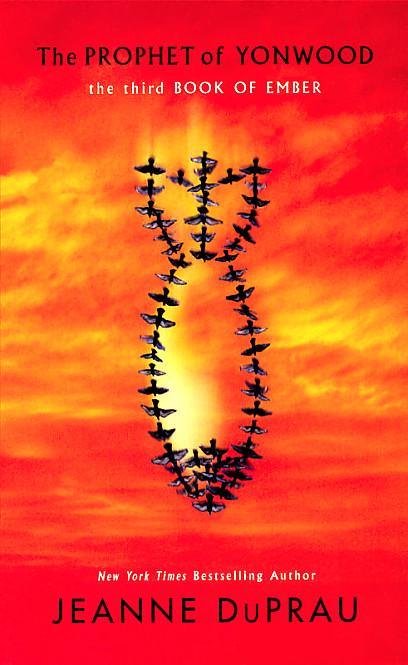
The Prophet of Yonwood, by Jeanne DuPrau

prophet of yonwoodThe Prophet of Yonwood is much, much better than The People of Sparks, though not quite as good as The City of Ember. It is, like Sparks, definitely a juvenile book, complete with sections of fact completely brushed over. But in this book, the facts don’t matter so much. It’s the little town of Yonwood and the woman there who has the vision of a fiery future. This is supposed to be a prequel, and in some ways it is (it happens before Ember and in an epilogue-like chapter tells about events that lead up to the Disaster), but mostly, it’s not as dystopian or apocalyptic as the other two.

Nickie and her aunt Crystal travel to Yonwood to take care of the house Crystal inherited from her grandfather, who has just died. Yonwood is sort of going crazy – a woman there had a vision of the future, and since then hasn’t been right in the head. Her rambling mumblings are interpreted as instructions from God for the town, so that the town follows all sorts of bizarre and arbitrary rules, like “no singing.” There is, like in Sparks, a moral lesson in this book, though it is no where near as patently obvious from the beginning. Also, like Sparks, what happens in the town is a metaphor for what happens in the world, but again, not as simple. I couldn’t predict everything that was going to happen ahead of time. I didn’t feel like I was being talked down to so much. And I liked the moral battle that took place – at first, I wasn’t even sure exactly what Duprau was teaching. In the end, this book was a decided statement against societies run by religions and against lack of tolerance. Take the following (very heavy-handed, I admit) example from near the end of the book:

All over the world, people who believed in one truth fought against people who believed in a different truth, all of them believing theirs was the only real truth, and all of them willing to do anything – absolutely anything – to defend it.

It was a very nice message. I’m very against religion-run governments and against people thinking they have the “right” answer. I don’t personally believe in universal truth, and I see how devastating it is when people assume they are right and everyone else is wrong. Wars and bigotry and prejudice and all sorts of terrible things come out of that kind of closemindedness. And I thought DuPrau did a good job showing this on a small scale in this book, in a way kids can understand. I appreciate her frankness and honesty and purpose in writing. And beyond that, this was just an engaging narrative, with good characters and fun mysteries and such. I liked it.

Posted in 2008, Children's, Prose | Tagged , | 1 Comment

The People of Sparks, by Jeanne DuPrau

210px-The-People-of-SparksSpoilers for the first book in the series.

The People of Sparks takes up where The City of Ember left off. Lina and Doon have flung down the instructions for escaping Ember, and Lina’s guardian picks them up. Within a few days, many of the people from Ember have arrived aboveground. The people from Ember find a post-Disaster settlement, Sparks, and the book deals with what happens when two cultures come into conflict, what happens when limited resources causes stress on people, how war comes to pass. What happens in Sparks becomes a small-scale metaphor for what happened to the world pre-Disaster.

I didn’t like this book as much as I did the first in the series. Unlike Ember, which was much more universal, this book could definitely be categorized as juvenile fiction. DuPrau treats the reader like they are a little simpler than her audience for the first book. There was a certain amount of toddleresque fairy-tale quality to it, complete with built-in moral (war is bad and too easy to get into). It was more predictable, it had a definite moral statement to make, and overall, it wasn’t as well-written or engaging. Having said that, I did like the book, and I do plan on reading the others in the series. I just hope they aren’t as predictable as this one.

Not much else to say without spoilers, but I must say I’ve learned not to trust Lizzie (one of Lina’s friends). She’s never a bad guy, but she’s certainly no good judge of character…

Posted in 2008, Children's, Prose | Tagged | 2 Comments

The Headless Cupid, by Zilpha Keatley Snyder

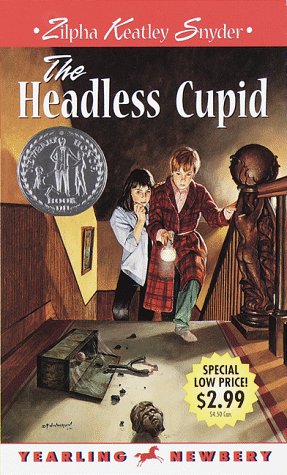
headlesscupid2When I turned ten, a friend of mine gave me a pack of five books by various authors for my birthday. One of them was The Egypt Game by Zilpha Keatley Snyder. I loved that book! I read it over and over for a couple years, and then eventually abandoned it as I got older. I never forgot it, though. About a year ago, I came across a copy of it and reread it. I realized, in rereading it, how much of an effect Zilpha Keatley Snyder’s writing has had on my own writing, and on my reading habits. There are elements in The Egypt Game that I find myself looking for in many books that I read. There were whole passages that I apparently had memorized at one point, because every word seemed familiar and comfortable despite not reading it for nearly two decades.

I never read any other Zilpha Keatley Snyder book. I’m not sure I ever even encountered another one until yesterday, when we were at the thrift store letting the kids pick out a book. Jason came by a pristine copy of The Headless Cupid, and I knew immediately that I was willing to pay the 69 cents to get it.

I was not disappointed. I can’t say I like The Headless Cupid as much as The Egypt Game, but there’s a certain amount of nostalgia in that, plus the fact that this is definitely a children’s book, and I never read it as a child. The book is about a family who has to deal with their widowed father getting remarried, and also deal with the stepsister that comes to live with them. The stepsister, Amanda, is into witchcraft and the occult (in a very 12-year-old-like way) and is also very upset about the new living arrangements (her parents are divorced). She periodically tries to integrate into the family and get revenge on her mother and all the other sorts of things you’d expect a 12-year-old to do. There’s a certain element of the supernatural which gives the book a pleasant atmosphere (that’s my childlike love coming out) but not so much as to be an RL Stine book. The book deals with a lot of mature subjects, especially for the early 70s when it came out. And apparently, it’s been on banned/debated/challenged lists because the kids are practicing “witchcraft.” To be perfectly fair to the book, I’m not sure anyone who banned it actually read it. If they had, they might not have gotten so distorted an impression.

I love Zilpha Keatley Snyder’s writing. It’s well crafted, and it’s really amazing to literally see where you got your ground in writing and reading tastes. This book deserves its Newbery Honor Award.

Posted in 2008, Children's, Prose | Tagged | 1 Comment

City of Ember, by Jeanne DuPrau

emberThe two main characters in The City of Ember, Lina and Doon, are twelve-year-olds who have just been assigned their jobs in the city of Ember. Ember is a city that lives in complete darkness, with lamps to light up the “day” during certain hours. It’s the size of a small town, and no one knows anything about the outside world. Supplies are running thin, the lights start going out, the generator and plumbing system are dying, and people are starting to panic. Lisa and Doon, through a series of events I won’t discuss for spoiler’s sake, find clues that suggest there may be a way out of Ember.

This book touches on many themes: religion and hope, rioting and fear, political corruption, moral and ethical issues, the root of life, and so on. There’s a lot shoved into this kid’s book. It’s DuPrau’s first novel, and I was very impressed. For a girl who was extremely bored of reading today, who opened several books in the last couple days and couldn’t get past page 15 on a lot of them, this really broke through my mood and shined. It was fun, it had some depth, and it was different from other dystopian/post-apocalyptic novels I’ve ever read. This felt fresh and new.

Posted in 2008, Children's, Prose | Tagged | 3 Comments

Kabul Beauty School, by Deborah Rodriguez

kabul-beauty-school1As opposed to The Bookseller of Kabul, I really enjoyed this book. It is about an American woman who goes to Afghanistan with a relief group. She’s a hairdresser, not a medical professional or any other professional whose skills were immediately needed in the war-torn country, but she soon finds her niche. Beyond catering to Westerners who want a little salon pampering, Deborah is able to help form (and later basically take over) a beauty school for women. A salon is one place where men are not allowed in their culture, and therefore Deborah’s efforts really help to find women a place for good employment.

The whole book is filled with stories, good, bad, funny, terrifying, depressing. Deborah is not afraid of Afghan culture. She embraces it, though she is not blind to the problems over there. Rather than judge the whole culture as totally worthless (like Asne Seierstad seems to do), she is compassionate and caring. She wants to help people. She tried to understand where they are coming from and overcome cultural barriers. I was impressed by her courage, and glad to hear a very balanced memoir about Afghan culture. This is what I was looking for the first time I read a book on Kabul (and what I obviously didn’t get). Kabul Beauty School does not gloss over any of the horror stories, but it also doesn’t chalk it up to “oh, they’re from the Middle East, that’s why they’re like this” either. And it doesn’t dismiss the inspiring stories.

I learned sooooo much in this book, far more than I expected. I came to care about just about everyone in it. There are people whose stories aren’t done yet, or people who’ve dropped off the face of the planet and have never been heard from again, and I wish I could hear they’re okay. Memoirs aren’t really like that, though. There are no closed endings – real life goes on. But in spite of my fanciful wishes to know everything, I was extremely impressed every moment of this book. Deborah Rodriguez isn’t a professional writer, so the prose is clear, simple, and oftentimes sounds just like conversation. It was the perfect tone for this book – unassuming and unpretentious. She didn’t have political agendas that she forced on the reader the whole time. She didn’t go in for scare tactics to sell her book. She didn’t exploit the people around her. She was a wonderful storyteller. Many times I laughed out loud for five minutes at a time. I really recommend this book to everyone. It’s fast and fun and easy to read, and gives an honest perspective on a part of the world few of us know much about.

Posted in 2008, Adult, Prose | Tagged , , , , , | 1 Comment

The Other Boleyn Girl, by Philippa Gregory

tobgcoverThere can’t really be any spoilers with this book, as it’s at least loosely based on historical fact. King Henry VIII cheats on his first wife, eventually annuls their marriage, marries Anne Boleyn, only to chop off her head a few short years later. Stuff I learned in high school. Henry VIII’s six wives: “Divorced, beheaded, died, divorced, beheaded, survived.” I always remembered that. For some reason, while most of history bored me in school, the fate of Henry VIII and his wives fascinated me. I haven’t paid the story any attention for a long time, but this book caught my eye awhile back and I’ve finally gotten around to reading it.

The events above are played out over the course of fifteen years in The Other Boleyn Girl. They’re told from the point of view of Anne’s sister, Mary. Mary Boleyn has been rather ignored in history compared with her much more famous sister, and Gregory decided to make this a fictional account of her life throughout this time period. Some things in there are fact, some are not, some are disputed. I imagine any historical fiction piece based on a person who left almost no legacy would lead to this same ambiguity. But, accurate or not, this did make fun reading.

I didn’t know, when I picked it up, that a lot of this book would be in the form of romance novels. I’m not a romance novel reader for the most part, and it was intriguing to see the way Gregory tried to set up “romance” scenes without resorting to present-day language. I must admit, after awhile, I got pretty bored. There are a couple hundred pages right in the middle of the book that are the same thing over and over and over again. The book in itself is quite long – 735 pages – and I think it could have done with some sheering. That was my biggest complaint. The beginning third and the ending third were real page-turners, and sucked me into the book enough to want to keep going continuously. Just the middle felt very repetitive. Like Gregory didn’t want to jump through years without saying anything (the book is not set up in chapters, but in season quarters – ie Spring 1522, Summer 1522, etc) but nothing new happened for a few years, so that each season section would last a page or two, and yet they couldn’t be skipped. Quickly six or seven years passed without me realizing it.

My only other real complaint (other than the petty fact that she says “the other Boleyn girl” way too many times in this novel) was that Mary’s character didn’t seem fully thought out. Her stance on the world around her fluctuated without any real reason, not like a real person who might be conflicted but like a fictional character who is created to feel one thing, but then must alter for real life events that occur in the book. I felt more as if she was fit into the story rather than this being her story come to life.

Other than that, it was a fun book, tasteful for the most part, and I did learn things (never heard of the sweating sickness before, for instance), but it was certainly not life-changing or deep in any way. It made me want to go back and read more about Henry VIII and his wives. However, I doubt I’d read others of her novels (she’s got four sequels to this one, I think). There’s also a movie based on this book, which I haven’t seen, and I’m undecided at this point if I’d like to. [Updated: I did watch the movie, and it was fine. Nothing special, but not bad either.]

Posted in 2008, Adult, Prose | Tagged | Leave a comment

Protected: The House on Mango Street, by Sandra Cisneros

This content is password-protected. To view it, please enter the password below.

Posted in 2008, Adult, Prose | Tagged , | Enter your password to view comments.

The Witch of Blackbird Pond, by Elizabeth George Speare

SpeareWitchBlackbirdPondThis story is about Kit, a teenage girl who travels from Barbados to Connecticut after her last remaining relative on the island dies. Once in Connecticut, she’s met with suspicion from the entire community she comes to live in. They are Puritans, and this is the 1600s. The fact that she can swim and read automatically singles her out as a witch. Only the powerful presence of her uncle in the community protects her. She befriends a Quaker on the edge of town, an old woman who is already suspected of being a witch, and eventually she herself is accused and brought to a hearing for witchcraft.

The book is remarkable for several reasons. First, the descriptions of setting: the boat she travels on, Barbados, 1600s Connecticut. Second, for all the other descriptions. Ms. Speare must have done tons of research. The reader peripherally hears about all the things people had to do to survive back in a time where they had none of our conveniences and no money on top of it. The way they had to cook, how they had to make candles for the winter, how they had to make their own thread for sewing, etc. It was fascinating. It was historical fiction without dragging on me like a history textbook. Even the politics didn’t drag on me. And above all, the book evoked a great breadth of emotion, which is impressive because it really is hard to connect to characters who don’t share any commonalities with you. These characters, despite working in ways almost incomprehensible in modern society, were perfectly relate-able.

I learned that I would not have wanted to be part of the Puritan society. What a mess! But at the same time, Ms. Speare opened me up to the society so long that I began to see the good things in it, too. It isn’t so black and white. Even Kit, who is supposed to be the counterpoint to the Puritans, can’t be considered all-good in her way of life – she had her own personal slaves in Barbados, for instance, and never thought about her slaves as people. Overall, I think the best part of the book was really feeling immersed in a culture from history, learning more from this than I ever did from history books. Stuff I’ll remember, too.

Oh, and it reinforces my desire to go to the Caribbean.

Posted in 2008, Children's, Prose | Tagged , , | 2 Comments

The Thirteenth Tale, by Diane Setterfield

200px-ThirteenthtaleI was going to try to do this without spoilers, but I don’t think that’s possible – my feelings on the book will give away the answer to the mystery. So I proceed by giving you ample warning. I will try to keep spoilers to a minimum, but really, only one matters: Is Vida Winter telling the truth, or is she not.

First, let me explain the premise of the book. The narrator, Margaret Lea, is contacted by famous author Vida Winter to write up Miss Winter’s biography. Miss Winter has had numerous biographers in the past, and she’s never told them anywhere near the truth of her life story. She’s a storyteller. She makes stories up. That’s how she presents her life, too, though now she claims she wants to tell someone the truth (she’s about to die). Miss Lea has never even read a book by Miss Vida, and she’s not sure she wants to take on the assignment. She’s only an amateur biographer, who deals with dead people and library archives. Her publications amount to a couple essays. She has no idea why Vida has contacted her, but she decides to go and see what all this is about.

So Vida Winter proceeds to tell her life story. Most of the book is contained in this story-within-a-story, and I found it much more interesting than the surrounding plot. Actually, when I first started the book, I’d almost given up on it before it got interesting. It’s really slow to start. It wasn’t until page 45 that I perked up. At page 50, I’d planned to turn my back on it if it didn’t get better. But after page 45, my interest was captured and held.

The mystery, of course, is whether or not Miss Winter is actually telling Miss Lea her true life story. She starts with the story of her parents, a really bizarre, twisted tale of kids with horrible sadistic tendencies. A rather gruesome scene of a 14 year old brother cutting his 5 year old sister’s arm with a rusty wire, and how she likes it and does the same to her other arm. Yeah. It wasn’t a gross scene – it was actually tastefully done, at least as much as one can expect with a gruesome scene like that, sort of reminded me of the ghost scene at the beginning of Wuthering Heights – but it certainly didn’t sound believable at all. I suppose maybe things like that might happen in real life, but usually, they don’t, and not everything that happens in real life is actually believable in fiction (ironically). Immediately, my thought was, “Okay, if this turns out that Miss Winter is lying, I’ll be okay with that. If this is supposed to be true, this is a stupid book.” And this is where I can’t go any further without a spoiler. In the end, I was partly satisfied. If you think about it, how could Miss Winter even know what her parents were like as 14 and 5 year olds? Even if she’s telling the truth about everything that happened in her lifetime, everything else is speculation, right? Sure, her mother may have gone to the asylum as an adult because she cut herself. Sure, she may be the daughter of an incestuous relationship. But to go into great detail about the rusty wire? Might that not have been an embellishment of the storyteller?

Only by telling myself that a lot of this was embellishment can I go through to the end and be satisfied. Only by reminding myself that The Thirteenth Tale is not meant to be realistic or literary, just fiction. There are so many layers of truth and fiction that, in the end, does it even matter?

So overall, I liked the book. It was decently written (though I got irked with a whole lot of second-person and a couple scenes that seemed to be solely for shock value), and closed cleanly. It isn’t a book that will end up on my bookshelf to reread in years to come, but I was reasonably satisfied and I was certainly entertained.

Posted in 2008, Adult, Prose | Tagged | Leave a comment

Protected: Oracle Night, by Paul Auster

This content is password-protected. To view it, please enter the password below.

Posted in 2008, Adult, Prose | Enter your password to view comments.