Books:
Archive:
Favorite Reviews:
I have reviewed many books over the years, and some reviews have been more interesting or fun to write than others. The below list were my favorites to write.
• Ada, or Ardor
• Choose Your Own Autobiography
• Dr. Jekyll and Mr. Hyde
• If Not, Winter
• Jonathan Strange & Mr. Norrell
• The Kid Table
• Like Water for Chocolate
• Lolita
• The Monk
• The Night Circus
• Oathbringer
• Return of the Native
• Rhythm of War
• S
• Things Fall Apart
• The Unit
• The Woods Are Always WatchingCategories:
Tags:
- abandoned
- Africa
- Asia
- atmospheric
- audio
- BBAW
- body image
- callback
- circus horror
- classics
- collection
- comfort
- Cosmere
- cruise
- divinity
- dream-invader
- education
- end of year
- fanfiction
- favorite
- fitness
- food
- gender studies
- goals
- good omens
- Harry Potter
- health
- historical
- house
- humor
- I made a thing.
- joint review
- KonMari
- Latin America
- LGBTQIA
- lists
- memorable
- Middle East
- mini-review
- multi-read
- nonfiction
- photography
- place-character
- POC
- portentous
- psychology
- quarantine
- race report
- readathon
- reread
- revisiting
- RIP-worthy
- running
- shredded me
- speculative
- Sunday Coffee
- tarot
- tattoo
- the ferals
- translation
- travel
- Wellness Wednesday
- WTF moments
- Yarn Art


-


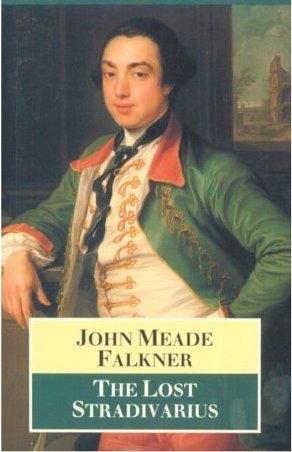
The Lost Stradivarius, by John Meade Falkner (audio)
Yes, I suppose there are some spoilers in this review.
Contrary to my previous assertions that I don’t like audiobooks, I actually enjoyed this one. Of course, it was a lot shorter than my last attempt with Librivox, and that helped, but I’m sure the story and readers helped as well. The Lost Stradivarius is about a young man at Oxford, John Maltravers, who begins to experience strange phenomena after his best friend, William Gaskell, brings over some music he got in Italy on a trip. The particular music that causes the trouble is part of the Areopagita suite – the Gagliarda (let me just say here that I really appreciated that at least one Librivox reader, Karen Savage, pronounced these properly). Each time the two men play the Gagliarda, they hear the sound of someone sitting down in the wicker chair that’s in the room, and eventually, John actually sees the ghost. This sets off a span of events that eventually culminates in the discovery of an antique Stradivarius violin.
The discovery of this violin is not a good thing – John becomes moody, secretive, and withdrawn. He lives out a few short years under the powerful influence of the violin and the Gagliarda, which he plays almost constantly. Most of this time, he spends in Naples, neglecting his wife, his newborn son, his sister, and all business affairs. While it is never expressly said, the reader is led to believe that the violin is haunted with an evil spirit.
I thought the writing in this book was absolutely beautiful, and I wish I could read a print copy of it. There isn’t one available in our library, and I’m not a big fan of being glued to the computer to read it on Gutenberg. I was very impressed, however, with the language, with the way Falkner wove metaphor into sentences without overdoing it. Every sentence seemed to be active, alive, radiant. Just as a quick example of something I remember offhand:
The moon showed that blunted and deformed appearance which she assumes a day or two past the full, and the moisture in the air encircled her with a stormy-looking halo. … The glaucous shrubs that grow in between the balusters were wet and dripping with the salt breath of the sea…
Just beautiful! I was completely enthralled by it. As for the story, I was drawn in immediately. I thought the first half of the book was much stronger than the second half. The problem was – the book is written as a letter from John’s sister to his son, and at the beginning, she knows everything John has been through at Oxford, and narrates it from his point of view, but as he moves into the moody, secretive side and begins to spend all his time at Naples, she starts narrating from her own vantage point. The last chapter is a note from Mr. Gaskell, revealing further details from John’s confessions, things his sister didn’t know. And there are mysteries never solved, where both narrators say, “I never could figure this out.” While Mr. Gaskell’s narration fills in some gaps, it felt a little too much like a device to me. It seemed almost as if Falkner was afraid to say what he wanted to say with this book (particularly in the sections he left completely unsolved). It was too pagan or too unconventional or too something, and he just avoided it altogether. I like being “in the moment” with books, so I really enjoyed the ghost story from the beginning, and was a little disappointed at the second half. Not so much that I wouldn’t recommend the story, though – I did like it. I just wish he’d kept writing the book all the way through the way he did at the beginning. Thankfully, the beautiful language was consistent all the way throughout. I’m interested in seeing what else he wrote.
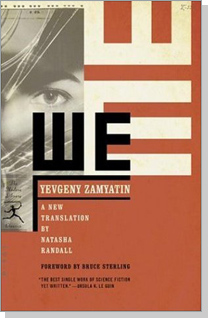
We, by Yevgeny Zamyatin
This is one of the weirdest books I’ve ever read. I finished reading it a couple days ago; I’ve been pondering it since and still I can’t make heads or tails of it. Seriously, I think about three quarters of the book went straight over my head. Not just in the thematic, symbolic way of things, but in the plot. Really, the general plot was fairly simple. The book takes place many centuries in the future, with a race of people who work like mathematical machines. They live inside a city covered by a glass dome wall, and all of their buildings are translucent. They eat petroleum-based food. There is absolutely no nature inside their city – in fact, none of them have ever seen even the sun undiluted. Everything runs on a time table: you chew 50 times for each bite (at the same time as everyone else), you sleep at the same time as everyone else, you have personal hours at the same time, etc. Everything is regulated, down to the days and hours you’re allowed to have sex, and with whom. There is no freedom, and this is thus equated with happiness. With freedom, there is no happiness – or so says the philosophy of this society.
Apparently this book, in one sense, is a retelling of the Garden of Eden story, from an obviously dystopian rather than utopian viewpoint. Jason pointed that out to me from some criticism he’d read, but I doubt I would have caught that on my own (though it seems obvious now that he said it). The main character, D-503, is a perfect little cog in the system, until he runs across I-330 and falls in love. He considers this a sickness. Even dreaming is a sickness. D-503 becomes severely sick: he develops a “soul.” His semi-girlfriend, I-330, is part of a rebel group called MEPHI which is bent on freeing the people in this metropolis. They create mass chaos at one point, when they finally reveal themselves, and later blow a hole in the glass wall. I won’t tell anyone how it ends, though; that’s enough spoilers.
It seems pretty straightforward, yes? I don’t know, maybe I’m just not good at the science fiction thing. There were several problems, I think, that contributed to my absolute ignorance. First, this is translated from Russian, and I think maybe I would have understood it better in its original language. Too bad I can’t read Russian. Second, it is written in the form of D-503′s diary, which makes the narrative scant. D-503 is unaware what his readers do and do not know about their society, so there are things that he takes for granted, which is all well and good for the book’s style but doesn’t help the reader any. Third, the race of people seem to be quite different from humans now, so I was confused sometimes. For example, D-503′s assigned girlfriend, O-90, really wants to have a baby, but she’s too short of the “maternal norm.” No, I don’t know where she falls short, or if it’s literally a height thing. But either way, this is a very big deal for her, and she really wants a baby, and at one point she induces D-503 to give her one. Now D-503 and O-90 have their sex days every couple days, so I’m not sure why on this one instance, she can yell, “Give me a baby!” and he just does, without question or uncertainty. I don’t know what is physically different about these people that makes that possible. But I take that for granted as something I simply don’t know about their race. But then, what appeared to me to be only a week or two later, O-90 is round and about a month off from having the baby. At that point, I don’t know if I’ve mistaken the timeline and it’s really been 8 months instead of 2 weeks, or if they’re just different physical beings and have their babies in rapid time periods (Oh man, I wish I could have had 6-week long full pregnancies!). It’s this sort of confusion that plagued me throughout the whole narrative.
We, along with 1984 and Brave New World, were at one time considered the “definitive trilogy” of dystopian novels (they may be now, too, but I’m not sure, the essay I read was from 50 years ago). While the latter two are political, I’m not sure if this one is. It might be. But frankly, I missed so much of the plot that there was just about no way I could read on two levels to try to tell what the meaning was behind the metaphor. I don’t think if I read it 10 more times that I’d understand it much better. I’d probably need to be back in a college class with an expert or to sit around doing research on my own to get a grasp of what’s in there. I’m not knocking the book, though. It appears to be well-written (though it’s hard to tell, considering it’s a translation), and there’s certainly a lot of depth. It’s science fiction, but it defies its genre, and I really respect that. It isn’t often that a book goes over my head, so that increases my respect for it, and I wasn’t bored reading it, even if I was often confused. So overall, I’d say this is a good book, even if it’s one of the weirdest, most disorienting things I’ve ever read.
Note: This book was reread and re-reviewed in October 2011, with far more insight than I had here in 2008.
Posted in 2008, Adult, Prose
Tagged classics, favorite, memorable, psychology, speculative, translation
2 Comments
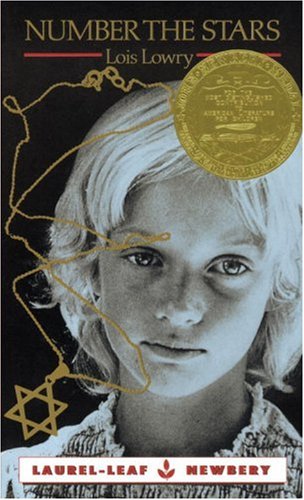
Number the Stars, by Lois Lowry
For some reason, this one grabbed my attention when I was helping my kids pick out library books the other day. Normally I don’t read books on the Holocaust so much – they’re often too depressing for me – but I thoroughly enjoyed this one. I’m not a history person, so I retained very little from school about the details of WWII. Mostly the war was presented through very politics-based viewpoints, and I tend to tune that out. This book, however, gives the war and the prejudice against anything anti-Germany a very different perspective.
The book is about two families who live in the same apartment complex in Denmark, the Johansens and the Rosens. The Rosens are Jewish. Annemarie Johansen and Ellen Rosen, both 10, are best friends and do everything together. When the announcement comes that the Jews are to be “relocated,” the Johansen family does everything they can to protect the Rosens, first hiding Ellen and later trying to help her family escape to Sweden.
I learned a lot of details about the war that I never would have found out otherwise. There’s an afterword which talks about what is fact and what is fiction in the book, so that some of the more far-out elements are revealed actually to be truth. For example, its true that Danish fisherman helping to smuggle Jews were given handkerchiefs to divert dogs trained to sniff out human scent. Apparently Swedish scientists found a combination of dried rabbit’s blood and cocaine to put on the handkerchiefs, so that the dogs would be attracted to them but would temporarily lose their sense of smell at the first whiff. There was a lot of little informative tidbits like that that I liked. Plus, this book really showed the pervasive fear that was prevalent in countries taken over by the Nazis, without anything gory or wholly shocking. I can only read so many books about concentration camps, you know? But this book is very balanced. There is a lot of fear, much of it generalized and unspecific, an ignorant something’s-wrong-and-I-don’t-really-know-what sort of fear. The book is extremely suspenseful, and the tone is ultimately triumphant. I think it has equal merit for adults and children, written in a way to appeal to both. I was very impressed.
Emma, by Jane Austen
This is the second Jane Austen I’ve read (I read Persuasion last summer), and I enjoyed Emma much more than Persuasion. That’s probably because the latter was not fully finished – and therefore probably not fully edited – when Austen died. I don’t think she had time to give it as much charm as she usually does. Of course, that ‘usually’ is an assumption on my part, but I say it because I have a good many friends who love Austen and have devoured her works, and always talk about her charm and humor. Persuasion was slightly lacking in those departments for me!
Emma, however, was full of both charm and humor. The characters are just slightly caricatured – real enough to be people you feel you’ve met before, but off enough to get full measure of all their quirks up front. I enjoyed them all, though I do admit that some of the jokes got a little annoying by about halfway through because they were repeated so often. Austen could have used a little moderation there.
I had no idea that Emma was the basis for the movie Clueless. It only took a few chapters, however, to see how similar the two were. I was laughing at a scene near the beginning where Mr. Elton is exclaiming over Emma’s painting of her friend Harriet, thinking how I knew that Emma was misinterpreting his affections by believing them to be for Harriet rather than for her artistic talents. I was only a quarter of the way through the book when I mentioned my amusement to Jason, and he said that Clueless WAS based on Emma, so I looked it up on IMDb and found he was perfectly right. So I pretty much knew exactly what was going to happen before it did. Not that I think the reader was ever supposed to be in doubt. I think the reader was supposed to know better than Emma the whole time. There’s one character, for instance, who is portrayed in Clueless as the gay friend, and I sincerely doubted his character in this book, Frank Churchill, was going to turn out to be gay (might have been shocking in the early 1800s), but I still knew way in advance that he was secretly engaged to…well, I’d better not spoil it. 😉
I’m one of those fools who really likes Clueless. I think it’s fun. A couple days into the book, in fact, I broke down and watched it, because of all the reminders in Emma. It was delightful, and I’ll say the same thing for the book. I have very little to say negatively about it. I didn’t see any super greatness of depth, the lessons learned are fairly simply laid out, but I appreciated the read, and it was definitely a fun change from some of my normal books. It feels as if Austen enjoyed writing it, like she had fun. I don’t think, however, I can read more than one Austen book a year; her prose style is just a little too much after awhile. Small doses. So in another couple years, maybe I’ll have read the whole set.
1984, by George Orwell
1984 is not my favorite book, but it’s still pretty good. I had to read it in high school, alongside Brave New World (which I liked better), and now my monthly book club at the library is reading 1984, so I’ve read it all over again. I think I appreciated it better this time. I won’t give away any spoilers about it, because while most people out there have read this at one point or another in their lives, I know certain members of the book club who follow this blog have not read it, and I don’t want to ruin anything for them.
Anyway, this is a dystopian novel about where Orwell thought society would go, where it would be by 1984, if certain trends didn’t change. Society in 1984 is rigidly controlled. Sex is outlawed except for the purposes of having children, and then not allowed to be enjoyed. Relationships and friendships are outlawed, though this law, like many, is unspoken. History is rewritten as often as needed to make sure that the Party is always right. Society is constantly at war. People are encouraged to focus their hate on the elusive enemy. Everybody is watched at all times. Party members must swallow whatever the Party says, without realizing that what they are swallowing might be an overt contradiction to what was previously said (If the Party says it’s at war with Eastasia, then it is, and always has been, even if five minutes before, the Party was at war – and always had been – with Eurasia). It’s like a brainwashing exercise in purposeful stupidity.
Winston Smith, the main character, is a member of the Outer Party (sort of like the middle class) and is dissatisfied with life, though he knows such dissatisfaction is a crime. He seeks to rebel, first privately, then alongside an Outer Party woman named Julia, and then with a man in the Inner Party named O’Brian. He is, of course, caught, which isn’t a spoiler because it’s obvious from page 1 that no rebellion is possible in this society, that no crime will go unpunished. Even a facial twitch (an indication of thoughtcrime) can induce them to arrest you. Big Brother, the symbol of the Party, is everywhere, the Thought Police are always watching, there are telescreens (like two-way audio and visual televisions) on every surface, children are raised to spy on their parents. There is no escape. Winston himself knows this, and often refers to himself as the Dead.
The book is unnerving in places and, for the most part, well written. My only real qualm with it is one I’ve had periodically with other Orwell novels. I don’t like the end, the last two chapters. I think he leads up to them very well, and he had something very important to say, but when we as readers get to the elusive Room 101, the things that happen in there are supposed to be earth shattering, and for me, they just seemed badly executed (text-wise). Winston’s supposed to change, but I don’t feel that happen. And because that chapter is so anticlimactic, the last chapter, which is based on that one, is less realistic, too. Since the whole book feels unnervingly realistic, to the point where it’s easy to recognize portions of their society in our own, having an unconvincing end like that really makes me feel like the book fell apart. The last chapter is supposed to be terrifying when we see Winston after his transformation, but to me it was just unbelievable. I’ve felt that about other Orwell novels, in particular, Keep the Aspidistra Flying, which also was well written and then had a botched important end. But other than that, I think this is a good read, and it certainly makes you think. I do recommend it.
Note: Review date is only an approximate of when this book was read/reviewed in 2008.
Note: Originally read in fall 1996.
The Odd Sea, by Frederick Reiken
Okay, so now I’ve read Mr. Reiken’s debut novel. I was sort of borderline on his second (The Lost Legends of New Jersey), on whether or not I liked it. I was impressed with his realism and some of the imagery was striking, plus I liked his almost-experimental style. Having read both novels now, however, I’m less impressed. I felt like the second book was just a rehashing of this one, with a slightly different plot. As for plot, this is about a family who is torn apart when one of the five children walks off to go swimming one day and disappears. The book chronicles five years after the disappearance, told from the point of view of the fourth child, Philip. It discusses how the different family members deal with the disappearance over time. How they deal with a death that can’t be confirmed as a death, hope that can’t be realized, and that sort of thing.
So that’s not the same as a family of four being torn apart by divorce, right? Well, it takes place during the same years (late 70s to early 80s). In both books there is/are: kids learning constellations by cheap star charts, a character with two different colored eyes, a dead/missing brother and that brother’s diary, a living character continuing the journal in some fashion, a mother who goes crazy but who eventually gets better, a father who “goes back to his roots” as a coping mechanism, characters who vomit every time they get upset (as absolutely unrealistic as that is), and a confessional-style ending (“I’ve written this as I [insert action here] and it’s taken me X-years to write it”). Even some of the characters felt rehashed – the older sister Amy in this book, for example, seems to be a whole heck of a lot like the next door neighbor’s kid in Legends. So not the same plot, but for me, the books were just too similar to feel like more than different drafts of the same story.
Of the two books, even though this one had a more interesting plot, the second I think was better written. There was at least a certain amount of memory-like quality to it to make the memories seem somewhat nostalgic, like bits of a dream you remember years later. That one fact separates it a little bit from the hordes of modern literature out there. Modern lit bugs me, the same way modern commercial fiction does, only for different reasons. Modern lit has a tendency, in both novel and short story, to turn everything into absolute banality. Every event a person lives through becomes mundane, and then nothing means anything. Okay, I can see that as a concept, but frankly it makes the reading quite boring. Modern fiction has no depth; modern lit has no surface. Neither are generally great, in my opinion. Why would I bother to read something that is boring? I have my own life for mundane banality. Why would I bother to read something that doesn’t make me think? I could watch a movie for that.
And then, The Odd Sea seems to fall into other modern traps. It focuses, even more than Legends, on the sex lives of its characters. For some reason, in modern lit, you have to talk about sex, you have to talk about drugs, you have to swear in order to prove you’re contemporary. It’s so irritating! Like modern lit writers are all sheep that have to follow these conventions! Where is the originality in that? And then, what’s worse is that they have to write up sex scenes that are absolutely devoid of feeling, to make them even more banal and mundane than the rest of the book, thus proving that as authors, they aren’t ordinary fiction writers. It all feels so childish and immature to me. Sex happens, yes, but if you want to exploit it in your book, do you have to turn around and exploit yourself as well? Half of this book, to me, just felt like a perverse daydream written without feeling in order to hide that fact.
So all in all, I don’t think I will be reading any more of Reiken’s books. He’s got very good technique, and there’s no doubt that his writing – his actual words – are well done (beyond a few lines I’d be horribly embarrassed of if it were me, things like “This was not just cold air–it was the same arctic air that polar bears had farted in.”). It’s no surprise to me that he’s a professor. But unfortunately, the books, in the main, bored me.
Posted in 2008, Adult, Prose
Leave a comment
The Lost Legends of New Jersey, by Frederick Reiken
I seem to be reading a lot of modern lit lately despite my propensity towards disliking them. Frederick Reiken recently had an article on a Glimmer Train bulletin, and in looking him up, I read descriptions of his two novels. Both looked interesting, so I ordered them from the library. His second novel came in first, so it’s the first one I read and am now reviewing. I do admit the first novel actually looked more interesting, and I’ll be reading it soon. Take it as a good sign that I still want to read it after finishing this one!
I did like this book. I wasn’t jumping out of my chair the way I was with The Jane Austen Book Club, but this wasn’t bad. It’s a character-based story about a 4-person family who has fallen apart in the late 70s: the husband, who cheats on his wife; the wife, who has some sort of undiagnosed psychological disorder and has spells of absolute insanity; the older sister, Dani – well, she’s not talked about a whole lot, actually, that was one of the points of the book I’d have liked to see more on; and the younger brother, Anthony, a hockey player struggling through adolescence (especially with regards to girls) and from whose pov the story is told (for the most part anyway). The story is set up, in the main, in a series of stories about events, told in a legend-ish format (hence the title). While this is mainly from Anthony’s pov, a lot of it is third person (as in ‘Anthony went to a hockey game’). It’s a little convoluted to actually discuss the setup of the book, because really the plot isn’t what’s important. What’s important is that each of the characters are having to come to terms with a whole lot that’s happening – with relationships, with their family, with friendships, etc. There were a couple things I didn’t like – not knowing more about Dani, for instance, or the number of times people started vomiting – but for the most part, it was captivating and well done.
Oddly, and completely coincidentally, this book actually has some bizarre parallels with the last book I read (The Eight). Unintentional, I’m sure, but for awhile I was reading both of these books together, one on one day, one the next, so the parallels were more obvious. Both had a lot of Jewish people in it – even some of the same Jewish slang was repeated. They each had a section about the same year in the 70s. Both books had a character with two different colored eyes. And so on. There were probably 10 or so parallels between them. I know this makes no difference to anything and it’s completely unrelated to any review of either book, but it was interesting enough that I thought I’d note it.
I would say this is a pretty good book if you like character books. There is nothing out of the ordinary. It’s about ordinary people trying to make sense of their lives, and maybe even give them meaning. In the end, I didn’t feel like I’d learned anything in particular that I haven’t already learned from life (though I think there are lessons to be learned, this just happened to touch on ones not relevant to my current life), and I’m not sure I will remember these characters in five years, because they really are very ordinary. (To me, this is what the definition of ‘realism’ should be.) But at the same time, I like this type of book, and it was nice to read, the same way that it’s nice to study people and their habits. A psychological study far more interesting than a non-fiction study. The mother in particular is fascinating, but abnormal psychology is my kind of thing. Reiken writes well, and I’m interested to see what his debut novel is like.
*Tacked on later: I was thinking about this later in the night and realized that it isn’t that I will probably forget the characters. It’s more like this book is written in a reminiscing way. The scenes and stories have a memory-type quality with a quiet sort of power. They don’t beat at the forefront of my brain like many book images do, but I have a feeling that for years they will periodically float before me in a haunting, dreamlike way. In twenty years I might suddenly think of the little anorexic boy with the bear claw over his hand in the hospital, or the empty syringes washing up on the beach, and I’ll remember it the same way I remember stories friends told me in my childhood, or maybe even the way I remember stories from my own childhood. I might try to focus on them and wonder who told them to me, or if I might have read about it on CNN.com once. They are so realistic and ordinary that they transcend the story-scene category. The characters could be people from your own life, and the events, too. I won’t remember the characters individually, but I will wonder, incorrectly, who I knew that once saw instruments in a landfill, or who I knew who played starfish wrestling with their friends. And I have to say, once I realized this fact, I became much more impressed by the book. I had to add this.
**Note: It did not take long for my positive opinion of this book to sour. Reading the debut book – which was basically just another version of this one – started the souring, and the fact that a few days later, I couldn’t even remember the book – that didn’t help. Now, even reading through the description here, I have absolutely no idea what this book was about. I literally remember one scene from the two books by Reiken that I read, and I don’t remember which book it was.
The Eight, by Katherine Neville
When I first read the Wikipedia description of The Eight, recommended to me by my cousin Jen, I somehow got the impression that this was a young adult novel. When I got it, a very thick hardback of 550 pages, from the library, I realized otherwise.
I can’t say I particularly liked this book. I was – somewhat – entertained. At very least, after the first third of the book, I started wanting to pick it up in my idle time. In contrast with the last modern mystic thriller I read, this one was oversaturated with realism. I’m not real up on my history, and for that reason, I wouldn’t know if Neville was a history expert or was making half of the book’s history up. Either way, it didn’t matter, because the majority of what she put in there in the way of history didn’t matter one bit to the plotline. It felt more like she needed to touch every major player in politics just to show off, or to try to impress upon the reader how pervasive her made-up chess set is. Napoleon, Ben Franklin, Voltaire, Catherine the Great, etc, etc, not to mention the Freemasons, not to mention every Eastern religion that ever existed. Somehow it’s all connected, they’re all connected. And somehow, they all love chess, and are chessmasters. Actually, in this way (the all connected way), it reminded me of Forrest Gump and how Forrest has to be involved, in some way, with every event in history, down to the reporting of flashlights at the Watergate Hotel, and giving John Lennon the idea for “Imagine.”
So anyway, the history aspect of the book was well-crafted (at least from a total history ignoramous’s point of view), but not believable (for me). The characters were flat and didn’t seem to have real personalities. There were a couple of token scenes of passionate love, a couple super-intense scenes of battles that the good guys manage to survive against all odds, and a whole lot of babble about science, music, and alchemy that really didn’t tie anything together too well. And then, every single character the reader meets is somehow involved in this fanatical search for the Montglane Service. And really, if all these people are after it, how is it that the main characters don’t even know what it is at the beginning? It’s supposed to be a secret. All way too convenient.
And then, there’s the obvious thing – if this chess set is so dangerous, why don’t they just destroy it? For goodness sake!! But no, that solution is too obvious.
At the beginning, I tried to get all the characters straight, and the history and everything, but about 100 pages in, I gave up. What was the point? My knowledge didn’t matter one bit, this wasn’t a mystery I would be able to unravel. The only mysteries I could unravel were the ones that were too easy. For example, a woman who just took a lover for the first time gets violently ill a month later. She continues to be ill for at least another month – What was going on?? Surely, it was the water in one of the passing towns that made her ill. Hmm…
And speaking of the rhetorical question up there, I have to make a note of something that really held me back from enjoying the book: it is trapped in 80s style. Everything, everything, in this book is 80s. The way the people act, the way they dress (despite not being about the 80s), the way the author riddles her book with “What was going on?”s, the token sex scenes, the heightened sense of uberfeminism, the prejudices of the time, the dry but prolific prose, and so on. Reading the book was an amazing experience in time travel, though unfortunately not to the time periods Neville intended to write about.
In the end, I’d have to say my conclusion is that this is not a deep-thinking book. It’s fairly enjoyable once you get past the first bit where there’s so much textbook instruction that it’s hard to concentrate, and only enjoyable if you can see beyond its stuck-in-time qualities and don’t care if your characters and plot are a little unrealistic. There’s nothing terribly good to recommend it, and it’s not even super-fast like the thrillers on the market today, so unless you’re a really big chess buff, you might skip this and pick up something a little less archaic.
Oh, and regarding my last review on mystical thrillers, this book wasn’t exactly what I was searching for either. I think I’m looking for a book steeped in mysticism and religion that is (for the most part, at least) relative to the characters rather than one that relies on history or any real events, something that is enclosed rather than archetypal. This one was pretty archetypal and it certainly had fingers in everything major, from Russian monarchy to OPEC to the Reign of Terror to Orthodox Jews. Yeah.
The Tenant of Wildfell Hall, by Anne Bronte
This recommendation was made by a woman at my non-online book club when we discussed Jane Eyre last month. Before just over a year ago, I’d never read anything by any of the Brontes, and have now read all three. I disliked Emily, I loved Charlotte, so what to expect then, of Anne?
The Tenant of Wildfell Hall is set up as a series of letters from Gilbert Markham to his brother-in-law, and is split into three parts – the first and last being told from Gilbert’s point of view, the second part, much longer than the other two, being made up entirely of Helen Huntingdon (Gilbert’s love interest)’s journal. The set up reminds me somewhat of Wuthering Heights, how Emily started with a male narrator but got as quickly as possible to the female storyteller. The language, prose, and style of this book, however, is more similar to Charlotte than Emily. The first 30-50 pages start out slow, difficult, just as in Jane Eyre. After that, however, the story takes off, becoming harder to resist as the pages go by (no supernatural stuff in this one, though). But Anne is not just a combination of her sisters, and this book is not just mirror fragments of theirs. While structure and prose may be similar in some regards, Anne definitely has her own place in the world.
I don’t know about her other works, but this one has a sure political bent. While Jane Eyre has some politics hidden within a love story, Anne made no attempt whatsoever to hide her views in The Tenant of Wildfell Hall, even though there is a love story (or several) involved. In fact, her views are so blatant that at times the book felt heavy-handed, particularly at the beginning and end. Take for example the last paragraph of chapter 7, where Gilbert’s mother talks about the roles of men and women in marriage:
Then, you must fall each into your proper place. You’ll do your business, and she, if she’s worthy of you, will do hers; but it’s your business to please yourself, and hers to please you. … [Your father] always said I was a good wife, and did my duty; and he always did his–bless him!–he was steady and punctual, seldom found fault without a reason, always did justice to my good dinners, and hardly ever spoiled my cookery by delay–and that’s as much as any woman can expect of any man.
At which point Gilbert writes to his brother-in-law:
Is it so, Halford? Is that the extent of your domestic virtues; and does your happy wife exact no more?
So yes, immediately you can see this book is about the unhappy role of women in then-present day society. This was back in the time when a woman had no say-so over her household, over any fortune she might have brought to a marriage, over her child’s rearing, over anything whatsoever. It was a crime for a woman to leave her husband under just about any circumstances, and even worse a crime to take her children with her. Helen Huntingdon’s husband is a disgusting wretch who teaches his toddler to swear, disobey his mother, and even get tipsy nightly on wine, brandy, and “other spirits.” Helen is miserable, and plots escape, which she eventually does for a time. I won’t post any spoilers, though – these things I’ve said are written across the back of the book – about what happens to her in the long run, or to her husband, or her child, or to Gilbert.
Anne has the same gift for realistic characters that I saw in Charlotte’s work. While Helen is a little too idealistic to be real, Mr. Huntingdon and his friends slide from indulgence to overindulgence in all bodily appetites with perfect narrative grace (though without any grace within their story). It is a bizarre contrast at times – a story that is a definite moral tale, not just a statement on the powerlessness of women, but on what a person should be in order to live a good, blameless, righteous life, shown more by its passages involving scenes of alcoholic frenzy than those of righteous lifestyle. The domestic scenes surrounding Mr. Huntingdon are so realistic, not to mention familiar in modern times, that they are almost disturbing even 200 years later, and I understand why they shocked readers on first publication. I wonder, with how vivid these scenes are, if Anne was ever exposed to extreme alcoholism in her life.
So, beyond the occasional heavy-handedness and an overly melodramatic end (whether the ending is bad or good, please don’t drag it out needlessly for twenty pages!), the narrative is captivating and well-written. I’ve decided I like Anne, not as much as Charlotte, but a whole heck of a lot more than Emily.