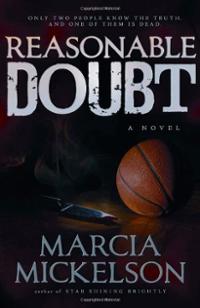
Reasonable Doubt, by Marcia Mickelson

reasonable-doubt-marcia-mickelson-paperback-cover-artMarcia Mickelson is a friend of mine, and I’ve read three of her novels (two that are published and one that I edited and will hopefully get published). Of the three, this is by far my favorite. Marcia is an LDS fiction writer (thus far at least), but I think this book transcends the genre a little. It does have its smattering of LDS-specific passages, but I think on the whole it’s quite enjoyable for non-LDS readers. It has its problems, of course – it could show more than tell, there are places I’d have loved to see some elaboration, and a few spots of general language tightening – but overall this rises above any issues and makes a very memorable experience. The characters are unique and it’s easy to empathize with them. I know Marcia has told me that a lot of people don’t like Julia, but I thought she was very well-written, the depth of her character is fantastic. I liked her. There is one image in the book that is so vivid for me that it sometimes crosses my mind randomly: an image of Julia curled under the blankets in a motel with her shoes and soaking wet coat still on, hugging her knees. For anyone who has been in a very vulnerable place in their lives – and not necessarily the same vulnerable place – this scene embodies all the feelings associated with that vulnerability. I could feel exactly what Julia felt, even though I’d never experienced her specific situation before. Very well done.

I would recommend this book to anyone, LDS or not. I would also recommend starting it in the morning on a fairly free day, because it’s not the sort of book you want to put down. Most people I know or I’ve heard of who’ve read Reasonable Doubt have stayed up way too late trying to finish it, and that includes me.

Note: Review date is only an approximate of when this book was read/reviewed in 2008.

Note: Originally read in December 2007.

Posted in 2008, Adult, Prose | Tagged , , | Leave a comment

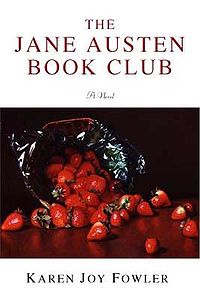
The Jane Austen Book Club, by Karen Joy Fowler

200px-JaneaustenbkclubThe last time I picked up a modern fiction book, I assumed I’d like it, and was disappointed. This time, with The Jane Austen Book Club, I assumed I wouldn’t like it, and ended up loving it. Go figure. I picked this book up primarily because I wanted to know what Karen Joy Fowler’s writing style was like. I wanted to get insight into why she chose me as a finalist in the Whiskey Island contest. I didn’t expect for this to be enjoyable, just instructional. I was sucked in almost immediately, not in the way that’s so seductive that you can’t put the book down for 8 hours until it’s read, but seductive enough to keep me reading steadily over a couple days, and thinking about the book, picking at it, deciphering it, in the hours not reading. A delicate and delightful balance not often achieved in modern writing. Then again, I’d say this book has a lot of things in it that aren’t normally achieved in modern fiction/lit. Most notably, it has layers. Layers and layers and layers. I like layers.

The plot is fairly simple: Six characters meet each month for six months to read the six Jane Austen novels. We have Jocelyn, who starts the club. She’s in her early fifties, never married, loves dogs (and breeds/shows them), and loves matchmaking (for other people only); she’s neat and orderly, the sort of person who dusts her lightbulbs regularly. Next, there’s Sylvia, Jocelyn’s best friend since childhood, also early fifties, who has been married for 32 years to her high school sweetheart, who just asked for a divorce. Sylvia loves love and romance but is also a very reserved person who doesn’t show her feelings easily. Her daughter, Allegra, is the third member of the group. Allegra is a thirty-year-old jewelry/craft maker with an explosive way of approaching life. She loves adventure (think skydiving) and throughout the book is dealing with the terrible betrayal of her longtime girlfriend. Bernadette (member #4) is in her mid-to-late sixties, has been married/divorced several times, is extremely friendly, always wants to make everyone feel loved and worth something, and is very talkative but without direction to her speech. At the beginning of this book, she’s decided never to look in a mirror again. Once she fixes her glasses with tape and paperclips. Prudie is the fifth member. She’s the youngest, at twenty-eight, and teaches French at the high school. She’s married to a man she worries will eventually get tired of her, though she never phrases it to herself that way. Prudie’s character cracks me up. She is chiseled in looks and personality, she’s extremely frightened of the world and never admits it to herself, instead cloaks herself in “quiet confidence.” She often throws French into her conversations with people, even though they know no French, especially when she’s making important points. A lot of awkward pauses follow Prudie’s speeches. Last, we have Grigg, in his early forties, a younger brother to three girls whose parents think he’s more “girlie” (sensitive) than his sisters. He’s a real big sci-fi geek and in love with Jocelyn, who he met a year before at a hotel that had two conferences going on – a comicon of some sort and a dog show rally of some sort. Jocelyn invites him to the book club to try to set him up with Sylvia, to distract Sylvia from her impending divorce.

Okay, so those are the players. What caught my attention right away was that the narrator was first person, though not from any of the mentioned characters’ points of view, as if there was an invisible, non-existent person at the book club. I’ll come back to this in a moment. The book consists of a prologue, six chapters (one for each book/character), and an epilogue. In each chapter, the character hosting the book club (which doesn’t always even happen in the chapter, indeed, in the book – some are just skipped) is opened up for the reader. In the first chapter, for example, Jocelyn hosts for the book Emma, and we get sections about the club discussions interspersed with sections about Jocelyn’s life. Not all the chapters are set up identically. Like I said, this book is very layered, and I have a feeling that if I worked harder, I could identify how each chapter’s setup coordinates with the personality of the character it portrays/represents. Some have more of the character’s history, some have more of their present, etc. In Prudie’s section, I’m pretty sure the first-person pov disappears altogether, so that suddenly we’re in third person for however many pages. In Bernadette’s, her personal parts of the chapter are done completely in first person, as if Bernadette herself is the narrator. At first I thought this was indicative of the whole book, that maybe Bernadette was the narrator but referring to herself in third person, but after reading the whole chapter, I was forced to conclude that I was probably wrong on that point.

I won’t give away any of the things that happen to each club member (does Grigg end up with Jocelyn? with Sylvia? What’s up with Prudie’s mother?). Everything is so ordinary and yet so fascinating (remind anyone of Austen herself?). I’ve only read one Austen book, Persuasion, so far, and seen the movies for S&S and P&P, but I’m sure I would catch more of the parallels Ms. Fowler put in there if I had read more. In the Persuasion chapter, for example, a couple members of the group have a picnic at the beach, and Allegra makes a wide jump on a rock-climbing wall and falls. For those who have read Persuasion, these two things will be familiar. I’m sure there are little points like that in all the chapters – I’m just not well-read enough to know them. It sure makes me want to read more Austen, though. I’m such a dork, but I mark The Jane Austen Book Club as a good book because I’d be more than willing to reread it to find more of the hidden pieces, symbols, etc.

This book goes beyond its epilogue. There’s a reader’s guide which has brief descriptions of each Austen book, a collection of impressions Austen gathered from friends/family about several of her books, and a collection of praise, critique, and criticism of Austen from the time she was living to present day. It’s hilarious to see how strongly people feel one way or another, and also to see how opinions and critiques change over time. Mark Twain apparently hated Austen (he says, “Every time I read Pride and Prejudice I want to dig her up and hit her over the skull with her own shin-bone.”), and Nabokov is as ever-flowing in his critiques as in his novels. And then after all the pages of this, there are discussion questions. Of course, they aren’t normal discussion questions. They are given, three each, by the characters themselves, and are absolutely hilarious. Each question portrays the asker’s personality and has a slight ironic tone as they ask about Fowler or about The Jane Austen Book Club itself. They appear almost-professional at times, but give themselves away, as flawed as the asker him/herself is. (#2 (Prudie): Il est plus honteux de se defier de ses amis, que d’en etre trompe. Agree or disagree?)

My only complaint with this book is something that seems to be a symptom of modern writing. Why, why, does the narrator – normally so composed, dignified, and intelligent – have to throw in a smattering of profanity for no reason every once in awhile? It’s not that I mind profanity – Catch-22 rolls off my back without me even noticing, you know? And there are a couple places where a character uses profanity and it makes sense and is appropriate – where it is consistent with that character. It flows and doesn’t detract from the story. But when this narrator does it, it makes me stop and roll my eyes and think that Ms. Fowler put it in simply to prove that she’s “contemporary.” I mean really, what’s the point of lowering yourself to a childlike “heheheh I said a bad word” mentality 10-15 times in a book? You have a better vocab than that! It’s like people have come to think that “shit” is the actual word for the bodily function, so that every time you want to make a comment on that function (which in itself is very childish and ridiculous), you have to use that word, no matter how it contrasts your normally eloquent prose. It bothers me. Thankfully, it doesn’t happen too often in this book.

But beyond that one point, this book is a real keeper. Lots of dimension, absolutely hilarious in that mild-ironic way. Ms. Fowler really captures in modern times a lot of what Jane Austen did in olden times, by way of societal observation. She masters what I know would be too difficult for me to master – making each chapter subtly coordinate with an Austen book (in style and event) and also with a character’s personality, and probably more than that too, if I knew the book better. My copy belongs to the library and I have to turn it in, but I think this one’s going on the list of “want to buy” and there hasn’t been a book to do that in a long time. I’m impressed and delighted to find something so captivating in modern lit.

Posted in 2008, Adult, Prose | Tagged | 2 Comments

The Cricket in Times Square, by George Selden

cricketThis book is about a country cricket named Chester who gets accidentally carried to NYC in a picnic basket. He meets up with a little boy, Mario, who keeps him as a pet, and with two city-toughened friends, Tucker Mouse and Harry Cat. The three animals (or, more accurately, non-humans) take up a mission – to help Mario’s family, who run a fairly unsuccessful newsstand in the Times Square subway station. So the animals scheme, and I have to say the end was almost touching, in a very young way.

So it’s definitely a kid’s book, but I don’t regret reading it. It was light, simple, and there’s really not much else to say about it. The only thing I didn’t really like was the stereotyped Chinese men, but the book was published in 1960, so I can understand even if I don’t particularly like Selden’s characterization. But overall, this was fun, and I think Morrigan (and maybe Ambrose, too) is going to read it next.

Posted in 2008, Children's, Prose | Tagged , | Leave a comment

Wide Sargasso Sea, by Jean Rhys

WSSI must say, this book was a very welcome change from Don Quixote. So welcome, that it only took two days to read. Of course, I admit it’s shorter – under 200 pages – but it’s also extremely captivating.

The story is supposed a prequel of sorts to Jane Eyre. It’s all about Mr. Rochester and his first wife, before she becomes “the madwoman on the third floor.” Rhys takes liberty with the idea and fleshes out what was vague in Bronte. Honestly, I thought this was the worst thing about the book – I personally enjoyed it more when I wasn’t attaching it to Jane Eyre. There are plot discrepancies (the way the madwoman looks, her family tree, etc) that can’t just be explained away by the fact that most of the story comes out of Mr. Rochester’s mouth in Jane Eyre. Yes, he’s probably not all that reliable of a narrator when telling about the horror of his past, but that doesn’t change the fact that there is a multi-year discrepancy in how long he lived with his mad wife in the West Indies, for example. Or why Jane describes her physique completely differently than she’s described in this book. But if I take this book and remove it from the context of being attached to another novel, I find this story engaging, powerful, and telling.

The book is separated into three parts. The first and last are narrated by Antoinette Cosway (who later becomes Bertha Mason, last name by her mother’s remarriage, first name because Rochester simply starts calling her by a different name when he finds out she might be going mad). The second is narrated, except for one section, by Rochester (that one section is Antoinette again). The narrative voice is vastly different between these two, and since the parts told by Antoinette start from the time she is a little girl and go until her death, the reader gets to see her gradual change in mental competency. There is a question of whether or not Antoinette’s madness is brought on by Rochester, or if she might have escaped insanity if her life had been good, but all the same, from the time she is little, we see the world through a convoluted and slightly creepy mindset. The story is told in mild stream-of-consciousness (though Rochester’s section is much more orderly, less like thought, and more apt to explain to the reader what’s going on), which of course makes it a little difficult to follow at times, but it’s nowhere near the quagmire that Faulkner puts together. And part of my difficulty, I think, has to do with the fact that I know nothing about the West Indies, culturally or historically, so that references to obeah (a type of religious witchcraft – think voodoo, without the same belief system) and various slang terms (like “white cockroach”), for example, threw me off.

At first, I didn’t think I liked this much. Very suddenly, though, Rhys throws in a startlingly vivid moment where Antoinette is terrified she’s going to find a dead man’s dried hand, chicken feathers, and a cock with his neck cut open, dripping blood, in her nurse’s bedroom. That’s the obeah, but I didn’t know that at first, so it took me by surprise. But after that moment, only 20 pages or so in, I really liked it. There were so many striking images, put forth by the author so extraordinarily, that it was like I was living right beside the narrator (either one). And while I never connected with Antoinette on a personal level, while I could with Rochester, I think that has more to do with my utter lack of experience with regards to West Indies atmosphere, culture, and landscape.

With many writers, my ignorance of this sort of thing is somehow compensated by with their writing. They make it so I can connect, so I can see where they are and can feel what they feel. On the surface, this makes it seem as if Rhys hasn’t done her job, that my lack of connection is a flaw in the book. I don’t think so, though. I think that she’s actually portrayed this world (which she is very familiar with, having lived there for a great part of her life) in a way that those with no experience are supposed to feel completely alien to it. We can see the beauty of it, but don’t understand it. Antoinette understands it, and therefore never explains it in her narrative. We simply ride along and try to figure it out, which leaves us a little bewildered. And then when we switch to Rochester, we feel his absolute non-understanding when it comes to this culture, because he feels the same way we do (the way I do at least, I don’t want to speak for others who might know more than me). It’s alien to him. And I think that that has a twofold benefit. First, it creates sympathy for a character who, by the end of his section, doesn’t really deserve much sympathy (I’ll discuss this in a minute), and second, it enables us to see how alien England is for Antoinette when she gets there, without ever having to say a word about it.

Regarding Rochester, through his whole section, he seems like a very sympathetic character. He’s duped into this marriage but thinks it’s a good thing overall until he starts hearing tales about madness in the family. After that, he’s wary and stays away from his wife, which destroys her. These are all very believable emotions, and I, for one, had no trouble in discrediting the things that, for instance, the obeah woman says to him about his cruelty and lack of worth. But right before they leave for England, there’s an incident with a crying little boy, who doesn’t have a name, and Rochester’s actions in that situation pull the mask off and reveal that indeed he isn’t the nicest person, but is vain enough to always think of himself in good terms. We learn that, though we may sympathize and relate to his character better, his words and thoughts aren’t necessarily true. And in a way, I think that Rhys has shown us with that little trick exactly where we are all blind.

That’s not to say I have all that much sympathy with Antoinette or any of the other people in the West Indies that we meet. I don’t. But I’m left feeling as if this is perhaps because I am too Western myself to fully understand, that this is some fault in me. It makes me question myself – am I really that arrogant that I don’t realize how blind I am? Maybe I am. This book has certainly opened up a new avenue of thought. I’m sure as I think on it more, and perhaps even do a little research on it, I’ll learn a ton of things I never even thought about in my quick combing-over. I, for instance, don’t know enough about British Imperialism to understand how this book relates to that, and I know this is supposed to be a political commentary.

I do recommend this book. It’s fairly short, and very engaging.

Posted in 2008, Adult, Prose | Tagged , , , , , , | 1 Comment

Don Quixote (book 1), by Miguel Cervantes

donquixoteSpoilers.

Hem. Well, I’ll make this brief. I didn’t like this book at all. This is supposed to be such a great book, the model for modern times, or whatever such nonsense. To me, it felt like the 1600s version of Monty Python (which I also hate). Lots of bodily fluid, lots of sex jokes, lots of prejudice, etc, etc. The antics of Don Quixote and Sancho Panza went on for ages, stuff that could easily have been reduced to a fraction of their length. Admittedly, about 200 pages in (of about 450), Cervantes gives the reader a long break. We meet a lot of people not in any way related to Don Quixote, and they tell very interesting stories for a 100 pages or so. There’s even a lot of places where Don Quixote isn’t there. That, I think, is the only thing that enabled me to reach the end. If it had all gone on like the first 150-200 pages, I would have given up. I couldn’t have handled it. One more reference to vomit or feces and I was out of there! The last part slipped along pretty fast, though, as I said before, when Don Quixote was out of the way.

I have yet to do any research on this book, and I’m not sure what I’m going to find when I do. I personally didn’t get anything out of it except a desire to throw the book against the wall (but couldn’t, because it belongs to the library). I’m sure the critics will have a lot better review than I do, and that I’ll have tons of stuff that I may or may not believe to bring to my book club when I have to present this book mid-June. All I know now is that I will not be reading Book 2.

I do want to say one good thing about this book, though. Cervantes certainly has a strong sense of individual voice. Each character speaks in his own way, which made it really easy to skim through all those flowery, chivalry-copied speeches of Don Quixote’s, and really easy to read through the tales of other characters. If it was all in Quixote-language, I’d still be mid-book. So yay for that. I definitely concede that Cervantes is a good writer. Unfortunately, I don’t think that’s good enough to recommend the book, because good writing on a bad plot isn’t necessarily worth reading. As I say, some parts are interesting, but the humor in this – it’s supposed to be a comedy – just didn’t appeal to me. I’ve never been one for potty humor. Sorry.

Oh, and I suppose a brief plot synopsis is in order: A man reads a lot of chivalry books and goes insane. He runs off, thinking he’s a knight errant (dubbing himself Don Quixote), gets himself a squire, and goes on a lot of pointless adventures that are constructed to be grand (or even “real” sometimes – he does attack windmills that he thinks are giants…) in his mind. Everyone laughs at him and generally he gets beaten up, as well as his squire (Sancho Panza). Then the reader hears a lot of love-gone-awry stories from other people, which eventually right themselves, and Don Quixote is carted off back home by concerned fellow-villagers. If that sounds interesting enough to take up 450 pages of your time, and you don’t mind Monty Python type humor, have at it – this book is for you.

Posted in 2008, Adult, Prose | Tagged , , | 4 Comments

Protected: The Book of Names, by Jill Gregory and Karen Tintori

This content is password-protected. To view it, please enter the password below.

Posted in 2008, Adult, Prose | Tagged , | Enter your password to view comments.

Protected: Phantom of the Opera, by Gaston Leroux

This content is password-protected. To view it, please enter the password below.

Posted in 2008, Adult, Prose | Tagged , , , , | Enter your password to view comments.

The Bookseller of Kabul, by Asne Seierstad

the-bookseller-of-kabulIn her introduction, Seierstad states that she met Sultan Khan (the bookseller, whose name has been changed for anonymity) in Kabul, Afghanistan, after spending six months tagging along as a journalist with the military offensive in the country. She was impressed by his intelligence, by his love of literature, and by his refusal to give up his business despite decades of political oppression, and asked if he would allow her to spend several months living with his family, in order to write a book about them. The book, she tells readers up front, would not be the tale of typical Afghan life (most of the family is literate, several speak English, and they have plenty of money), but life as it was for this specific family. She also admits that she writes in what she deems a “literary” style – she acts as an omniscient narrator and puts in inner dialogue, thoughts, and feelings as she sees fit.

Now, that being said, Seierstad then goes through various happenings from her time in Kabul, as well as recounting some stories that happened before she got there (like the story of Sultan Khan’s proposal to his second wife, Sonya, a girl some forty years younger than him). Slowly, we go along little adventures, chapter at a time: tales of daily life of the refugee family members living in Pakistan (including an honor killing next door), an illegal and dangerous business trip across the Afghanistan/Pakistan border, various marriage proposals and negotiations, a trip to the bazaar, a wedding, a pilgrimage to the tomb of Ali in Mazar-i-Sharif, a trip to a women’s bathhouse (hammam), a trip to school, a woman’s quest for a job, a trip to the Ministry of Education, the plight of a thief (who stole from Sultan, who’s relentless) and his family, and a hunt for al-Qaida.

Seierstad claims to be the impartial, “invisible” companion and guest here, but from page one, it is very obvious that this is not an impartial book. The book is riddled with biases so strong it slants the entire narrative. Though she is fluent in five languages, she is not fluent in the language most of the family members speak, so she received most of her information through the three family members who spoke good English. Already, people presenting their family for other people to read about often slant their stories, and then those stories get re-slanted through the interpreter’s eyes, and then they are passed through the mouth of the author. Throughout the whole book, I felt like all I was getting was Seierstad’s personal beefs with the culture. She seemed unable to understand their customs, and determined not to try to, either. She didn’t approve of the way women were treated there, and so she spent the majority of the book telling us about how cruel women are treated and how awful men are. There is no room for other points of view. And beyond the treatment of women, just the culture in general she didn’t seem to approve of, so she spent all her time pointing out how it’s their culture that causes all their problems. The narrative is sensationalist and childishly crude at times, and she seems to have a hang up on the suppressed sex drive of Muslims, which really bothered me.

While many of the stories and images were memorable and/or touching, because of her biased reporting and contrived “literary” style, I don’t know that I can believe anything that I read. What she presents as good and bad aren’t necessarily so. They are just what she believes is good and bad. I felt the same way toward this book as I do about American tourists who think that other cultures are amusing but fundamentally wrong just because they aren’t American. I didn’t feel like I learned anything at all about Afghan culture (even about unusual middle-class Afghan culture), which is really what I’d looked forward to in picking this up. Having stayed a week surrounded by my brother-in-law’s Muslim family in Palestine, I could see moments when people or setting resembled my experiences, and I felt like I was denied something that could have been really spectacular by the horrendous job Seierstad did as a journalist. Now, I know that Afghanistan and Palestine aren’t exactly the same, but there are some similarities, and I could definitely recognize a culture similar to what I’ve seen behind the mask of what she’d presented.

Honestly, I was slightly offended by her take on the whole thing, and I don’t blame Shah Muhammad Rais (the real name of Sultan Khan, who was so distinctive in the book that a false name couldn’t hide him) for his anger at her. He is taking her to court in Norway right now, claiming she defamed him, his family, and his country. He is also asking for political refugee status after the book began to be sold on the black market in Persian, claiming his family is now unsafe, as everyone recognized him as Sultan Khan. He is too well known in Kabul for anonymity. In the meantime, he has fired back by writing his own narrative (which I’m sure is no less biased, though on the other side of the fence), called There Once was a Bookseller in Kabul. Unfortunately, it hasn’t been translated into English. I’d love to read it.

Posted in 2008, Adult, Prose | Tagged , , , , | 3 Comments

My Antonia, by Willa Cather

my-antonia-willa-cather-paperback-cover-artSpoilers.

I got an unusual lesson in “Never judge a book by its cover” while reading My Antonia. My book cover tells me that Antonia Shimerda elopes with a railway conductor after her father’s tragic death, and later comes back to the city. Once she’s back, she’s “unprepared for the lecherous reaction her lush sensuality provokes” because of the toiling country life she’s used to. Despite obstacles, however, she struggles toward happiness.

Anyone who has read this book might wonder what in the world this description is about. First, Antonia moves from the country to the city several years after her father dies, and a long time before there is ever any mention of a railway conductor. Second, she never elopes. She plans a wedding with a longtime sweetheart but gets jilted and left pregnant. And that’s a decade or so after her father dies. After that, she goes back to the country and never lives in the city again. Yes, she struggles toward happiness; that might be the only correct point given in my Bantam Classic version’s synopsis. I’ve never been so confused in comparison. I kept waiting for Antonia to elope…

My Antonia is told from the point of view of one of Antonia’s childhood friends, Jim Burden. It is a very quiet story, where the details of what does and doesn’t happen are very trivial in comparison with the spirit of the book. I can see why it would be difficult to come up with a summary. The book captures prairie life. Across the course of over three decades, we see what happens to people and land. Willa Cather is amazing in her descriptions. While not every person will agree with her style of writing – it isn’t my particular favorite style – it can definitely be said that she knows exactly what she’s doing when it comes to description. She is very decisive in her voice. Each stroke she paints is clear and definite. Lines such as

…everything was wonderful to [Lena], and everything was true. It was like going to revival meetings with someone who is always being converted

and

The curly grass about us was on fire now. The bark of the oaks turned red as copper. There was a shimmer of gold on the brown river. Out in the stream the sandbars glittered like glass…

give a very final view of the things they describe. It is clear that Willa Cather could see, really see, everything she spoke about. Her people and landscapes are alive. And while I am not a particular fan of excessive setting, she integrates the setting in a subtle way, and I found myself at times actually seeing the pictures of fields of red grass in front of me, rather than floating blindly along the words. That doesn’t happen too often with landscape for me; it’s one of those places I lack in imagination when I read.

Nothing spectacular happens in My Antonia, plot-wise. It really is a very quiet book. A quiet struggle that isn’t always a struggle, a quiet success that isn’t always a success. It’s slow, but not in the way of boring. More like in the way of a lazy summer afternoon. So that you just want to relax in a hammock when you read. That would have been nice.

A couple little mentionables: First, don’t read the stories about Peter and Pavel and the wolves or about the vagrant and the wheat thresher when you’re in the middle of a quiet lunch when your kids are sleeping. How I happened to catch both these stories mid-meal, I don’t know, but the irony was not funny. Or maybe it was. Second, I think I have to consider any book to be worth reading if the following lines occur (Antonia speaking first):

“Now, all you children be quiet, Rudolph is going to tell about the murder.”
“Hurrah! The murder!” the children murmured, looking pleased and interested.

And then later, a little parenthetical insert halfway through the murder story:

Here the children interrupted Rudolph’s narrative by smothered giggles.

If that doesn’t get you interested…

Posted in 2008, Adult, Prose | Tagged , , | 1 Comment

The Eye, by Vladimir Nabokov

eyeSpoilers.

The Eye is Vladimir Nabokov’s fourth novel (more of a novella, really). It is told from the point of view of a tutor, who, towards the beginning of the book, is beaten up and humiliated in front of his students by the jealous husband of his mistress. He then goes home and attempts suicide. Now, whether the suicide is successful can be debated; suffice to say that he “recovers” and thinks of himself as dead, afterwards forming a new life among people he hasn’t known before. Most of these people are familiar with each other – family or old friends – all except one: Smurov. The narrator, who considers himself now to be nothing more than an all-seeing “eye,” initially describes Smurov as a gentleman. Smurov is intelligent, witty, comfortable in society, handsome, mysterious, well-mannered, and well-dressed. The narrator assumes that Vanya, the single lady within the group, will fall in love with Smurov.

It becomes clear fairly quickly (though it is never said directly until the end) that the narrator and Smurov are the same person, and that he is speaking of himself in third person. It is clever on Nabokov’s part, because Smurov is a classically unreliable person – not only in his judgment of himself, but in his dealings with others. Through the story, the narrator watches Smurov (at one point he says of himself, “In respect to myself I was now an onlooker”) and those around him, attempting to discern Vanya’s feelings for him. As he watches and snoops (going so far as to steal someone’s mail to find out their opinion of Smurov), he discovers that those around Smurov think of him as shabby, self-absorbed, absurd, and deceitful, also as a fraud, a “sexual lefty,” a spy, and a thief. The only person who thinks well of Smurov, in fact, is the demented old uncle who has actually confused him with Vanya’s fiancé. While the narrator suffers each of these opinions as personal blows, the reader doesn’t need the narrator’s snooping to discover these things – they are apparent simply by the double narrative. While the narrator may think he speaks well of Smurov, or himself, he reveals at the same time his blundering, petty nature.

Towards the end, the narrator makes a grand (and ridiculous) declaration of love to Vanya despite the fact that she is engaged. He runs off afterwards and hides in a flower shop with a mirrored wall, and when he leaves, Nabokov writes, in my opinion, the most poignant and meaningful description in the book:

As I pushed the door, I noticed the reflection in the side mirror: a young man in a derby carrying a bouquet, hurried toward me. That reflection and I merged into one. I walked out into the street.

From this moment on, the narrator is referred to as Smurov, whereas he never has been before. After this, he is called by name for the first time. The “eye” has integrated back into the body. Smurov no longer sees himself only in reflection (the mirrors being the people he associates with). After this, all he sees is what he wants to see. The last two passages are mere fantasy, grossly obvious to the reader even if Smurov does his best to convince us otherwise. He is as unconvincing in the lie to the reader as he has been in all his previous lies to other characters. No reader would believe him at the end when he proclaims how happy he is:

I swear, I swear I am happy. I have realized that the only happiness in this world is…to be nothing but a big, slightly vitreous, somewhat bloodshot, unblinking eye. I swear that this is happiness. What does it matter that I am a bit cheap … What more can I do to prove it, how to proclaim that I am happy? Oh, to shout it so that all of you believe me at last, you cruel, smug people…

Nabokov’s gift is his prose. Often, in fact, he seems to go too far, sacrificing content and substance for style, structure, and color. Every sentence is a play of [sic] words. On first reading The Eye, I was dissatisfied, and I decided to take a day to think about it before writing up a review. There are so many layers to a Nabokov book that it takes time to sift through them. What Nabokov has presented in this book is a strong criticism of first person narration. First person narration is often thought of as reliable simply because the world is seen directly through the narrator’s eyes. People, however, are notoriously unreliable in their judgment of themselves and the world around them. Through a many-layered narrative, a separation for most of the book of Smurov and narrator, the reader comes to see Smurov for what he is, the same way that the group he mixes with comes to see him. Smurov discovers this viewpoint of himself, but too late to save himself from the reader’s judgment. I read an essay that quotes Wayne Booth as saying this is a “Secret communion of the author and reader behind the narrator’s back,” and I think that’s a very apt description for this book. I don’t believe The Eye is anywhere near as masterful as some of Nabokov’s other works (Lolita, for example, is superb), but it is amusing, well-written, and worth reading.

Posted in 2008, Adult, Prose | Tagged , | Leave a comment