
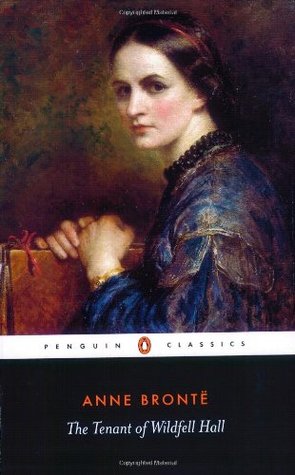
 This recommendation was made by a woman at my non-online book club when we discussed Jane Eyre last month. Before just over a year ago, I’d never read anything by any of the Brontes, and have now read all three. I disliked Emily, I loved Charlotte, so what to expect then, of Anne?
The Tenant of Wildfell Hall is set up as a series of letters from Gilbert Markham to his brother-in-law, and is split into three parts – the first and last being told from Gilbert’s point of view, the second part, much longer than the other two, being made up entirely of Helen Huntingdon (Gilbert’s love interest)’s journal. The set up reminds me somewhat of Wuthering Heights, how Emily started with a male narrator but got as quickly as possible to the female storyteller. The language, prose, and style of this book, however, is more similar to Charlotte than Emily. The first 30-50 pages start out slow, difficult, just as in Jane Eyre. After that, however, the story takes off, becoming harder to resist as the pages go by (no supernatural stuff in this one, though). But Anne is not just a combination of her sisters, and this book is not just mirror fragments of theirs. While structure and prose may be similar in some regards, Anne definitely has her own place in the world.
I don’t know about her other works, but this one has a sure political bent. While Jane Eyre has some politics hidden within a love story, Anne made no attempt whatsoever to hide her views in The Tenant of Wildfell Hall, even though there is a love story (or several) involved. In fact, her views are so blatant that at times the book felt heavy-handed, particularly at the beginning and end. Take for example the last paragraph of chapter 7, where Gilbert’s mother talks about the roles of men and women in marriage:
Then, you must fall each into your proper place. You’ll do your business, and she, if she’s worthy of you, will do hers; but it’s your business to please yourself, and hers to please you. … [Your father] always said I was a good wife, and did my duty; and he always did his–bless him!–he was steady and punctual, seldom found fault without a reason, always did justice to my good dinners, and hardly ever spoiled my cookery by delay–and that’s as much as any woman can expect of any man.
At which point Gilbert writes to his brother-in-law:
Is it so, Halford? Is that the extent of your domestic virtues; and does your happy wife exact no more?
So yes, immediately you can see this book is about the unhappy role of women in then-present day society. This was back in the time when a woman had no say-so over her household, over any fortune she might have brought to a marriage, over her child’s rearing, over anything whatsoever. It was a crime for a woman to leave her husband under just about any circumstances, and even worse a crime to take her children with her. Helen Huntingdon’s husband is a disgusting wretch who teaches his toddler to swear, disobey his mother, and even get tipsy nightly on wine, brandy, and “other spirits.” Helen is miserable, and plots escape, which she eventually does for a time. I won’t post any spoilers, though – these things I’ve said are written across the back of the book – about what happens to her in the long run, or to her husband, or her child, or to Gilbert.
Anne has the same gift for realistic characters that I saw in Charlotte’s work. While Helen is a little too idealistic to be real, Mr. Huntingdon and his friends slide from indulgence to overindulgence in all bodily appetites with perfect narrative grace (though without any grace within their story). It is a bizarre contrast at times – a story that is a definite moral tale, not just a statement on the powerlessness of women, but on what a person should be in order to live a good, blameless, righteous life, shown more by its passages involving scenes of alcoholic frenzy than those of righteous lifestyle. The domestic scenes surrounding Mr. Huntingdon are so realistic, not to mention familiar in modern times, that they are almost disturbing even 200 years later, and I understand why they shocked readers on first publication. I wonder, with how vivid these scenes are, if Anne was ever exposed to extreme alcoholism in her life.
So, beyond the occasional heavy-handedness and an overly melodramatic end (whether the ending is bad or good, please don’t drag it out needlessly for twenty pages!), the narrative is captivating and well-written. I’ve decided I like Anne, not as much as Charlotte, but a whole heck of a lot more than Emily.




Pingback: Sunday Coffee – Beginnings | The Zen Leaf