The Tale of Despereaux, by Kate DiCamillo

200px-The_Tale_of_DespereauxThis is a story about an odd mouse who falls in love with a princess and risks everything to save her from an odd serving girl and an odd rat. That’s probably the simplest way I can wrap up the plot.

This one didn’t appeal to me. I think it was just too young for me, despite the fact that I love children’s and YA lit. What particularly irked me was that the narrator spoke to the reader the whole time, asking them if they knew the definitions of certain words, asking them questions, etc. Maybe if I was younger, this wouldn’t have bothered me, but because I’m 29, I didn’t appreciate being addressed like I was 5. I understand that it’s a children’s book, but it got on my nerves. It got on my nerves so much, in fact, that I really paid little attention to the story itself.

I will say that I think this is going to make a great movie. The movie is supposed to come out next month, and I think it will be far superior to the book. It’s not often that I say that, but I do think this story will lend itself to film quite well. I think screenwriters have the opportunity to make something much bigger and better out of it.

There’s really not much more for me to say. I recommend the book for children.

Posted in 2008, Children's, Prose | Tagged | 2 Comments

Protected: On Writing, by Stephen King

This content is password-protected. To view it, please enter the password below.

Posted in 2008, Adult, Prose | Tagged | Enter your password to view comments.

Gathering Blue, by Lois Lowry

Lowry_gathering_blue_coverGathering Blue is the companion novel to The Giver and second in Lois Lowry’s trilogy. (The third book is Messenger, which I plan to read in 2009.) I’m not actually sure why this is considered a companion novel beyond the fact that the two are dystopian and they may or may not link together in the third book. Other than that, these two have no similarities.

In this dystopian (or more accurately post-apocalyptic) novel, society consists of people with very primitive knowledge. They are poor and live in hut-like dwellings, without running water for most of them, electricity, or pretty much technology of any kind. They are an almost stereotypical hunter/gatherer society, except not nomadic. The women are inferior to men (they aren’t allowed to read, for example), the men fight for hunting rights, and the children are beaten by their parents. The weak – deformed, injured, etc – are left for dead in a nearby field. One mother, however, fights for her child. Kira is born fatherless and with a twisted leg. By the rules of society, she should be left for dead, but her mother and grandfather convince the Council to let her stay. She becomes a weaver’s helper because of her strong hands, and later, when her mother dies, she is taken under the Council’s wing in order to thread for the Singer’s robe. The Singer holds all of the world’s history, and once a year, at a ceremony called The Gathering, the entire village listens to him recount the historical song, which he remembers by use of a detailed carved staff and an embroidered robe.

As usually happens in dystopian novels, layers are peeled away as the story goes along until the dark undersides become apparent to the reader. While this book has less of that perfect/imperfect feel (since it’s more post-apocalyptic than dystopian), it does still have a certain amount of dystopian elements, and by the end, the reader is left pretty creeped out. It was well done. Lois Lowry, as usual, proves that she’s a brilliant writer.

Only two parts of the book irritated me. First, the ending was very abrupt. I turned the last page, thinking there’d be another chapter or two, and found out that reader’s guides and interviews populated those last 15-20 pages. The book ended with a lot of unanswered questions, just like The Giver, and I hope some of those things are resolved in the third installment. Second, the poorest of the poor in this book, who live in a place called Fen, are given a dialect that sounds, to my admittedly unstudied ear, like old slave/post-slave dialect. This made me quite uncomfortable. There is no mention of race – in fact, one of these Fen children are called “pink-faced” at one point – so I don’t think the poorest of the poor are in their situation because of race. The implications still made me uncomfortable, however.

Overall, though, this was a decent book. I do hope the unresolved issues in both the first two books get resolved in the third. There is so much stuffed into these books, that they are bursting with more than they can hold. I want to feel satisfied at the ending of the third.

Posted in 2008, Children's, Prose | Tagged | 2 Comments

Memoirs of a Geisha, by Arthur Golden

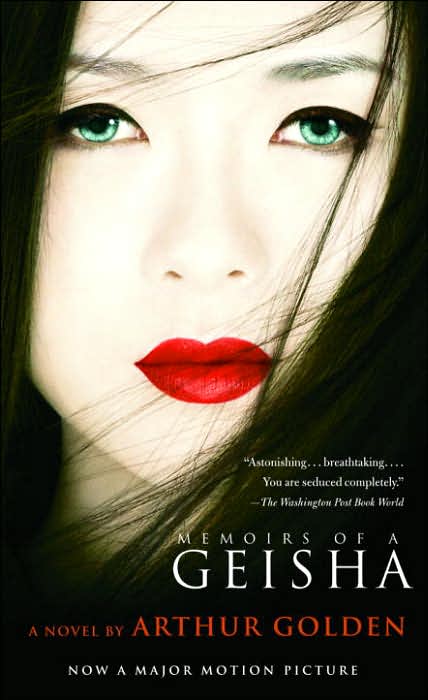
memoirsgeishaAll I can say is – wow. This book is utterly amazing. Considering it came out in the last decade or so, that’s really extravagant praise from me. Nearly every word was perfect (though I thought the “translater’s note” at the beginning was unnecessary, as the “translater” plays no role in the book at all). I was so completely immersed, I couldn’t put it down, but unlike books that normally make me turn the pages so quickly, I didn’t feel sick afterwards. Most page turners I’ve read have very little character development, and exist solely for plot twists and devices. This one, on the other hand, has a perfect blend of plot, character, setting, and emotion. I took the weekend off (Yay!) and this ended up being the perfect book to glide me through my mini-vacation.

The prose is gorgeous. It’s almost as if it’s written to be a symbolic counterpart of a geisha – beautifully structured and decorated, with a deep center hidden under all the poetry. Arthur Golden has some amazing talent. I was so immersed in this book, and the main character, Sayuri, was so convincing that it’s really hard to believe that an American man from modern times wrote it. I know he did extensive research, including visiting former geisha from Japan for interviews, but still it’s hard to believe. I’m quite impressed.

Apparently, though, there’s been some controversy regarding his research. The woman who he interviewed primarily, Mineko Iwasaki, talked only under the condition of anonymity, or at least that’s what she claims. Golden, however, included her in his acknowledgements. He thanked her for all her help. While his plot and characters were fictional, a lot of his knowledge about the world of the geisha came from Iwasaki, and she received a lot of backlash when people found out (there’s an unspoken code of silence among geisha). I don’t imagine he was trying to hurt her – I mean, he was giving her his primary thanks in the acknowledgements – but there ended up being a court case some years back, and Iwasaki actually wrote her own book. It was her memoir, written in part to prove the character of Sayuri and her life were not based on Iwasaki’s life. I think that sounds interesting; I might read it soon.

As for the movie, which I really did like before reading this book – it just doesn’t compare. It’s still a good film, don’t misunderstand me, but like the majority of movies based on books, it simply pales in comparison. This is a wonderful book. I recommend it to everyone.

Posted in 2008, Adult, Prose | Tagged , , , | Leave a comment

The Gypsy Game, by Zilpha Keatley Snyder

GypsyI needed something a little lighter after reading American Gods. Something to clear my head a bit. My husband found the perfect solution for me the other day when we went out shopping – the sequel to one of my favorite childhood books, The Egypt Game.

The Gypsy Game was published in the late 90s, decades after The Egypt Game, but picks up, literally, on the very next line of the story. The founding members of the Egypt Game, Melanie and April, decide they might want to study gypsies instead, now that everyone knows…well, I won’t spoil the first book either. The two of them consult the other four members of the Egypt Game, and most of them are pretty enthusiastic. Very little time on the book is actually spent studying about gypsies and designing the game. Most of the focus turns onto one of the other members of the game, Toby, who has major family problems and doesn’t want to confide in anyone. Throughout the book, the members of the Gypsy Game learn a lot about loyalty, discrimination, poverty, family, and love.

I can’t say I enjoyed this book as much as The Egypt Game, or even as much as The Headless Cupid. It seemed, somehow, less atmospheric, I suppose. The Egypt Game takes place many decades ago, and while these were the same characters picking up in the same place and the book only lasts for a couple weeks, it didn’t feel like the 60s. It also felt a little more like I described Jeanne DuPrau’s follow-up books in the Ember series – like Snyder was writing to kids, rather than writing for them. Some of the writing fell a little flat. I didn’t feel like she understood the characters the same way she did when she wrote The Egypt Game.

Now of course, part of this is probably just my biases and hangups regarding the first book of the duo, but I don’t think that’s all. I do think the first is better written. Looking around the bloggernet, I think that’s a common sentiment. If you haven’t read any of Snyder’s books before, I wouldn’t recommend starting with this one.

Posted in 2008, Children's, Prose | Leave a comment

Protected: American Gods, by Neil Gaiman

This content is password-protected. To view it, please enter the password below.

Posted in 2008, Adult, Prose | Tagged , | Enter your password to view comments.

Coraline, by Neil Gaiman

coralinecoverTrish from Trish’s Reading Nook reviewed this book recently. For some reason – probably because I read so little modern fiction – I’d never heard of it. Her review excited me, and I wanted to get my hands on this book immediately. Unfortunately, the copy at my local library was checked out, due back 11/1. I put the book on hold, and one from another branch shipped out to me. As of today, it still hasn’t arrived – nor has the copy at my library been returned. Grr. So today, after my editing group at Barnes & Nobles, I pulled Coraline off the shelf and settled into a big comfy chair for an hour. In that time, I read over a third of the book, and that’s when I decided to just buy it and bring it home. I only took me another hour or two to finish.

Coraline is a little girl whose world is somewhat stale and boring. Her parents aren’t the most attentive, and grown-ups in general ignore everything she says (they keep calling her Caroline, for instance). She’s moved to a new house, the middle flat in a three story home, and she likes to explore. In her explorations, she discovers that one of the doors in her house doesn’t open. Her mother unlocks it for her and shows her the wall of bricks behind it – apparently it used to lead to the empty flat across the way. Soon after, Coraline reopens the door to find the bricks missing. She crosses into a house that looks suspiciously like her own, only better. She has a mother and father there, as well, except that her Other Mother and Other Father have buttons on their eyes, and they want her to stay with them at all costs. Coraline must not only escape, but rescue her parents (who have been taken spiritually-captive) and the dead souls of other children trapped before her.

This is a fascinating book, a fast read, and quite creepy. Gaiman has a definite voice – something I’ve found lacking in many modern books – and the world he builds is convincingly terrifying. It’s a children’s book, but I’m not sure I’d want my kids to read it – nightmares might ensue… Honestly, I’d hoped it would be more grown up, or at least more parallel-reading, than it was. It lacked the duality that I’ve found in other juvenile fiction. While it was enjoyable, it was also very predictable in places (for example, I figured out where the parents were hidden waaay before Coraline). It also seemed like Coraline’s journey was a bit too easy. The focus was so much on the creepiness that it lacked a certain resistance typical of horror tales, though perhaps this was simply due to the age of the intended reader. Overall, I liked the book and don’t begrudge owning a copy because of my library system’s slowness. I will probably end up reading it again, and in the meantime, I’ll soon be checking out one of Gaiman’s adult novels to see if I can add him to the (very small) list of modern writers I like. He certainly has that potential; he passed the first test.

In a sidenote about Coraline, the illustrations were fabulous! The book was illustrated by Dave McKean (hmm…I wonder if he’s related to Michael McKean…nope, doesn’t look like it, but no wonder his name sounds so familiar – he illustrated albums for Stabbing Westward!). He starts with interesting but fairly benign pictures which become progressively more frightening. I loved them! They added so much to the book.

Another note: apparently there’s a movie of this book coming out in February.

Thanks, Trish, for introducing me to this one!!

Posted in 2008, Children's, Prose | Tagged , , | 7 Comments

Animal Farm, by George Orwell

animal-farm-book-cover1After my failed attempt at reading The Sleeper Awakes by H.G. Wells, I was suddenly stuck with no books in the to-read pile on my desk. I have a few on the way from the library but they haven’t gotten to my branch yet, and one of those I want to read right away, so I don’t want to be in the middle of something when it comes. The other day, I’d quoted Animal Farm in a blog post, and was too lazy as of yet to put the book back on the shelf (thus, it was on my desk). It looked so thin and inviting…a perfect solution to the “I need a short book” dilemma. Of course, it only took me 2 hours to read, so I’m back in the situation I was in earlier in the afternoon yesterday…ah well.

This is the second time I’ve read Animal Farm. I read it the first time either in middle school or early high school. Either way, I knew very little about politics, history, and communist Russia, so as a fable, the book did me very little good. I remember thinking it was an okay book. This time, however, it’s much easier to see the quite obvious parallel going through it. Each character represents a person or a group of people in the making/running of communist Russia. The plot is straightforward and heavy-handed, but it was meant to be that way. A lot of the things Orwell explored in 1984 – falsification of history and figures, poverty, hunger, inequality – were also discussed in Animal Farm, and while this one is more heavy-handed, I actually think it’s far better done. It’s more believable than 1984. Rather than using a dystopian handling, Orwell uses a children’s fable to get across what happened in Russia – and what he believes the dangers of communism elsewhere would be.

Despite having first read it well over a decade ago, I remembered almost everything in this book, even down to change in phrase the sheep bleat at the end (I won’t give it away if you haven’t already read it). Politically-minded or no, the book must have struck a chord with me, even if I didn’t realize it. I’ve read three Orwell novels in my life, and I think that this is my favorite of the three. It is better written than the other two, and had a perfect ending, which both the others lacked for me. It is simple to read, very fast, and universal. Though Orwell specifically concentrated on what was happening in Russia at the time, the book hasn’t lost its universal quality. It is applicable as a warning against all forms of totalitarian government, and it’s a scary look at how easily people can be mislead and misused.

Note: Review date is only an approximate of when this book was read/reviewed in 2008.

Note: Originally read in ~1994-ish.

Posted in 2008, Adult, Prose | Tagged , , | 1 Comment

In the Land of Invisible Women, by Qanta A. Ahmed

invisibleI hardly know what to say about this book. I’ve been trying to read it for the last two weeks, and though it’s only 437 pages long, I struggled to get through it. I don’t want to say it’s a bad book. It’s not a bad book. It provided the most balanced perspective on Middle Eastern and Muslim culture that I’ve ever read. It didn’t say, like The Bookseller of Kabul, that the culture was inherently bad because it’s not Westernized. But it also wasn’t entirely defensive of Middle Eastern culture. To every degree possible, Qanta Ahmed points out the good and the bad of Saudi Arabia.

The book is a memoir of a female doctor’s two years living and working in Saudi Arabia. The two years were mostly pre-9/11; she left the Middle East in November of 2001. Throughout the book, she tells about her experiences in Riyadh (where she lived and worked), about her Hajj (the pilgrimage she took to Mecca), about love and the intricacies of internet semi-dating, about weddings and all sorts of events. She tells stories about things that happened with coworkers and friends. She learned tons about Islam (she was Muslim from birth, but raised in England and never knew much about the roots of her faith), tons about women, tons about feminism and repression.

This is the sort of thing I love. I love looking at another culture and becoming completely immersed in it. Having experienced, briefly, a time in Palestine, I could hear, smell, and feel so many of the things Ahmed describes. I recognized almost everything. She writes the broken English dialog perfectly – I can hear the accent that goes along with it, even. But though I could really feel the world she showed me, I had a very rough time dealing with this book. Many times, I almost quit reading it. I couldn’t get into it until about halfway through, when she started talking about her love affair (of sorts). The problem was simply in the writing. It wasn’t badly written by any stretch of the imagination. Ahmed is extremely intelligent and that came through in every sentence. There are no cheesy metaphors or cliched phrases. On the contrary, this read like a dissertation. I felt like I was reading a textbook, or a long medical paper.

I have a hard time with nonfiction. I always have. I hated reading textbooks straight through. I love memoirs because of the creative elements in them, but this memoir was not traditional in that regard. It was very fragmented. A couple chapters about one person, a couple chapters about another, many people never showing up again. There wasn’t enough underlying thematic elements to tie everything together. I know that the culture in Saudi Arabia was supposed to tie it all together, but since that’s the premise of the book, it didn’t double well as the theme. In Reading Lolita in Tehran, Azar Nafisi uses literature and her forbidden book club as a theme to tie in everything. Though she meanders around in time and between characters, it always comes back to books and literature. A theme is a necessary grounding, which In the Land of Invisible Women lacked. Though I thought the people she described were interesting, I don’t think I’ll remember them, and I find that very sad, because I would like to remember them. I enjoyed them. I thought they were fantastic people and I wanted to know more.

So this book frustrated me. I kept reading because I loved the subject matter, and I kept putting it down because I was bored. I don’t feel like I learned anything in particular – many of the lessons taught were ones I’d already encountered in former books or experiences regarding the Middle Eastern world – but I do feel like someone else without my particular experiences might learn a whole lot, if they can wade through the thousand references to brand names (do I care one bit what kind of shoes or watch or furniture a person wears/has? I couldn’t tell you the difference between two designer-brand shirts…what’s the point of bringing that up every single time you meet someone or enter their house??) and the very clinical tone of the book. Sorry for that last extremely run-on sentence…

In conclusion, I’m not sure what to say. The book was disappointing to me, but I can’t say it’s a bad book. It does a marvelous job dispelling untruths and verifying truths. It shows Saudi culture for exactly what it is, good points and bad points. If you are interested in learning more about modern Middle Eastern culture in a balanced, unbiased way, this is perfect. Just don’t expect it to read like a traditional memoir.

Posted in 2008, Adult, Prose | Tagged , , , , | 1 Comment

The Stranger, by Albert Camus

The_Stranger.largeThe Stranger is a tiny novel (my translation is 123 pages) by Albert Camus published in 1946. It is a tale of a man, Mersault, who lives life completely and utterly without morals. By that, I don’t mean that he’s going out to do drugs or hook up with prostitutes. I mean that he does not acknowledge universal truth, and he does not abide by social norms. He recognizes that all rules are transient and socially-based, and because he acknowledges this, he does away with everything. He does this absently, not consciously, and lives pretty much how an animal might live. He has stripped away the layers of humanity and become only the creature he really is.

Mersault’s mother dies at the beginning of the novel. He attends her funeral but doesn’t want to look at her in the casket. He smokes, drinks coffee, and dozes a bit during her wake. He doesn’t cry. He’s uncomfortable walking out in the heat during the funeral procession. The next day, he meets up with an ex-coworker and they end up starting a relationship. Throughout the book, this is basically how Mersault’s life goes. He lives according to his present, immediate needs. His feelings are muted or nonexistent. There is no self-reflection. Midway through the book, he’s out on the hot beach, with the sun glaring down on him painfully, and in his extreme discomfort, he shoots a man. Throughout the rest of the book, he is put on trial, where he is condemned not because of his crime, but because he displayed less than adequate behavior with regards to his mother’s death. The prosecutor and jury are far more concerned with his lack of emotion than his crime.

Albert Camus explores in this book what the world is like to someone who views life as utterly meaningless. Someone who lives life according to sensory input rather than emotions; someone to whom religion means nothing. Some people have labeled the book existentialist, others absurdist. Both probably have some elements of truth to them.

I find this book fascinating because when I was a lot younger, I once tried to live in total indifference to my surroundings. For several years, I observed everything from the point of view of meaninglessness. I was never as extreme as Mersault by any stretch of the imagination, but certainly the world looked a whole lot more absurd from that point of view. Social norms – shaking hands, small talk, who stands where in an elevator – all became ridiculous. To this day, I hate small talk, though it doesn’t disgust me the way it did when I was a late teenager. I think my period spent in semi-indifference helps me to connect with this book, which I know many people don’t like. Many people don’t want to see what the world looks like from an existential or nihilistic point of view. But to me, this is fascinating.

I did want to make a note here with regards to my review on The Handmaid’s Tale. This book, though Mersault is condemned to die and has no access to someplace to write his tale, is told in first person. Camus, unlike Atwood, allows suspension of disbelief to carry his story. We hear the book on an intimate level with the narrator, with no thoughts about why or how this story got told. It isn’t written to be like a diary or memoir. It tells of experience, and leaves it like that. Though it would be utterly impossible in reality for such a story to get out, that doesn’t matter. This is what I wish Atwood had done. I felt much more connected to Mersault than Offred. I wish Atwood would have allowed her reader to just experience, rather than trying to reason with them. But I digress…

I read The Stranger first many years ago. It was far more enlightening this second time around. My translation is done by Matthew Ward and I think he does a brilliant job. Highly recommended.

Note: Review date is only an approximate of when this book was read/reviewed in 2008.

Note: Originally read in 2001. (?)

Posted in 2008, Adult, Prose | Tagged , , , | 2 Comments