The War of the Worlds, by HG Wells (audio)

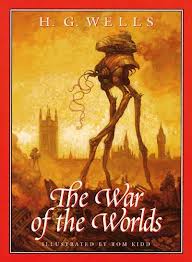
warWar of the Worlds is my current book club selection. It is only the third selection I’ve seriously considered giving up on (the other two being Don Quixote and A Connecticut Yankee in King Arthur’s Court). In fact, I did give up on it, before being struck with an inspiration: listening to it on audiobook. Librivox to the rescue!! I listened to the majority of this one, and read the last 50 pages or so today just to get it over with. Seriously, it took me several weeks to read a book that’s less than 200 pages long.

I wanted to like this book. It is, of course, one of the bedrocks of classic science fiction. I enjoyed the movie that came out a couple years ago. The plot and premise were interesting. But I just couldn’t get into the book. The characters weren’t real people (I’m not sure the narrator even had a name, and I know his wife didn’t). They had no personalities, with the exception of a few minor characters who acted like caricatures. The writing was horrific (how could he have missed using the word “tumultuous” about 15 times in one paragraph, several times even in the same sentence!!??!? If I never hear that word again, I will be a happy woman). I don’t mind that the “science” was completely lame. I know the book is old and they didn’t know as much then, so that didn’t bother me. Unfortunately, everything else did bother me.

The book was far superior in audio format, though I still can’t say I liked it. I at least managed to read it, which is more than I thought I’d be able to do by the time I hit the fourth or fifth chapter. I managed to pay a little bit of attention, and there was one spot with a joke that actually made me smile. But even in audio format, I barely got through it.

It would be interesting to listen to the Orson Wells adaptation, to see if that would be more palatable for me, and to really understand the frenzy of panic that took place back when it was first read over the radio. I find the public reaction far more interesting than the original book itself.

Posted in 2008, Adult, Prose | Tagged , , | 1 Comment

Gossamer, by Lois Lowry

gossamerI love Lois Lowry. I’m so excited to have discovered her this year! For Christmas, I received Gossamer from my friend Julie (thank you!!), which is one of Lowry’s that I hadn’t heard of before. It was light and thin, so I took it with me when we went to visit my in-laws the last couple days. Turns out it was the perfect selection.

Most of the Lowry books I’ve read so far have been middle-grade to young adult, but this was aged younger, probably about 8 or 9 for the target audience. Littlest One is a young dream-giver in training. She is inquisitive and sometimes fails to follow the rules exactly, but she has a big heart and natural instincts at her job. Along with her trainer, Thin Elderly, Littlest One has to help her charges – an elderly woman taking care of a troubled foster child – ward off the nightmares caused by a horde of evil Sinisteeds.

This was very easy to read, and had the right touch of happiness to help me through the stress of traveling the last couple days. I’m sure it’s not for everyone – it is written for a very young audience – but it’s a great selection especially for children. And I really liked it. It’s well done.

Posted in 2008, Children's, Prose | Tagged | Leave a comment

The Diving Bell and the Butterfly, by Jean-Dominique Bauby

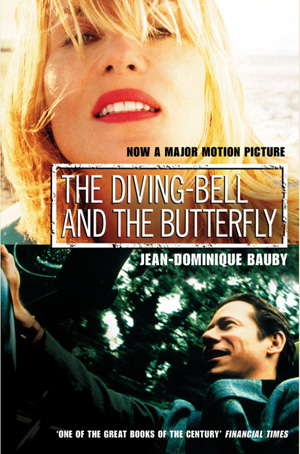
Diving-bellI came across this book when trying to look up images of a diving bell when reading Airman. I’d never heard of a diving bell before and had no idea what Colfer was talking about. The image search led me to a page with a short summary of this book.

This is a short memoir of Jean-Dominique Bauby, the former editor of Elle. In 1995, he had a stroke that left him fully paralyzed, with what’s known as “locked-in” syndrome. In other words, he could think but not communicate. The description I read said he was only able to move his left eyelid, but after reading the book, I found that that wasn’t quite accurate. He could swivel his head a little bit, and after a good eight to ten months of PT, he was able to make a couple sounds a day. Eventually, his mouth could open wide enough to put in a lollipop. He couldn’t, however, talk, swallow, eat, etc. The doctors found a way for him to communicate. They took the French alphabet (he’s French) and ordered it by use-frequency. Visitors would read the letters off a sheet of paper, and Bauby would blink his left eye when they got to the right letter. Letter by letter, he communicated with the world.

Over the summer of 1996, he dictated his thoughts to a woman named Claude Mendibil using this blinking technique. The entire book (the French version, of course) was written in a series of blinks. That totally blew me away. Still does. What a remarkable achievement! Bauby died two days after the French publication of the book.

Now, the flip side. While the creation of this book is certainly outstanding, I honestly didn’t feel the book itself was that great. I feel really terrible for saying this. Honestly, I wonder if it would have been better in its original language. I think there was something lost in translation. I wonder if perhaps more had been communicated in French. It was definitely an interesting look at an insider’s perspective on locked-in syndrome. I really, really hope I never end up in a situation like that. It’s terrifying. And I really wanted this book to be more than it ended up being. I was disappointed by it’s lack of…well, everything. There just wasn’t much in there. There was very little about the syndrome, very little about his emotions, little about his family and friends and magazine and life. I read the entire book today, and hardly remember a thing about it only a few hours later. By the end, I wasn’t exactly sure what Bauby meant his point to be. Then again, it’s not like he could go back and edit. He had to memorize his sentences in advance and repeat them to himself over and over before dictating them. His achievement really was remarkable, and I give him full credit for that. Like I said, I feel really bad for being disappointed in the book.

There’s a movie out now based on this book. I might check that out.

Posted in 2008, Adult, Prose | Tagged , | Leave a comment

The Good Thief, by Hannah Tinti

good_thief1Twelve-year-old Ren has lived in a Catholic orphanage ever since he can remember. His hand has been missing all that time, too, which is why no one ever chooses to adopt him. When Benjamin Nab unexpectedly shows up at the orphanage claiming to be his brother, Ren is excited and nervous about leaving the only home he’s ever known. Soon, he finds out Mr. Nab is not who he claims to be. Ren gets dragged into the underbelly of society, amongst thieves, liars, con-artists, murderers, and grave-robbers, always looking for a way to survive the future; eventually finding, instead, a clue to his past.

The book was well-written, a sort of Kidnapped-like atmosphere set in the early stages of American history. Despite that, I didn’t particularly enjoy it. That really had nothing to do with the book, though. I think it was a combination of the fact that I don’t normally enjoy Kidnapped-type adventure stories, and that I’ve been completely stressed out and distracted while reading. Between my anniversary, Christmas, my kids getting out of school, budding allergies, and my aunt’s failing health, I’ve been reading The Good Thief in snatches over the last week. Perhaps if I’d been in a better frame of mind, I would have enjoyed this more – like I said, it was well-written.

Good things: The setting and time period seemed to be accurately researched, with little details that made me feel the story took place at that time. The story had its touching moments. The mysteries were unraveled slowly and weren’t too predictable. If I hadn’t had to read in snatches, I probably would have been pulled along the plot quickly.

Not-so-good things: I didn’t really care about any of the characters. They were well-developed, but they were the scum of society. I wouldn’t care about a bunch of drug addicts and child pornographers in a book about today’s time, either. Also, the ending was a little too clean and neat.

So in summary, a well-written book, but not really my taste.

Posted in 2008, Prose, Young Adult | Tagged | Leave a comment

Awakening, by Robin Wasserman

awakeningThis book is part 1 of a trilogy about a girl who wakes up with amnesia and who struggles to remember her past while also dealing with bizarre physical abilities and haunting hallucinations that might just be real.

I’m not sure what I think of this book yet. It ends in such a way that it feels like part 1 of a book, rather than part 1 of a trilogy. No closure, no answers. I will need to read the next books for it to fully make sense.

It was an easy read though, took me only a couple hours yesterday. Though this classifies as a YA book, the writing seemed much younger, more middle grade.

I’d hate to give a like/dislike analysis right now, because I simply don’t know enough yet. Is the girl schizophrenic and completely delusional? Does she really have the ability to destroy things she’s not touching? Are the people around her real or figments of her imagination? And who was she prior to waking up with amnesia? All questions that have no answers by the end of the first book, and some interesting implications on either side of the crazy/supernatural argument. So we’ll see. I’ll have to read the other two.

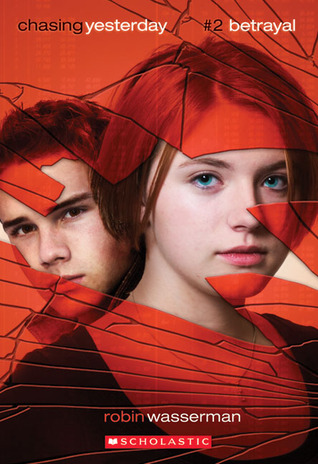
(PS – I love the cover art.)

Posted in 2008, Children's, Prose | Tagged | 2 Comments

Belong to Me, by Marisa de los Santos

belong-to-me-largeOnce again, Marisa de los Santos pulls off a fun and effortless book. This time, there are three stories that twist around each other. First is Cornelia, one of the main characters of the first book (Love Walked In), who has moved to the suburbs with her husband. There, she has to deal with very catty neighbors and a complete inability to fit into suburbia. Second, there’s the story of one of the catty neighbors, Piper, who is about as stereotyped a WASP bitch as one can be. (And it’s not the writing. Piper tries to be that way. She says so in the book.) Piper is struggling with the fact that her best friend, Elizabeth, is dying of cancer, and the perfect world Piper’s created for herself is equally dying. Third is the story of Lake and her son Dev, who recently moved to the same area under mysterious circumstances that Dev is struggling to figure out, and which his mom is thoroughly hiding from him.

While I just finished the book and therefore have had little time to reflect on it, my initial impressions are that I liked Love Walked In better than this one. I think there was a tad too much thrown into this one. Too many sideplots outside the main plots. It’s also more difficult weaving three main stories, especially when the outside two (Lake and Piper) don’t really have much to do with each other, just with Cornelia. The spider’s web is a lot more complicated here, and a couple times I had to go back and figure out what was going on. Also, I don’t really buy Piper’s character and character development. I don’t buy that Cornelia and Piper would ever become friends under any circumstances. There was just a touch too much unbelievable in the whole situation. Lastly, I missed Cornelia’s delightful indulgence in literature and old movies, which is present in this book, but far less so. Her personality seems muted, though perhaps that’s just because there are far fewer chapters devoted to her story.

Of course, there are good things, too. Most of the other characters were definitely believable. The end is messy and realistic, without any real resolution (which I love). The revelations were shocking and took me by surprise. The death scenes around Elizabeth are outstanding, and even though I hated Piper, I actually felt sorry for her for a brief moment. The love story between Dev and Clare (the second storyline narrator from Love Walked In) is brilliantly done, too.

Maybe I liked this book less because I can’t stand the suburb snobbery throughout it. I don’t like that sort of thing in real life, so reading about it was near torture. Thankfully, I could tell that the author didn’t particular care for it either, and most of the characters were repulsed by it, too. But still, that was the setting, and the setting tainted the book a bit. Made it just slightly distasteful.

But overall, I liked it and thought it was well written. I look forward to Marisa de los Santos’s next book, whatever it may be.

And of course, I should mention, the coolest thing about the book is that my middle son, Ambrose, owns that pair of blue boots on the cover. Seriously. Exactly the same kind, with the red stripes and soles and the little arches on the top. All three of my kids stuff their feet into those boots during various games, and all three of them have, individually, noticed the cover of this book and gotten excited by the fact that Ambrose’s boots are on there. Like, hopping up and down excited. 🙂

Posted in 2008, Adult, Prose | 1 Comment

Airman, by Eoin Colfer

200px-AirmanImmediately on seeing the picture of Airman, I knew this wasn’t typical of what I read. I’m not really an adventure-type person, and this was definitely an adventure book. But despite that, I ended up enjoying this one a lot. It was like a movie in book form.

In essence, this is a modern retelling of the story of Icarus, only on a much grander scale. Icarus is even mentioned at one point.

I enjoyed a lot about this book. The writing was smart and pleasant. The pacing was excellent – not too fast, but never slow – and Colfer doesn’t underestimate his reader at all. At one point near the beginning, I thought he was going to, but it turns out the reader knows many secrets, even when the characters don’t. For the most part, the characters develop well, with the exception of the arch nemesis, Bonvilain (oh yes, the name is symbolic, as is Mr. Broekhart’s), who is the shadiest of shady and never changes a bit. The end wraps up neatly and exactly as one would expect a good adventure novel to end. But despite the patently obvious symbolism, the super-bad bad guys, and the predictable ending, the book doesn’t feel like a generic copy of every other adventure book (at least it didn’t to me). The ending may be caricatured, but it also feels natural, and made me cheer.

In the end, this wasn’t an earth-shattering book, but it was quite fun, and I’d read it again. It was a good break from heavy books. I’m glad for the exposure outside my normal tastes, too.

Posted in 2008, Prose, Young Adult | Tagged , , | 2 Comments

Sense and Sensibility, by Jane Austen

sense-and-sensibilityThis is my third Jane Austen book. I hadn’t planned to read another one until next summer, but suddenly they’ve started a Jane Austen book club at my library, so I wanted to read this before the 13th so I can attend that afternoon.

I’m not sure whether I like this one or Emma better, though both are better than Persuasion. The book is the typical Austenesque plot – romances, families, betrayals, and an eventual happy ending for all. No need, really, to hash it all out.

(Okay, I admit it – Jane Austen really is the chic-lit of the 1800s.)

I have a hard time reading Austen books. The language is so maddeningly slow! I love the plots, but at the same time, they take me forever to read. I’ve been reading this book for three weeks now, and took time off to read both Loved Walked In and The Tales of Beedle the Bard on breaks from S&S. That isn’t to say I didn’t like it. I did. I’d seen the movie, so I knew what was going to happen, but I was still as anxious as the slow prose of Austen allowed me to be. I can see why die-hard Austen fans love it.

A note on Austen books in general:
I am really glad I don’t live in Austen’s time period and social class. Beyond the oddity of marrying one’s cousins, I just don’t think I could handle the small-talk of the day. It’s so oppressively polite! I don’t mind politeness, but my god! It’s insane! Everyone has to say one thing when they mean another; they speak contrary to what they feel; they must resist even when they want to accept…and on…and on…it’s a nightmare! I would never have survived. I was actually really happy to find a character in this Austen book who was a lot like me – Marianne Dashwood. She’s the first Austen character I’ve been able to relate to. She had no regards for propriety, she felt everything so strongly, she lived according to her passions, she was blunt and honest instead of passive-aggressively polite, and she was so full of life. Of course, there were downfalls in that – she was quite blind to reason and oftentimes didn’t see the traps she laid for herself – but all in all, I admired Marianne more than any other Austen character I’ve read. She was a breath of fresh air in a rather stifling environment.

Posted in 2008, Adult, Prose | Tagged | 2 Comments

The Tales of Beedle the Bard, by JK Rowling

beedleThe Tales of Beedle the Bard is the newest accessory in the land of Harry Potter. It is a book of five wizard-children’s fairy tales, mentioned first in Harry Potter and the Deathly Hallows. The five stories are “The Wizard and the Hopping Pot,” “The Fountain of Fair Fortune,” “The Warlock’s Hairy Heart,” “Babbitty Rabbitty and her Cackling Stump,” and “The Tale of the Three Brothers.” The last of these was already written out in the aforementioned HPatDH. Each story is followed by commentary by Albus Dumbledore, and there are some interesting footnotes as well (I now finally know the difference between a Warlock and a Wizard).

J.K. Rowling has a real talent for fairy tales, mythology, and other such similar topics. These were fantastic. They mirrored the sorts of fairy tales one hears in real life – Snow White, Cinderella, Little Red Riding Hood – in archetypal quality and tonal lilt. Though the plots are uniquely their own, not at all like Snow White or Cinderella, the same under-qualities are there, the same types of morals. These were very fun to read through. I zipped through them this morning after my book arrived around 9:45 pm last night. Dumbledore’s commentary was equally fun, especially his footnotes.

Of these stories, only one (“The Warlock’s Hairy Heart”) did not appear in Deathly Hallows. I may be wrong about this, but I don’t believe Rowling had originally planned to write out any of the stories except “The Tale of the Three Brothers.” The other three were only mentioned by title (and yes, “Babbitty Rabbitty” as a title was certainly laughed at by the other characters). I remember reading somewhere that Rowling said it was far more difficult than people would expect to find stories to match the titles she’d thrown out, especially “Babbitty Rabbitty and her Cackling Stump.” I was impressed. They were all perfect quality fairy tales, and matched the titles appropriately. In fact, the one I liked least was the only one not previously mentioned in Harry Potter: “The Warlock’s Hairy Heart.”

My favorite was “The Fountain of Fair Fortune.” It was the most fairy-tale of them all, had the greatest moral value in my opinion, and was just plain fun.

This book wouldn’t make much sense, probably, to those who aren’t already Harry Potter fans, but for those who are, this is worth purchasing. Also, a certain amount of the proceeds go towards charity (just like with Rowling’s other encyclopedic HP accessories, Quidditch Through the Ages and Fantastic Beasts and Where to Find Them). In this case, the charity is one that benefits children living in institutions. Good cause, good book. Well worth the buy/read.

Posted in 2008, Children's, Prose | Tagged , , | 1 Comment

Love Walked In, by Marisa de los Santos

love-walked-inBack in late November, I read an interview with Marisa de los Santos on a writing/publishing blog. Her second novel, Belong to Me, just came out in April. It was her answer to the question “What’s most important to you as a writer?” that intrigued me. She stated she didn’t write for an audience, didn’t want to lose integrity, writes what she needs to write, and is very character-driven in her stories. This isn’t something I see often in modern fiction, so I decided I would give her a try. Belong to Me is supposed to be a sort-of sequel to Love Walked In (her debut), so I decided to read the debut first.

I admit, I worried that the author’s perception of character-driven might not have been the same as my own. In modern fiction, it often isn’t. That’s the problem with being a classics girl – modern writers usually just don’t cut it for me. In this instance, however, I was delightfully surprised. This was a wonderful book. Not Steinbeck by any stretch of the imagination, but I don’t imagine it was meant to be, either. And despite not being Steinbeck, I really enjoyed Love Walked In.

This is two stories in one. The first is that of Cornelia Brown, a not-quite-ready-to-grow-up woman who’s in love with old movies and who lives life as if she’s on camera, down to the moment she falls in love with a Cary Grant lookalike, Martin Grace. The second is that of Clare, an eleven year old girl whose divorced mother is slowly having a nervous breakdown. The book bounces between the two stories until they collide, and then threads them all together until the end. There are a lot of complex subjects tackled – love, marriage, divorce, death, abandonment, family, mental illness (I felt so sorry for Clare’s mother – I recognized her disorder waaaay before she did…) – and they were all handled well. This book may not be a classic, but it certainly does touch on a lot of universal themes.

The characters in Love Walked In were realistic and believable and likable. I fell in love with them and wanted more. The plot, except in one small section I won’t reveal as it’d be a spoiler, was not contrived or forced, and was perfectly believable. About two-thirds of the way through the book, I was blindsided by a twist that blew my theories about the ending completely out of the water, so that for awhile I had no idea what was going to happen next (that doesn’t happen to me often). The ending was just the right mix of happy and sad.

Reading this book felt a lot like watching a heartbreaking-but-heartwarming mix of movies. Like a Susan-Sarandon-with-cancer movie mixed with an anyone-but-Meg-Ryan romantic comedy. I got the same feeling reading this as I get snuggled up in warm blankets on a cold winter night. And I loved all the references to old movies and books. I didn’t get half of them, I’m sure, and probably the ones I did get, I only understood cursorily, but it was a fun thematic element to lay out and it made me feel involved.

So, to conclude, I wouldn’t call the book earth-shattering, but I certainly loved it. I look forward to reading Belong to Me.

Posted in 2008, Adult, Prose | Tagged , , | 4 Comments