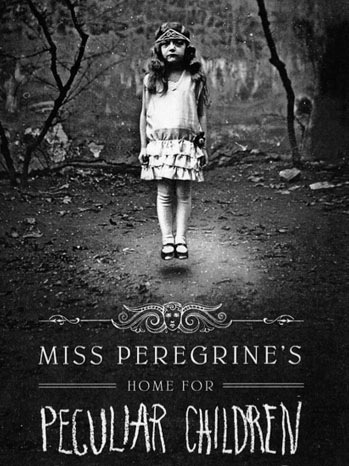
Miss Peregrine’s Home for Peculiar Children, by Ransom Riggs

peregrineSo this book has been big news for the last few months. Unfortunately, I was not really blown away by it the way many people seem to be. The story was fun enough, and creative, but I had quite a few issues with it.

If you haven’t heard what this one’s about, basically it’s the story of a boy whose grandfather told him crazy stories about the weird kids he grew up with. Kids with special abilities, like being able to levitate or lift boulders with one hand. This boy, Jacob, doesn’t believe the stories, until he gets caught up in them. Scattered throughout the book are photographs related to the story, usually relating to the weird kids.

Now the rumor that I’ve heard is that the entire plotline of this book was based on this series of photographs. Originally when I heard of the photo idea, I thought they were photos used as illustrations, created for the storyline, rather than the reverse. I thought that was quite clever, and really looked forward to the interplay of photography and text. However, if the rumor is true, then the book is the opposite, and the text is bent to match the photos, rather than the other way around. From the writing and storyline, this seems probable, and this is where my main issue with the book comes up.

I read a review of this book months ago that said the pictures felt like they got in the way of the story. At the time, I didn’t really understand, but now I do. This book reads a lot like a round robin story, only instead of multiple writers all dragging the story in new directions, it’s dragged around from place to place by random photos. It felt far more like a creative writing assignment than a novel. Periodically, stuff would happen that had no relevance to the story, just for the sake of the photo. You could always tell when a photo was coming, because the story would just veer off on some tangent. While I loved the photos and the idea of using photography for illustration, these photos in particular felt superfluous, or at times even detrimental to the story.

That was frustrating for me, because the story was definitely creative and original, and I liked where Riggs was going with it. But because it kept going back to these pictures, a lot of the writing and plot felt forced. The characterization was likewise forced – though not necessarily due to the photo issue – and despite the originality of the story, it was very predictable. It read far more like a middle grade novel in tone and foreshadowing than young adult, though the subject matter was too old for middle grade. I don’t know. It was just okay for me, I guess. It wasn’t quite what I was hoping it would be.

Posted in 2011, Prose, Young Adult | Tagged , | 1 Comment

The Likeness, by Tana French (audio)

Cover-of-The-LikenessI had a couple issues with the book, specifically the believability of the premise, and the repetitiveness of a cop getting too obsessed/into the case just like in the first book of this series, but otherwise it was a compelling read and I enjoyed the way it played out. I’ve read a lot of reviews that say the killer is obvious from very early on, and I’d agree with that, but the point of the book didn’t feel like you were meant to be figuring it out. It felt more focused on the interplay of the characters, and read less like a traditional mystery, and I liked that.

Book 1: In the Woods

Posted in 2011, Adult, Prose | Tagged , , | 3 Comments

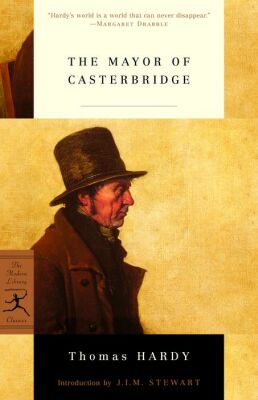
The Mayor of Casterbridge, by Thomas Hardy

mayor6Of the four books by Thomas Hardy that I’ve read now, this is my least favorite. There were a lot of good points about it, sure. I liked that in the end, honesty won. I liked the statements it made about dishonesty, manipulation, and selfishness. It had a lot of good moral points.

On the other hand, the writing was less than brilliant for me. Much of the plot was overly predictable, and the characterization was very sloppy, especially for Henchard. He waffled so much and so often that at times I wondered if Hardy wasn’t quite sure exactly what to do with him, and that’s pretty out of the ordinary for Hardy. Characterization is one of the things I expect to be exceptional, if a little archetypal. It also didn’t help that while honesty won, that win didn’t happen without many hundreds of pages spent with dishonest characters first, which just grates on me personally.

Despite the negative points, though, I’m looking forward to discussing this one with my book club, and I’m hopeful that with some discussion and some distance from it, I’ll be able to look on it in a more positive light.

Posted in 2011, Adult, Prose | Tagged | Leave a comment

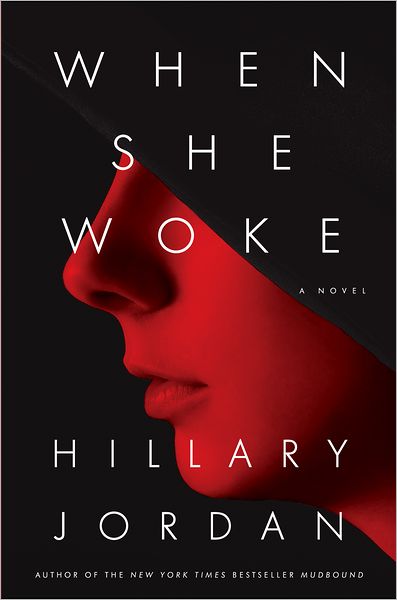
When She Woke, by Hillary Jordan

whenshewokeI’m in two minds about this book. It’s a dystopian retelling of The Scarlet Letter, so I expected there to be some similarities there. However, some of the similarities were, for me, a little too close: Hester Prynne = Hannah Payne. Arthur Dimmesdale = Aiden Dale. Pearl = Pearl. Etc. However, because of the very true closeness of the retelling, I was also a little offput by the last third of the book, which deviates widely from the original and felt incongruous given everything else. The ending came back together, but the stuff before the ending felt very forced and unnatural in comparison to the rest of the book. So in some ways, the book felt too close to the original, and in others, not close enough. Like I said, two minds.

On the other hand, the writing was very good, and it was definitely a book I couldn’t put down. I loved the concept of retelling The Scarlet Letter, and reading this book has made me want to reread The Scarlet Letter for the first time since high school (when I didn’t appreciate it nearly as much as I will now, I’m sure).

Posted in 2011, Prose, Young Adult | Tagged , | Leave a comment

Readathon: Wonderstruck, by Brian Selznick

wonderstruckI went into this book with some reservations, having heard other people say it was far too much like Hugo Cabret in style. Honestly, this doesn’t bother me so much stylistically – most artists have similar styles, patterns, and focuses that go from book to book, and imagine Brian Selznick is no different. I did notice many similarities, but found that it was easy to let those things go, especially because the story was a really good one.

What did end up bothering me was that it seemed like the story was badly structured. It takes place in two time periods, and when the two stories collide, the last third of the book is spent with one character telling another backstory. Far too much telling, not enough showing. By showing, I don’t mean illustrations – you can “show” in text too. There was just a lot of info-dump, and I would have rather experienced the bulk of the story rather than have it told to me this way. So I felt like the structure didn’t work for Wonderstruck. The story was good and the art was beautiful, but the book fell short in other ways.

Posted in 2011, Children's, Visual | Tagged , | Leave a comment

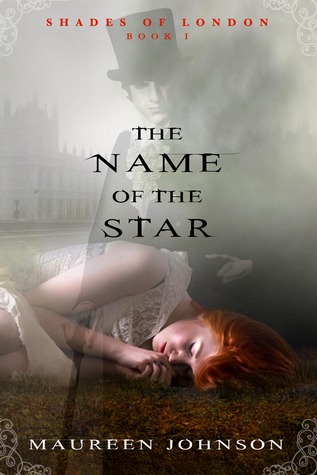
Readathon: The Name of the Star, by Maureen Johnson

The-Name-of-the-StarI think I have found my new favorite Maureen Johnson book. Seriously, this book was fantastic. Johnson does everything right. She makes her characters believable and real without glamorizing them. She makes them feel like teenagers without belittling or stereotyping them. She rides through drama without becoming melodramatic or letting anything get too big. She has a dry humor that helps to keep the book grounded even as tension builds. Lastly, she has a perfect sense of timing and pacing. This is why, in a time when I’ve grown tired of 95% of all YA, I keep coming back to Maureen Johnson. She’s just fantastic!

I didn’t know anything about Jack the Ripper before reading this book. I had heard the name and knew he was a murderer, but the rest – from the time period when he was killing to the fact that he was never caught – was completely unknown to me. Now, I feel like going out and reading some true crime about the case, which is far more interesting than I expected it to be. I loved the way Johnson handled his story, weaving in bits of history all throughout the book so there was never any straight-out info-dump, and how she made her present-day murder suspect believable.

I was also impressed with her ability to make this a complete, closed off book while also opening it to the rest of the trilogy. I generally run the other direction when I hear the words “trilogy” these days. I’ve read too many where stories cut off in the very middle of something, leaving dreadful cliffhangers, or where a trilogy is really a single story stretched out to ridiculous proportions in the hopes of selling more books. The Name of the Star was a complete and whole story, beginning to end. In the last chapter, there is a new development (ie set up for the sequel) that is related to the rest of the book but does not in any way change the rest of the book. The book itself is still complete. There is just something new for us to wait for. The beginning of something new, not the middle. Not a cliffhanger. The start. A teaser. In my mind, this is the best way to handle a sequel or series: finish each book completely, while giving the reader a reason to come back that isn’t such a huge reason that you’ll annoy them.

That’s all. I really liked this one. I’m looking forward to reading the rest of the trilogy.

Note: Reread in March 2013.

Posted in 2011, 2013, Prose, Young Adult | Tagged , , , , , | 1 Comment

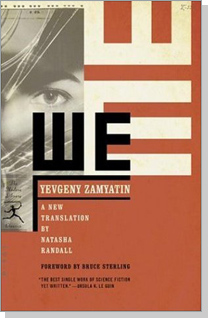
Callback: We

evgheni_zamiatin_weI first read We back in early July 2008. I’ve gone back and read my review from that time, and it’s clear that I had no idea what to make of this book. It’s supposedly one of the three best dystopias of all time, along with Brave New World and 1984, but I had a really hard time with the book. I knew that a good half of it, at minimum, went completely over my head.

In the intervening time, however, the book has had a chance to percolate in my brain. I don’t remember that feeling of not understanding We. Reading my review from 2008 actually surprised me, because I could have sworn the book made some sense to me. I remember having some confusion about the timeline, but that’s all. In the three years since then, the book has come to make perfect sense, and grown into one of my favorites. There are very few books that I can say I still think about on a regular basis years after reading them. We is one of those books. There are images from it that come back to me frequently. Striking, distinctive images, ones that must have affected me far more strongly than I understood at the time.

So this time, rereading We, I didn’t feel like any of the book went over my head. It made sense. I could see all the pieces of it, how it all fit together, why it worked, why it’s considered one of the best dystopias of all time.

What makes up happiness? We asks this question. One State asks this question. The Ancients, people like us, we ask this question too. How can we achieve complete happiness? What is the key to locking away sorrow? What sacrifices are necessary to give us exactly what we want? Is it better to risk extreme pain to experience extreme joy, or is it better to cut out all extremes and to live, instead, on a field of medium – medium pleasure, medium emotion, medium living?

Think about the innocence of a child. A child, sheltered from the pain of the world, is far happier than most adults. As they grow, they lose that innocence, they are filled with thoughts and experiences that cloud their happiness, and they lose that carefree joy of childhood. Once you learn something, you cannot unlearn it. You cannot regress back to innocence. But what if, instead, you can be cured of learning? Of experience? Of pain? If you could stay in that childlike innocent state, would it naturally follow that you would remain happy? Or is experience at some point necessary to place value on your feelings, like a touchstone? Is it truly possible to know happiness if you have never known sorrow?

They say that as humans we have a tendency to want what’s worst for us. The wish to never feel pain or sorrow or grief implies the necessity of cutting off the opposites of those feelings as well. Would we be willing to give ourselves over to slavery in order to always be content? Can contentment be enough, if it also means never having to hurt again?

It’s funny that I didn’t recognize these themes the first time I read through We. It boggles my mind that I didn’t see any of this, particularly because as a writer, I have written many, many stories and novels that touch on these same themes! It’s one of the things I explore the most, one of the things that I have been thinking about since I was in my early teens. Somehow, I was just blinded to all this the first time I read We. Another proof that sometimes rereading can be a beautiful thing.

Posted in 2011, Adult, Prose | Tagged , , , , , , , | 2 Comments

Habibi, by Craig Thompson

habibiThis could have been a really nice story, with beautiful illustrations, all woven together very well. However, the cultural portrayals made me very uncomfortable, and I was very distracted by the constant vomiting and juvenile humor written/drawn throughout. I noticed a lot of that (juvenile stuff) in Thompson’s other works that I’ve read, but read past it, and this time I guess it was just too much for me. I’m glad I read it, but I didn’t love it nearly as much as Blankets, nor did it live up to my expectations for it. :/

Posted in 2011, Adult, Visual | Tagged , , , , | Leave a comment

The Haunting of Hill House, by Shirley Jackson

hauntingI first read this book in 1999, when I was 20 years old. I’d seen the movie version of it in theatre with some friends and decided to try the book version, because of course I usually figured the book would be better than the movie. I read the book and was disappointed. It felt old-fashioned, clichéd, and ridiculous. The characterization made no sense. The tone and atmosphere were borderline silly, and I found myself giggling at the sheer awfulness of the book all the way through.

What I didn’t realize at the time was that the book wasn’t modern. I thought it was a recent book, not one published 40 years earlier, and so I was reading it with modern expectations. Those clichés? Not cliché at all, but more likely the invention of things that later became clichéd when other authors copied them. I dismissed the book through lack of knowledge and information, and I knew, after reading (and loving) several other Shirley Jackson books over the last few years, that I needed to give this one a second chance.

I’m so glad I did! Having the perspective of the book’s age, as well as a better understanding of tone, characterization, and writing than I did at age 20, made this a far better reading experience. I was struck right away by the ominous creepiness of Eleanor’s mind. While it was in third person narration, the narrator stuck by Eleanor, who never seems quite right. I found myself wondering if she was mentally handicapped, or mentally ill, or downright psychotic! Even before she gets to Hill House and the various phenomena start happening, her way of thinking is warped.

I love the doctor’s initial hypothesis of a house being able to drive people into insanity because its corners and lines are all slightly off-center, out of alignment, and not quite square. In a way, it makes me think of the ideas about modern living many US cultures have: that in order to have a good, happy, upright life, you must live by a specific, standardized set of rules, and those people who live contrary to them will slowly dissolve into degradation and unhappiness. Or maybe I’m reading too much into it. I don’t know. Still, it was fun to think of the book and of Hill House itself as a metaphor for what happens when you step out of line with the status quo, especially given that the book was published in 1959.

Even after a second read, I’m not sure I fully understand everything that went on in this book. There are so many jumps in the narrative, so many mood changes in Eleanor, and as the book goes on, everything unravels! It gets more and more surreal, until you’re left sort of blinking in confusion and wondering what went over your head. I imagine that’s the way it’s supposed to feel, sort of unsettled and not-quite-complete. It was perfect for the story.

I still can’t say that I liked this book more than We Have Always Lived in the Castle or The Lottery, but I am very happy to have reread it and straightened out my 20-year-old thoughts. Plus, I proved to myself, once again, that sometimes even books I disliked are worth a second chance.

Note: Originally read in 1999.

Posted in 2011, Adult, Prose | Tagged , , , , , | Leave a comment

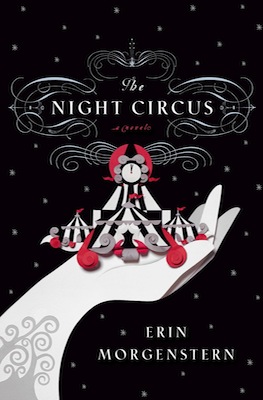
The Night Circus, by Erin Morgenstern

night_circus_coverI didn’t expect to love this one. There was so much hype, so many people loving it. I expected to get it from the library, read a few pages, and return it unread, simply due to my history of not really loving the books everyone else seems to love. I was wrong, though. The Night Circus swept me into its world immediately, and by the time I finished reading, it had joined the (very short) list of my favorite books of the year.

There are a whole lot of ways that books can really get to me. Sometimes I’m touched by beautiful writing. Sometimes it’s great storytelling. Occasionally a book changes the way I think or live. I can be affected by the depth of a book, or by its emotional impact. And periodically, the overriding factor in my love for a book is atmosphere or tone: Notes on a Scandal. Dr. Jekyll and Mr. Hyde. We Have Always Lived in the Castle. Catch-22. The Grapes of Wrath. Anything by Kafka.

The Night Circus is one of these books. Now, it was amazing on many levels – brilliant storytelling, exquisite writing, etc – but where it really shone for me was in tone. I don’t see all that many tone-oriented books in modern writing. Note that the above list only includes one book written less than 50 years ago. I’ve searched and searched for modern atmospheric books, and sometimes I’ll find one that attempts it, but it’s rare to find a modern book that does it well. The Night Circus is an exception. Its atmosphere and tone were perfect.

There are a lot of wonderful things about The Night Circus. I will not discuss the plot at all, not even a summary. There is too much in this book to try to condense into a few sentences, and I’ve honestly seen too many reviews around that semi-spoil the book by trying to summarize. The story itself is intricate and multifaceted. You hear about authors weaving their stories together, but it’s not like weaving, usually. Most authors braid their stories, intertwining a small handful of elements together into a cohesive whole. The Night Circus, on the other hand, is genuinely woven into something beautiful, something far more complex than the average book.

I can’t say just how much this book impressed me. As a writer myself, each of the elements that go into creating a book are important to me, and there is nothing lacking in any of them here. The characters are real and incredibly well-rounded. No one is fully good or bad, and there are no flat extras that people the background. The imagery is every bit as beautiful as the story and atmosphere. The story is timeless and archetypal, but also unique and new in this incarnation. Then there’s the fact that you become part of the story itself – you, the reader. It’s a rare author who can pull off second-person point of view, but Morgenstern does it.

All of these elements, just like the bits of story, are woven into the tapestry that is The Night Circus. I finished it with one primary thought in my head: This is more than a book. It’s an experience. One I want to experience many times.

Note: Reread in September 2013 & October 2018. (Also by audio in 2012, with dedicated post.)

Posted in 2011, 2013, 2018, Adult, Prose | Tagged , , , , , , , , , | 5 Comments