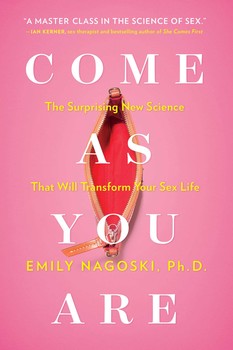
 Subtitled: The Surprising New Science That Will Transform Your Sex Life
In Come As You Are, Nagoski discusses what women’s sexuality is and isn’t, and talks about the many ways that culture and history has interfered with and influenced the way women see their sexuality and bodies. She also discusses ways to help come to terms with our bodies and how we react to various sexual contexts, in order to create more sex-positive environments for ourselves. There’s a lot of science (especially biology), though never too much that it becomes overwhelming, and there’s a lot of psychology and sociology.
What the book isn’t: Some sort of sex manual with instructions on positions and whatnot. I say this because 1) the cover is bright pink with semi-sexual imagery on it, so combined with the title, it gives off a bit of the wrong impression, and 2) I found my physical copy of the book displayed among the many iterations of modern-day Kama Sutra instruction manuals at Barnes & Nobles. No.
Instead, Come As You Are talks about how women’s sexuality has been studied (as “men’s sexuality, light”), and why that is inherently the wrong way to go about studying it. There’s discussion of anatomy and evolution, of inhibitors and accelerators and the various factors influencing brain-arousal (in the general sense), and of the messages women receive (moral, medical, media) about what their sexuality is/isn’t or should/shouldn’t be. The book is blunt and straightforward, with a couple oft-repeated messages: “Everyone is normal,” and “All the same parts, organized in different ways,” etc. There was historical discussion and debunking of pervasive theories on definitions of marriage, sex, orgasm, non-concordance, etc. There was also some geeky analogies referring to everything from Lord of the Rings (your emotional “one-ring”) to Jane Eyre (using one of my favorite quotes from the book to discuss attachment theory).
I feel like I’m doing a horrible job explaining this book. Let me switch into emotional mode: This was hands down one of the best books I’ve ever read. Life-changing. If you’ve ever had problems with sex, either in yourself or with a partner, this book has a lot to say on what might be causing those issues (and hint: it’s not because you’re broken or wrong or abnormal). Sex issues are a sticky subject and tricky to deal with, but Nagoski takes them out of the realm of emotion and puts them in terms of science. And once you remove the emotion, and take a look at the biological and psychological roots of various issues, it’s easier to view them without bias, and to come to understand your own sexuality without bias. That, I feel, is the biggest gain from this book.
This is one of those books that I just want to recommend to everyone. If you’re interested in human sexuality or women’s studies or psychology, or if you’re involved in the fight for body positivity or the equal treatment of women, or if you’ve ever wondered what’s wrong with you or why you react the way you do to sex, this is an especially good choice. Partway through the audiobook, I already knew it was going to be a book I needed to own, and I didn’t even wait to put it on a wishlist and see if I got it for Christmas. I had to own it now. And I didn’t regret that decision as I went through the rest of the book. I know I did a horrible job summing it up. Just trust me. Read it.
Notably, there is some discussion of trauma and sexual violence. Nagoski is very good to give trigger warnings before each section and tell you how far to skip, and she tries to minimize the discussion of actual violence, focusing instead on the long-reaching psychological effects. Some of it was difficult to read – for someone who hasn’t experienced sexual violence, but has experienced sexual trauma – but not so difficult that I fell to pieces or had to quit reading. I think Nagoski handled these sections well.
Performance: The audio was read by the author. Normally I’m not a fan of this, but Nagoski did a fabulous job. Also, the audiobook came with a PDF so that a listener can participate in the same questionnaires and worksheets as a readers of a physical copy of the book.

 Example #2: Acne (and not the normal kind) – I broke out in regular acne as a tween, like many folk. I have it to this day. It’s a constant struggle. Nothing makes a difference to it, not changing foods, not changing skin routines, not chemical or topical treatment from dermatologists. Granted, my mother is nearly 60 and she still has acne, so likely this is just never going away.