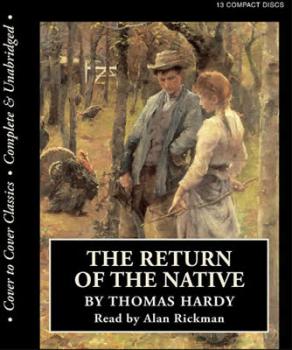
 Back in 2010, I read Return of the Native for the first time. A few comments about that. First, it was my first read of Hardy since Tess of the D’Urbervilles in 2006. I’d been scared to read more by him since he’s very pastoral and I didn’t enjoy those parts of Tess. Second, it was the first audiobook I loved and the book that caused me to fall in love with audiobooks generally. Third, my review remains my favorite ever written. It was so much fun to write! I didn’t get terribly serious in it, and now re-listening to the book after 8.5 years, I wanted to take a slightly deeper look at Return of the Native. For a funner, less-serious, and spoiler-free review, see the link above.
There are six main characters in this book. Three are in the Yeobright family: Mrs. Yeobright, her son Clym, and her niece Thomasin. Then there are three others tangled up with this family: Damon Wildeve (Thomasin’s eventual husband), Eustasia Vye (Clym’s eventual wife), and Diggory Venn (the noble character who also acts as deus ex machina for the story). Each of these characters represent an archetype, and most have a tragic flaw or two as well. Pride, selfishness, stubbornness, idealism, laziness, and impulsiveness are contrasted against innocence, love, self-sacrifice, respect, duty, and realism. Most of the cast end up dead or disabled. Only those who have primarily good qualities end up happy.
As I was reading this time, I found myself looking in particular at the two young women, Thomasin and Eustasia. The former is innocent and passive, the other is reckless and self-serving. As in my last reading, I wanted to feel sorry for Eustasia because she had so few choices, but it was difficult to feel pity when she used people and cast them aside so easily. She wanted everything in the world, but she wanted it handed to her and would not even think of lifting a finger to get it, even when she has the opportunity. The only thing she worked at was trying to manipulate others to her will, and that had me considering just how similar she was to Becky Sharp in Vanity Fair. Thomasin, too, was a contrast to Eustasia as Amelia was to Becky in VF. Amelia is the innocent, humble, quiet one; Becky is the manipulative, self-serving one. But in VF, both Amelia and Becky are anti-heroes, and Thackeray skewers them both mercilessly. In this book, Hardy is far more subtle. He extolls the misfortunes of Eustasia’s life that led her to be the person she is, while simultaneously making it just about impossible to pity her, and he pretty much leaves Thomasin alone. In fact, his treatment of Diggory Venn (the most Mary Sue character I’ve ever read) seems to indicate that Hardy (unlike Thackeray) approved of meekness, self-sacrifice, and duty-above-everything-else as a way of life.
Another thing I noticed quite a bit was the rural idealism. Hardy was fascinated by rural life and spent a lot of time idealizing it in all his books. He is not unlike Clym that way, after Clym comes home from Paris and decides that simple, rural, (idealized) life is far better than any other way of living. Even after Clym becomes disabled and is no longer able to go through with his plans to create a school that caters to rural communities, he copes by taking to manual farm labor. Nothing wrong with that, except that in doing so, he leaves his family without money and puts his marriage into a state of extreme distress. He’s stubborn and holds onto ideals even as the reality of those ideals doesn’t match up with his beliefs. It makes me wonder if there are any parallels to Hardy’s life there, or if Hardy was able to maintain his idealism in reality as well as novels.
I enjoyed revisiting Return of the Native, though I admit that on second read, it was easier to see some of the devices and heavy-handedness of the story. (I mean, come on, how many times will Diggory Venn show up at the exact right moment to rescue someone or alter the course of the story?) It was still a lovely book, though, and of course the audio read by Alan Rickman is superb.