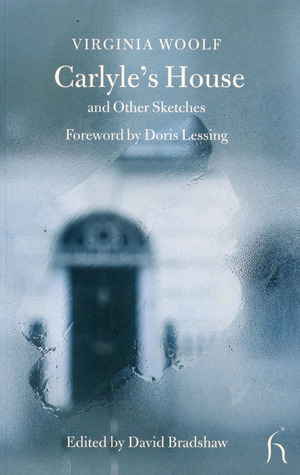
Carlyle’s House and Other Sketches, by Virginia Woolf

carlysleThis is an interesting little book that I picked up solely because I love Virginia Woolf and thought it would be fun to read through some of her writing sketches. I didn’t realize that instead it would be extracts from a journal she kept in 1909. When I first read through the pieces – I read them before reading the foreword, introduction, or commentary – I thought they were sketches (as the subtitle “and Other Sketches” suggests) of characters and scenes. In that respect, I thought the book was quite interesting. But then, when I read the rest of the parts of the book, I realized that these were journal entries, and thus not nearly as interesting to me. It didn’t help that the collection was begun with a foreword by Doris Lessing, a foreword that is biting, sarcastic, and horrible in tone, and which I half-skipped because it made me hate Lessing (a person I had no feeling about at all before). I don’t know. It was sort of like when I read the journal parts of Johnny Panic and the Bible of Dreams collection from Sylvia Plath. They were well written, but not particularly my favorite thing to read. I really didn’t get much out of this collection, which is sad.

Posted in 2010, Adult, Prose | Tagged , | Leave a comment

The Mark, by Jen Nadol

themarkDon’t judge this book by its cover, all my readers who wouldn’t normally read a book like this one. Please, take a moment to read the review – The Mark is very different from what you might expect.

Cassandra – aptly named – can tell when someone’s about to die. They have a mild glow around them, and when she sees this, she knows they will be dead in a matter of hours. Cursed with this knowledge, she tries to sort through what she should do about it. Should she tell people? Would they think she’s crazy (classic Cassandra complex), or would they listen to her? If they do listen to her, is she right to warn them? Can she prevent deaths, and if so, should she? Should she interfere with fate, or is it just that person’s right time to die? If it’s their time to die, should she try to give them a chance to put things right in their world or say goodbye to loved ones? These are the questions that burden her.

I’ve wanted to read this book now for about 1.5 years, since I saw an ARC (that they weren’t giving away sadly) at ALA in summer 2009. I’m not normally into paranormal YA, but this one had a special appeal to me. See, my grandmother – as crazy as this sounds – periodically goes through something similar to this. When she meets someone who will die in the near future, she gets this sort of headache and she just knows. This has happened all her life. It’s not the only thing she can see or feel psychically, or whatever you want to call it. My grandmother knew before I did each time I got pregnant. She would inform everyone in the family, so that when I called to tell, they all knew already, even though I lived across the country and she hadn’t talked to me at all. She just knew. She knows when someone’s about to get severely ill, or go through a divorce. She saw her own father’s death in a dream months before it happened, down to the exact way he died, and tried to warn everyone, only to be ignored. She had a dream foreshadowing the death of her children, and was able to prevent it from happening by explaining the circumstances to her oldest daughter. It doesn’t happen all the time. She doesn’t know everything. But when she knows something, she knows, and we listen.

Again, I know it sounds crazy. I don’t expect anyone to believe it, and I wouldn’t believe it myself except that I’ve seen and experienced it over and over again. So you can see why a book on this subject would really appeal to me. I do admit, though, that I was leery of the book. The problem with an explosion of any genre is that books are pushed out as fast as possible to capitalize on the movement. Many times the writing, style, voice, and character development are sacrificed in the rush. I worried this would be one of those books, the sort of book I could skim through and end up feeling very meh about.

It wasn’t. I was really surprised, especially now after two months of mostly mediocre books, but Jen Nadol writes fabulously. This book was far less concept-driven and more philosophical. Cassie takes a philosophy class throughout the course of the book and learns about all different ways to think about life, the meaning of life, and duty. She struggles with all those questions I mentioned in my synopsis. She tries different ways of dealing with this thing she can do, and different ways of looking at it.

There is so much packed in here, and all these themes are so well explored. Cassie is a wonderful character, and her discoveries about herself, her family, and her strength along the way are gradual and realistic. I can’t tell you how good it was to read something so wonderful again!

There’s only one bad thing I can say about the book: I wish I hadn’t read the last four chapters. They smacked of market manipulation. They changed the book from a wonderful character introspection to a way-out-there paranormal. It went from heart-rending to completely unbelievable. And what for? Well, to me it felt like a trilogy setup, though of course I might be wrong. That’s just what it felt like. It really irritated me, though, because the book could have cut off those four chapters, adding a concluding chapter, and worked as a brilliant standalone. The reveals in those last chapters felt completely wrong for the tone of the book, and I just couldn’t suspend my disbelief enough. I didn’t like them at all. I don’t like the current trend towards trilogies (whether or not that’s what was going on here) and I wish more authors/publishers would just let books stay as standalones.

Personally, I’m just going to pretend those last four chapters don’t exist and I won’t be reading any sequels. I’m not going to let those last chapters ruin what was otherwise a wonderful reading experience, and I highly recommend the book without them. Jen Nadol’s writing is wonderful and she has some really deep thoughts that run through The Mark.

Posted in 2010, Prose, Young Adult | Tagged , , | 1 Comment

The Hour Before the Dawn, by William Somerset Maugham

hourbeforedawnSo I really thought this book was going to be the end of my reading rut. I haven’t read a book I loved loved loved since The Tapestry of Love back in early October, and when I started this lesser-known book by one of my favorite classic authors, I was immediately swept away. I loved the writing, I loved the characters, I loved everything. Until the second half of the book. I can pinpoint the exact place where it seemed like Maugham decided to change his story around completely. The second half was rushed, out of character, and sloppy. I can see now why this is a lesser known work of Maugham’s, but it makes me sad because the first half was SO GOOD. Sigh.

This is the story of a British family right around the start of WWII. It’s a large family, and there are several interwoven plotlines. There were probably three main stories, so I’m going to focus on those three here. It was the third that really sent the book into a tailspin, and yet it’s also the third that is probably the most well known.*

The first story is that of the oldest son of the family, Roger, and his wife May. Roger works for the Military Intelligence and is gone constantly. He and May grew up together and always knew they’d get married, but after eight years of marriage, May realizes that it was companionship and not love, familiarity and not feeling, that she entered the marriage with. The two are practically brother and sister, with no passion between them at all, not even at the beginning of their relationship. And now May has fallen in love with another man and wants to divorce Roger.

Maugham explores this theme a LOT in his books, but both May and Roger transcend the normal attributes that Maugham gives to his characters in this situation. At first Roger seems like a bumbling, oblivious sort of guy, easy-going but not demonstrative. He could have been carbon-copied from Edward Craddock in Mrs. Craddock. But then, he turns out to be different. He has an extremely intelligent character, crafty and underhanded in dealing with spies in the MI office, charming when he needs to be to gain someone’s trust, and really devoted to his wife, even if not in the way she needs. May is different as well. She is not passionate or hysterical, but logical, calm, and really wants to do the right thing. She doesn’t cheat on her husband, but instead acknowledges her love for this new person and wants to talk to her husband before she acts on her feelings at all. It ends up being one of those situations of two people who simply aren’t right for each other, even if they care about each other a lot. It was really fascinating to watch their story unfold.

The second story has to do with Roger’s younger brother Jim, a college-aged boy who is a conscientious objector. Their family has always been military – fathers, grandfathers, husbands, sons, everyone – and Jim’s refusal to go into war is something that shocks everyone. He is willing to go to work for England, taking the place of soldiers who have left their jobs to go to war, but he says he can not in good conscience kill another person. He’s a pacifist and believes war will lead only to bad things. This was not a very popular viewpoint at the time, and Jim endures ridicule, discrimination, and rejection.

His family, however, is extremely close-knit. It reminds me a lot of my family, honestly, the way all the siblings and cousins and aunts and uncles are all so close we might have grown up together in the same household. The bond I have with my cousins, for instance, is so strong I can’t even imagine losing one of them. It would be like losing part of myself. Jim’s family is the same way. No one in the family agrees with him, but they try not to hurt him with their pain and anger. They can’t understand him, and they avoid the subject whenever possible, but they all do as his mother says:

You’re expected to treat him as my dearly loved son. The laws of England give him the right to do what he feels is his duty. No one in my family shall blame him. I will allow none of you by anything you say or anything you do to hurt him.

All of this was accompanied by some interesting information about conscientious objectors in early 1940s England. It was a really fascinating thing to read about.

But then there came the third plot. I won’t say much about it, because it would involve a major spoiler (the above plots aren’t spoilers – they’re there from the beginning). What I will say is that it was about a spy, and far more heavily focused on the war and the tension between England and Germany. This could have been good, especially the tension part, but instead, all the other plotlines fell apart in all this. Roger and May both started doing things that were out of character and a little silly. Jim’s mother starts insulting him for no reason. The spy once had a specific personality but then changed completely near the end of the book. Jim does some things that are completely contrary to his world view. Roger’s sister Jane, who is always a gaudy, silly creature, turns into the worst kind of farce, to the point of being insulting to women in general. The whole thing just falls apart, as if Maugham set up this beautiful story and then just didn’t know where to take it, or decided to write a different story instead. How frustrating.

I love Maugham, but this is not one of his better books. The first half is gorgeous, beautiful, wonderful, and if it had gone in a completely different direction that second half, it would have been so much better. But it didn’t, so I’m left slightly disappointed. I’m still glad I found and read the book, though, and I’m definitely keeping my copy (an original hardback first edition printing, I believe, found at a library sale for 50 cents). The first half was beautiful enough for me to still want to keep it! But I do wish the second half had been better.

*As I was looking for images for this book, I discovered there was a 1944 movie with Veronica Lake that focuses on the spy plotline. Interesting! I think I’ll have to check that one out. Assuming I can find it, as it’s not on Netflix or at my library. Sigh.

Posted in 2010, Adult, Prose | Tagged | Leave a comment

Illyria, by Elizabeth Hand

illyriaThe Tierney family all descended from a theatre tradition, though for several generations, that tradition has been shunned. The two youngest cousins, Rogan and Maddy, both have stage inclinations though, the former to singing, the latter to acting. They are also in love with each other despite being first cousins, and have to hide that love from the rest of their family.

This was an interesting novella, part coming of age, part family saga, part critique on talent versus training, part star-crossed love story. I enjoyed it, despite some big flaws, so I want to get those flaws out of the way first in this review so I can concentrate on the parts I really loved.

First, it’s historical fiction, but at times seems inconsistent with the timeline. I had a hard time placing the era, which I only discovered late in the book must have been the 60s or early 70s. At the beginning I thought it must be early 20th century, but then every once in awhile there would be a very modern reference from the narrator looking back over her life, so I knew it had to be closer. That was only a small thing though. The biggest flaw for me was that at times there were distractions to the narrative. I loved reading about the odd love story, and the theatre stuff, and the different paths of the two cousins. Periodically, though, there would be some side plotlines that seemed to lead into new territory that were then just abandoned. I felt like the book could have done with less of those and more development on the main points.

Okay. So those were the flaws. They kept me from saying this is a wonderful book and instead I’ll say it’s simply a good book. I enjoyed it despite the problems. The reason I think I loved it so much was because of a juxtaposition of talent and training, as well as the idea of burning out versus never shining as brightly. Maddy says, near the end:

In love, as in theatre, I had never had any magic. True, I never flamed out. And I never shone, not even for a moment, the way my cousin had.

Rogan has a beautiful voice that captivates everyone who hears it. When he uses it, he uses it fully, never conserving himself or treating himself well. He smokes and gets hooked on drugs, and his performance record is spotty at best, but still alive. Maddy, on the other hand, has only a small amount of inborn talent. She can’t captivate people on stage the way Rogan can, and she can’t sing at all. Everything she does in acting, she must learn. She must be taught. She has enough talent and dedication to learn, but not enough to ever become a star. But because she is focused so much more on training, whereas Rogan has no reason to ever really train, he is a star that burns bright and dies, while she is the moon that steadily reflects on and supports another person’s glory.

I used to think about this a lot, especially when it came to music. I remember when Kurt Cobain killed himself in the mid-90s and people saying it was such a waste, so much pure, raw talent gone in that instant, but then others questioned that position. Perhaps suicide wasn’t the best answer, but what if he’d just quit, at the height of his career, as many amazing musicians do? What if he quit before he burned out and faded away? There was that question – is it better to be steady and have a long career, even if you never get to be that star, or is it better to burst into a firework that awes people, and then disappear?

It’s not just in music, but in all areas of art. Think about it in books. There are some authors (Harper Lee is the first to come to mind) who wrote something brilliant and then never published again. There are some authors who wrote something brilliant, but everything else they ever wrote was just mediocre and forgotten. Then there are authors who wrote multiple works, maybe none of which were brilliant, but which add up to a huge body of great-if-not-brilliant books. Is one of these paths better than another?

This book really got me thinking, and that’s why I liked it so much.

One other note: I think this is meant to be a YA novel (or at least I’ve seen people classify it that way on GoodReads), but it didn’t feel like YA. Sure, the protagonists were young and they grow into adulthood, so that there’s a certain amount of coming-of-age in it, but the ideas in it felt more adult than YA to me. YA-friendly, if you don’t mind drugs and some heavy sex scenes, but still very adult in theme. Maybe that’s just what I got out of it, but it didn’t feel like any other YA novel I’ve ever read, so I’m classifying it as adult for the purposes of this review.

Posted in 2010, Adult, Prose | Tagged | Leave a comment

Gone, by Lisa McMann

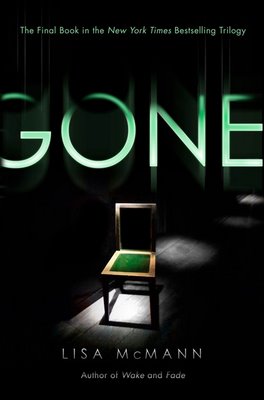
goneMy thoughts on this book followed the same pattern as the last two in the series. It was a fun series to read but nothing earth-shattering or particularly memorable. Each book made for a fun afternoon of reading. I think I probably liked this book more than the others because it got a little more personal, though at the same time it felt disconnected from the rest of the series. It also had a couple things in the writing that grated on my nerves, but that’s been the same since the beginning. Anyway, it was fun. Nothing more to say than that, really.

Book 1: Wake
Book 2: Fade

Posted in 2010, Prose, Young Adult | Tagged | Leave a comment

Protected: Let It Snow, by John Green, Maureen Johnson, and Lauren Myracle

This content is password-protected. To view it, please enter the password below.

Posted in 2010, Prose, Young Adult | Tagged | Enter your password to view comments.

Protected: Claudine at School, by Colette

This content is password-protected. To view it, please enter the password below.

Posted in 2010, Adult, Prose | Tagged , , | Enter your password to view comments.

The Alchemist (graphic novel), by Paulo Coelho

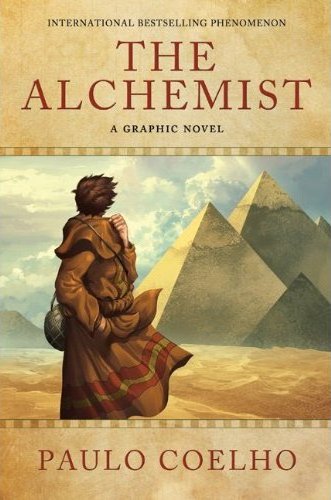
the alchemist gnI read The Alchemist back in March of 2009. Despite the fact that the book bordered the edge of something I wouldn’t normally like, I enjoyed the book. It was true enough to itself to not step over the line of too cheesy for me. Actually, now that I’ve read The Prophet by Kahlil Gibran, I can see the connection to The Alchemist and the very similar tone of the two books, which enhances my experience of both. So anyway, the point is that I liked the book enough that when I was offered a graphic novel version of The Alchemist as part of a TLC Tour, I accepted. I thought this would be a great way to revisit the story.

I didn’t remember much about the original after the last year and a half. In fact, I’d even forgotten the story that I paraphrased in my original review, so that when I read it in the GN, I was completely confused and wondered if it had been in the book. Only going back to look at my review afterwards showed me that it was indeed there. Apparently my memory didn’t serve me too well here! I remembered the second half of the book far more, especially the end. That made reading the GN like experiencing half the book for the first time.

As with most adaptations of text books, there was a lot left out, but I think the GN managed to capture the essence of the story, as well as the tone. What I found was interesting was that in the GN, the characters felt more like people, whereas in the original, they felt more like archetypes in a parable. Both worked, but in different ways. I felt like I got different things out of each medium, rather than just rereading book. That was good. I enjoyed seeing things in a different way, and I loved leading up to the end when I already knew what was going to happen. It made the events beforehand take on a different meaning.

There were only a few real downsides to the GN which would cause me to recommend it only as a companion and not as a standalone. I found the first half a little confusing in places, and I imagine if I didn’t remember the second half, I would have been confused the whole way through. The parts with the wind-women felt out of place and a little silly. I think those were my only quibbles. I’m glad I read the novel first. The novel made me want to read this version, and I don’t think I would be able to say the same in reverse. That’s primarily why I recommend this only as a companion.

The art style was not my favorite. It was a more typical GN style that I tend to associate with superhero comics. I was hoping for a style that reflected the tone of the book better, but it also didn’t bother me. I was fairly neutral about the art. I was just hoping that I’d be able to linger over it in the same way I lingered over the prose of the book. I did think it was very interesting that the artist decided to draw the author into the GN. That was a really nice touch, especially with Coelho’s note about it in the beginning of the book.

Posted in 2010, Adult, Visual | Tagged , | Leave a comment

Sweet Dates in Basra, by Jessica Jiji

basraThere’s a lot going on in this book, so it’s going to be a bit difficult to try to sum up in a paragraph. Sweet Dates in Basra takes place in 1940s Iraq in a time of political and religious conflict. The rest of the world was embroiled in conflict – World War II, the Nazi campaign against Jews, the rise of Communism – and all of that took its toll on Iraq. The story centers around three people. First, there are Shafiq and Omar, Jewish and Muslim (respectively) neighbors who have grown up like brothers and who would stand by each other no matter what. Then there is Kathmiya, a poor girl from the marshy regions of Iraq that is sent to Basra to work as a maid when she is a young teenager.

These stories weave in and out of each other. Sometimes Basra is peaceful, and sometimes full of riots. Sometimes outside influences (primarily the British) come in and try to stir up hatred between the religions. In particular, the prejudice and discrimination against the Jews grow, so that they have a hard time getting into college or starting up businesses. Shafiq’s family and friends all form different opinions on what the Jews should do. Some are pro-Zionism, some pro-Communism, and some think everyone in the country ought to be considered Iraqi first and foremost. All of this creates a turbulent atmosphere to grow up in.

Set on this atmosphere is a romance. The first time Shafiq and Kathmiya see each other, they are mutually intrigued by each other, which eventually grows into a friendship and more. Of course, any sort of relationship between them would be impossible. Kathmiya comes from a part of the country where honor is everything and honor killings are both common and praised. If she’s caught even talking to a boy, she could be killed, and him as well. In her culture, girls are married off before they are fifteen years old, and if you reach the ripe old age of eighteen, you’re pretty much destined to be an old spinster, or at best the third or fourth wife of an old man.

Kathmiya wants more than anything to marry like her older sister, but her father seems to hate her and forces her to go to work in the city. She does everything she can for her family, only to be rejected again and again by them all. Her story was the most interesting to me by far. First there was the rich and evocative setting that she lived in – I had no idea there were marshes in Iraq! Then there was the old fashioned, impoverished background that she came from – the strict religious morality, the honor code, the horrific plight of the women. Lastly there is her convoluted relationship with an unsympathetic mother who seems bent on thwarting her every chance at happiness. Kathmiya’s past is steeped in secrecy, though it’s a secrecy that’s pretty predictable, and her life becomes a self-fulfilling prophecy of sorts. It was both fascinating and horrifying to watch it unfurl.

I loved that this book didn’t end neatly. Situations like this are never neat in real life. They are messy, and scary, and filled with both hope and unhappiness. Jiji did an excellent job putting this all together, weaving all the storylines together without ever making them feel like separate plots or narrations. She did a great job making me feel this country and historical setting.

I only really had two qualms with the book. One is very esoteric: there seemed to be this idea that Kathmiya was “too beautiful” to be from a poor background in the swamps. I don’t like the idea that beauty is born of money, opportunity, or location. I understand that severe poverty can be detrimental to a person’s physical appearance, especially if they have no access to proper medical care, sanitary living conditions, and decent nutrition, combined with constant labor and exposure to the elements. However, the idea that beauty cannot ever emerge from this setting or that it somehow “belongs” to the richer or “more civilized and/or sophisticated” elements of society is something I can’t deal with. It’s a very class-centric idea. It’s also an old-fashioned idea that would not have been out of place in the time period the book is set in, but there were times when it felt like the narrator/author was expressing this opinion, rather than the characters, and that’s what bothered me.

My other qualm is a spoiler: I have difficulty believing that two people who have spent years restraining themselves around each other would finally break those restraints – as well as those of their religion, culture, and upbringing – and end up sleeping with each other right away. I can see breaking and holding hands, or even kissing, but to go from no contact at all to having sex seems a little extreme given the circumstances. End spoiler.

However, despite those minor quibbles, this was a really good book. It was interesting to read within the framework of Arab Jews when most of what I’ve read before has been about the new non-Arab Jewish population that immigrated to the Middle East (particularly in Palestine). I also loved the way Kahlil Gibran’s The Prophet became a thematic element all throughout the text, and I’m glad I just read it recently! I highly recommend this book.

Posted in 2010, Adult, Prose | Tagged , , , , | Leave a comment

Black No More, by George Schuyler

blacknomoreIn a dystopian 1930s America, a scientist invents a procedure to change black people into white people in appearance, thinking that he will be solving America’s racial problems. As blacks flock to his hospitals to undergo the three day treatment, however, the racial tension in America grows worse.

I wasn’t sure what to expect from this Harlem Renaissance-era novel when I checked it out from my library. The premise seemed really disturbing to me, as well as profound. Much of the story follows the life of Max, who goes through the treatment to become white and later changes his name to Matthew. At first, it seemed as if this was going to be a social commentary on the loss of black culture. Max was despondent about not being trusted among people who were once friends, and he missed the passion and soul of black culture. White culture was boring to him. Even though he now felt free in a way he hadn’t before, he missed parts of his old life. He wanted some things back.

But then the book changed, and became more of a satire. Still social commentary, of course, but masked in the comic. Max’s character went no deeper than the above paragraph, though the caricature that his character later became was somewhat horrifying. In fact, just about all the caricatures – because they were all caricatures, not really characters – in this book were horrifying. There were black-turned-white people who declared the supremacy of white ancestry. Preachers that used the bible to justify racial segregation and even worse acts. Henchmen not above burning down buildings to protect their real identities. Black leaders who were really just scamming their patrons for money. And so on.

Just like in Catch-22, one of my favorite satires, by the end of the book the comedic strain flattens into something deadly and disturbing. Some of the events near the end are very chilling, while others are steeped in the perfect amount of irony. It was very poignant.

I can’t say that I liked this book as much as I’ve liked other books I’ve read from that time period and on the same subjects. Some of the satire felt a little forced to me, and I would have liked some character development. That’s one of the reasons I like Catch-22 so much – even in all the farce, there are certain characters whose lives and emotions are really explored, so that you feel connected to them. The satire exists around them, so that you feel just as lost and dizzy by it as the character. Since Max/Matthew ended up being part of the satire, I never really had a chance to connect to him or anyone else. It felt like the book lacked a main character, so that there was no touchstone. That central element was missing.

It was definitely an interesting book to read, though. I have a feeling that it would work better for people more familiar with the historical and political context than I am. There was a lot of politics and history in the book, and neither are subjects I’ve ever been too good with. But despite my ignorance in this area, the book really did bring up a lot of stuff that really struck home even about today’s society, and is well worth the read.

Posted in 2010, Adult, Prose | Tagged , , , | Leave a comment