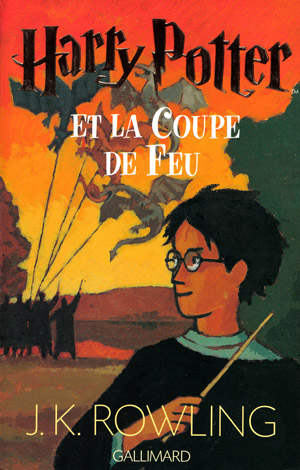
Harry Potter et la Chambre des Secrets, by JK Rowling

HarryPotterEtLaChambreDesSecretsThe adventures continue for Harry and the gang, en français.

Sigh. This was actually a pretty discouraging read, for two reasons. The first has to do with myself, the second with the translation.

Reading this book, I realized something about my language skills. While I can understand the French that I’m reading, I know there is no way I could write or speak in French at all. There is so much complexity in the grammatical structure. Because I already know what the books say (all those multiple reads of Harry Potter lead to a basic memorization), and I know the French vocabulary, I can read a sentence and restructure it in my head to an order that makes sense to me. Unfortunately, I can’t deconstruct English and put it into French. I’m to an unfortunate age when language no longer comes natural to me. I don’t know if I’ll ever progress any further into my French. I imagine I can get back to a passable level with work, but I don’t know if I can improve anymore. Which is sort of depressing.

As for the translation…it was awful. And I mean AWFUL. It was riddled with errors, from basic copyediting stuff (missing periods, etc) to story errors. For example, when the teachers have to lead the kids around the school, it’s Snape who leads the kids from Herbology to DADA. Um…what? In the real book, it’s Sprout who leads them, which makes sense. It does not make sense to have Snape randomly come into a scene when he’s not part of either class. Other places were like that too, characters who weren’t in the scene would suddenly say something and disappear again. Funny thing is, whoever owned this book before me was obviously annoyed with translation issues too and took to crossing things out and correcting them when it was a glaring error (“Ron said” instead of “Fred said” etc).

There was also huge sections of missing stuff. A full half of Lockhart’s lines were gone. The first hint about Ginny and her diary? Gone completely. Missing stuff all over the place. It wasn’t like the first book, where there were a couple errors and a couple missing sentences. This had whole sections, paragraphs, hints, and concepts deleted. It felt lazy and rushed. Again, I don’t know if it’s because I was reading a mass market paperback rather than a trade, but for whatever reason, I was really disappointed. I’m really hoping the next book will be better. Especially since it’s one of my two favorites in the series!

One really awesome thing about the book: I love what they did for Tom Riddle’s name. He’s named Tom Elvis Jedusor (“jeu du sort”), which rearranges to spell out “Je suis Voldemort.” I love that they found a way not only to translate “Riddle” well but to still anagram the name into close to the same phrase as the original (only leaving out “Lord”). That made me very happy. It also makes me giggle that his Muggle-hating grandfather’s name was Elvis. I can’t think of the name Elvis without thinking of the Elvis, so it just makes me laugh. 😀

Oh! and I wanted to ask my French-speaking readers (I know I don’t have many…), what is the word for “girlfriend” in French? We learned in school that it was petite-amie, and petit-ami for boyfriend, but when I stayed in Bourges for six weeks in 1999, no one had any idea what I was talking about when I used the word. The woman I was staying with had a boyfriend who spent nights with her and she called him her copain. I met a guy from Italy who spoke French and he called his girlfriend his copine. We were taught in school that copain and copine just meant “good friend.” I figured the lessons were just wrong and I started using copain and copine for boyfriend and girlfriend. However, in this book, Percy’s girlfriend is referred to as his petite-amie. What am I missing here??

Posted in 2011, Children's, Prose | Tagged , , | Leave a comment

Orlando, by Virginia Woolf (audio)

orlandoI don’t even begin to know how to describe Orlando. On the surface, I suppose I could say this is about a person, Orlando, who lives for hundreds of years, from the 1500s to the early 1900s. Orlando begins life’s journey male, and halfway through the book, spontaneously becomes female after a long sleep. He – and she – is fixated on poetry, love, and the meaning of life, and is not the only person on this journey who lives through centuries.

Odd enough for you? Orlando is a very strange book, like many of Woolf’s books. This is the ninth work by Woolf that I’ve read. From my experience, her books seem to fall into two categories: relatively easy, straightforward prose (The Voyage Out, Flush) and more difficult, almost stream-of-consciousness prose (Mrs. Dalloway, Jacob’s Room). Orlando definitely fell into this latter category.

I thought, perhaps, it would be good to try to listen to one of Woolf’s books. I have a tendency to read them and miss 95% of what she says when she uses her more difficult style. She’s so much smarter than I’ll ever be, and often I have to read her books twice or even three times before I feel like I understand even a quarter of them. It’s been a really long time since I read one of her more difficult works and I knew Orlando would be one of them, so I thought perhaps I could try an audio version in order to force myself to slow down and (hopefully) understand better. It worked for Nabokov’s Lolita, so hey, why not Woolf too? Wrong. Wrong wrong wrong. Audio was the wrong choice. I didn’t understand this book any more than I usually understand Woolf’s more difficult novels, and I didn’t have the advantage of going back to reread passages when I got completely lost.

My impressions, walking away from Orlando, are mild and only barely scratch the surface of what’s in here. It doesn’t help that I know absolutely nothing about history and so the people and events Woolf kept mentioning made no impression on me. I’m the sort of person who doesn’t know the difference between Alexander Pope and Alexander the Great. Seriously. No lie. Jason laughed at me for that one. So when a book relies heavily on me needing to know my world and European history, I’m already in trouble. Add Woolf’s poetic tongue to the mix and I’m really in trouble.

I understood that there was a certain amount of satire on the biographical process, particularly in the way we remember people by a few key profound statements they made in their lives. I understand she was making fun of those people who always sigh and complain about modern literature while extolling the wonders of the past (“Gloire! Gloire!”). I know she made a lot of statements on gender issues, both on the differences between the roles of men and women and on their changes over time. There was also something about identity and selves and whether or not it’s possible to really know one’s true self. Beyond that, I’ve got nothing.

Virginia Woolf is one of those authors who continues to baffle me. I adore her completely! This isn’t meant to say that I disliked the book or anything! But reading one of her more difficult books is like wading into a pond of mud and trying to find my way through. I know there’s something special in all those words, but I’m not smart enough to find it! So I keep trying, keep rereading, keep testing the water, until I can more solidly grasp some of the little things and hopefully one day understand just a tiny bit better what she’s trying to tell me.

Performance: While I personally think I would never try audio for reading Woolf again, I have nothing bad to say about the performance. Orlando was read by Clare Higgins, who did an excellent job. I would definitely listen to something else she read. Just not Woolf. Must read the rest in print!!

Posted in 2011, Adult, Prose | Tagged , , , , | Leave a comment

Delirium, by Lauren Oliver

DeliriumLaurenOliver_The world has changed. Love has been identified as a disease, and everyone receives the cure for it around their eighteenth birthday. Lena is nearly eighteen and very excited that she will finally be safe, until she meets Alex and falls victim to the disease.

I’m in two minds about this book. On the one hand, I thought certain elements were very well done, and I think Lauren Oliver is a brilliant writer. On the other hand, there were parts of this book that just did not win me over. Let me start with those.

I had a very hard time with believability factor. That this is a dystopian world where love is considered a disease, no problem. I can believe that. It felt a little iffy that familial love and romantic love would be considered under the same umbrella, but okay. I’ve read lots of dystopias and I’m used to stretched realities. I can deal with that. However, there were other elements to the governmental and cultural structure that made absolutely no sense. In a world where government can simply eradicate whole classes of literature, music, art, and history, it makes no sense that they would, for instance, rewrite biblical history. You’d think they’d just do away with the Bible altogether. Many of the “wrong” things felt pointless, like it being wrong to like the color orange. Why should the government care? Those are just two of the many things that made me scratch my head a little bit.

Then the book was really, really predictable. I can’t say how without spoiling things, so let me just give an example of the type of predictable. Picture, for instance, an old horror film. In that film, you know that the girl is going to walk into a dark house and be unable to turn on the lights. You know she’s going to hear a noise and instead of running away, she’ll go to investigate. You know that once she finds the killer, she’ll run straight to a place where she can’t escape. Then if she’s a side character, she’ll get killed, or if she’s a main character, she’ll find some miraculous escape at the last second, either through the stupidity of the killer or because a boy shows up to save her. You know these things. Well, for 3/4ths of Delirium, I could tell you exactly what was going to happen next, every page.

On the flip side, and this is where I start talking about good things, despite it being predictable, I couldn’t put the book down. Lauren Oliver wrote it so well that even when I knew what was coming next, the book was suspenseful and I was tense reading it. I had to know what was going to happen, even if I already knew what was going to happen. That almost never happens to me, so I give a lot of credit to Oliver’s writing on that point. If it had not been written well, I would have been bored by the predictability and would have started skimming.

I also liked the characters. I liked Lena, her best friend Hana, and Alex. I liked Gracie and I even liked the rest of Lena’s braindead family. Even if I couldn’t believe a lot of what was happening in the book, I could believe the relationships and character development. Reading about interesting people helped me to overcome that whole unbelievability factor. By the last quarter – which I admit threw some curveballs that I wasn’t expecting – I was really into the book. I can’t say this was the best book ever, or that it lives up to other dystopias I’ve read. It actually felt a bit like a cross between Matched and Uglies, only not as good as either. Despite that, though, I might actually pick up the sequel when it comes out. Delirium’s characters won me over by the end, and while I may not believe everything about the world-building, I still want to know what happens next to Lena et al!

Posted in 2011, Prose, Young Adult | Tagged | Leave a comment

Mary, by Vladimir Nabokov

mary-nabokovGanin is a Russian ex-pat living in Germany in a boarding house with a bunch of other Russian ex-pats and exiles. One of his neighbors is particularly chatty and intrusive, which bothers Ganin until the man shows him a picture of his wife, Mary, who will arrive in Germany soon. Ganin then spends the next week flashing back to an earlier part of his life, when he and Mary knew and loved each other.

Mary is Nabokov’s first novel, written when he was in mid-20s, and that definitely shows both in style and theme of the book. This makes the twelfth of nineteen novels I’ve read of Nabokov’s, and falls somewhere in the middle for enjoyment. The prose does not yet show Nabokov’s mastery, though perhaps that’s because he only assisted with the translation of this one, and kept it as straight to the original as possible as noted in his introduction, rather than playing with the text to give it the same feel. It also shows a lot of the hallmarks of first novels. The techniques, as well as the focus of the story and the ending, feel very young.

Most of the book is told in flashbacks: how Ganin and Mary met, how they became involved, and eventually, how they parted. The present narrative, after Ganin breaks out of the bored routine of daily life with the advent of Mary’s impending arrival, turns into an obsession that flows through the pages almost like the rhythm of a heart, beating and beating with all thoughts flowing towards one point: She is coming. She is coming. She is coming. My favorite passage from the book comes right after Ganin sees Mary’s picture, when life becomes real to him again:

Occasionally…something would happen which no one walking in a city ever notices: a star, faster than thought and with less sound than a tear, would fall. Gaudier, gayer than the stars were the letters of fire which poured out one after another above a black roof, paraded in single file and vanished all at once in the darkness.

“Can–it–be–possible,” said the letters in a discreet neon whisper, then the night would sweep them away at a single velvet stroke. Again, they would start to creep across the sky: “Can–it–”

And darkness descended again.

Oh the beauty of that scene! The magnificence of Nabokov’s symbolism, juxtaposing this re-found, miraculous love with a trashy motel sign, both alight with possibility, though perhaps of two different kinds. This book was worth reading just for that one moment at the beginning of chapter three. To me, that was the pinnacle of the book, and my favorite moment. It was the moment the story came to life.

The rest was less fulfilling, I admit. Too many flashbacks, and a twist-end that, again, felt very young. I prefer Nabokov’s slower novels, rather than the rushed pace of Mary. I prefer his drawn-out works to his shorter novellas. As a beginning, Mary is a great novel, a wonderful debut, but since Nabokov was mastery itself, the book does not quite live up to his later works. Still, it is definitely worth reading, and an interesting way to get to know Nabokov’s written progress a little better.

Posted in 2011, Adult, Prose | Tagged , | Leave a comment

The Woman Who Fell from the Sky, by Jennifer Steil

womanwhofellIn the mid-2000s, Jennifer Steil agreed to teach a three-week course on proper journalism in Yemen. At the end of her time there, she was offered a year-long contract managing the newspaper, and after a few weeks of reflection back in the states, she decided to accept. She returned to Yemen and began a fairly painful journey trying to improve the newspaper she was put in charge of.

Okay I know that description doesn’t sound like much unless you’re particularly interested in journalism or a behind-the-scenes look at how newspapers work. However, that’s not all this book is about. At its heart, this book is really about Yemen and the Yemeni people, and that’s why I wanted to read it. I’m not personally interested in journalism or newspapers, but I am interested in Yemen.

I didn’t even know where Yemen existed on a map before my sister spent a year teaching English there in 2005-2006, but ever since she went, the country has fascinated me. I loved her stories and have read a lot about Yemen since then, including one of my Enchantment books that I reviewed awhile back. I loved hearing all about the people and the culture, which is why I wanted to read this book. I was delighted that Steil included a lot of culture and people and traditions all through the book rather than focusing solely on journalism. It was actually pretty funny to read because a lot of the issues and problems Steil encounters with her staff at the newspaper are the same ones that my sister encountered with her students.

That really brings home what I liked so much about this book: it was a real and true look at the Yemeni people and at Yemeni culture. It did not, like in some memoirs I’ve read from the Middle East (The Bookseller of Kabul), treat Middle Eastern culture or Islam as inferior, stupid, backward, or alien. Steil took the time before going to Yemen to study the culture, and she embraced it as much as she could. She also respected the religious practices of the people in Yemen. She doesn’t condone everything that happens in Yemen, but she also doesn’t blanket-crucify everything that does (as Seierstad did). Steil takes the time to know the difference between injustice and simple cultural/religious differences. That is apparent from the very beginning of the book, and what made this book absolutely wonderful to me.

Steil is also a fantastic writer. Many memoirs are scattered and sort of random, but this one is cohesive and well put together. Steil demonstrates her training as a journalist and writer in this book so that not only is it respectful and accurate, but interesting to read. It normally takes me weeks to get through nonfiction but this only took a few days. I absolutely adored it!

Posted in 2011, Adult, Prose | Tagged , , , | Leave a comment

North and South, by Elizabeth Gaskell

north southWhen Margaret Hale’s father decides to leave the Church of England (he’s a preacher), the family is uprooted and moved to the industrial north, where Margaret gets involved in industrial-era politics. This book is both a romance and a political work about industrialism and class differences.

I’m really sorry to all those people out there who wanted me to read this one, but I really, really didn’t like it. I’d forgotten the things I didn’t like about my attempts to read Gaskell before, and went into this one thinking it would be different. It wasn’t. The experience was painful enough that after about a quarter of the way through, I started skimming, and after the halfway mark, I read the full synopsis on Wikipedia before super-skimming the rest. I can hardly say I’ve “read” this book, but I really wanted to make it through to the end. I wanted to finish something by Gaskell.

My issues were two-fold. First, there was the writing, which felt very clunky to me. It was all telling and no showing, and then it swung on a pendulum back and forth between gossip and politics. Every change in swing felt jarring, as if this were two different books sewn together. The second has to do with one of my pet peeves from nineteenth century literature, and something I noted when I first attempted to read Gaskell, in a Librivox audio recording of Ruth. Many writers, Gaskell included, treated women as if they were glass and would suffer from the slightest bit of damage. It didn’t take much to bring on faintness or deathly illness. All women had to do was cry, walk outside in the dew, get a very mild injury, have an emotional shock, breathe bad air, or have any part of their body touched by rain. Any one of those things, and others, is enough to nearly kill a woman in the nineteenth century, if you are to believe many writers. Of course, you have writers like Charlotte Bronte, who makes her heroine laugh at these notions and spend tons of time walking in both dew and rain without getting sick. Maybe that’s why I love Jane Eyre so much – the only time she gets deathly ill is after being exposed to the elements with no food for days on end, which I think would make anyone sick!

North and South definitely suffered from the melodramatic-woman syndrome. Margaret nearly dies because a pebble grazes her temple, and once they worry she’s going to be on her deathbed because she cries for a couple hours. I just have a hard time with that kind of silliness and melodrama, which (as I said above) I also discussed in my abandoned review of Ruth. At the time I thought perhaps it was the obnoxious Librivox narrator, who read the book as if reading to a kindergarten class, that made the book seem silly, rather than the events themselves, but that was far too hopeful and naive on my part.

As for the romance, I was hoping it would be the one element to redeem the book for me, but I quickly found out I didn’t enjoy it either. I disliked the chosen man (I highly preferred the man from the beginning), and at the same time, I felt like the romance was a major Pride & Prejudice rip-off anyway.

That’s it. That’s all I got out of this book. I really wanted to like it and really wish I had. It makes me very sad to react the way I did. I’m determined to give Gaskell one more chance, though, with Cranford. I’ve heard it’s very different from this one, which would be a good thing for me, and I’m also going to try listening to a professional audio recording of it, hoping that will help. It will be my third attempt at Gaskell, if you don’t count the one short story I read, and if it doesn’t work for me, then I’m just going to have to give up on her. I will give her a fair chance, but I can’t feel bad if three books in a row don’t work for me.

Posted in 2011, Adult, Prose | Tagged , | 1 Comment

Radio Shangri-La, by Lisa Napoli

Radio Shangri-La Final imageLisa Napoli traveled to Bhutan, a small country sandwiched between India and China, after hearing it was “the happiest kingdom on earth.” She was given the opportunity to go without the daily $200 tourist tariff as long as she helped set up a radio station while she was there. While in Bhutan, she learned a lot about the culture and formed many relationships with people there. This is her memoir of that time.

When I accepted this book from TLC Tours, I didn’t know anything about the radio-station portion of this book. I’m not sure how I missed it when checking out what the book would be about, but I did. For some odd reason, I thought this was going to be straight memoir/travelogue with a focus and concentration on the culture and people in Bhutan. It wasn’t, and I admit I didn’t pay much attention to the parts about the radio. Those parts weren’t what drew me to the book. Instead, I sifted through them to get to the parts about Bhutan.

Napoli does a great job painting a picture of what an outsider sees of the culture there. She talks about the food, the house structures, the way the families interact, etc. It made me want to go read one of my Enchantment of the World books on Bhutan, but unfortunately, my library doesn’t carry that particular volume. Sad! No supplemental reading for me on this review. It was interesting to see how many similarities exist between this country and other small countries I’ve studied in the past, not even from the same part of the world, and it made me wonder about how culture changes as a country progresses technologically.

I was sort of sad to hear about the “advances” Bhutan was making, like for instance the introduction of fast food chains. That’s one part of modern society that I’m not sure is a great one to add. It was discouraging to see how the people were trying to become more Western, willing to leave behind a lot of their own culture for this “new and better” one. I’m always sad when I hear about things like that!

The part that interested me most in this book was the relationship Napoli forms with a girl named Ngawang. It starts more like a friendship and develops into something more mother-daughter, in both good and bad ways. I like that the book took Napoli back to the US and then back to Bhutan a couple times so we could see the contrast, especially when Ngawang comes to visit her in California.

This was a pretty good book, even though it wasn’t exactly what I was expecting. I’m interesting in learning more about Bhutan, which, like many people, I’d never even heard of before now.

Posted in 2011, Adult, Prose | Tagged , , | Leave a comment

Readathon: Chocolat, by Joanne Harris

chocolatVianne and her daughter Anouk move to a little town in France and open a chocolate shop, which offends the priest in town because she does this right at the start of the Lent season. The two lock into a battle of wills, and the whole town gets drawn into the fight.

I first tried to read this book in fall of 2009 and failed to get very far. However, I watched the movie a few months back and really enjoyed it, so I decided to give the book another chance. I’m so glad I did!! It was fantastic, even better than the movie except in one point. I loved the back and forth between Vianne and the priest. I loved the philosophy of the book: that common courtesy, kindness, honesty, and charity towards others is what makes a person good, rather than following strict religious dogma that often excludes and hurts others. While the specific dogma targeted in this book is Catholicism, I think the same thing can be applied to any organized religion (Christian or otherwise) that rules by intimidation, bullying, deceit, and humiliation. The book also brought up wonderful points on many other issues, including spousal abuse, euthanasia, discrimination against targeted groups, smother-mothering, and the need for movement/travel versus the need to settle in a permanent place. The only issue I took with the book is the end, which I won’t spoil, but it involves the choices Vianne makes regarding that whole travel vs settling issue and her relationships in general. I liked the movie ending better! But still, wonderful book, and a great way to end the Readathon!

Posted in 2011, Adult, Prose | Tagged , , , , , , | Leave a comment

Readathon: By the Time You Read This, I’ll be Dead, by Julie Anne Peters

by the timeDaelyn is tired of being bullied and hurt, and has decided to commit suicide. In twenty-three days, she will make another attempt, and this time, she won’t fail again. In the meantime, she starts to say goodbye to everything around her, and tries her best not to let anyone – not the boy who keeps trying to engage her after school, not the other outcast girl at school – penetrate her walled exterior.

As usual for Julie Anne Peters, this book was amazing. It was so hard to read about all the things Daelyn has suffered through in her short life. I remember being impressed with Thirteen Reasons Why, which also discussed suicide, and now comparing the two books, this one is immensely better. I could feel all the characters so strongly, and I ached for them. My only problem was that I worried this would become one of those “a romance will save her” sorts of books and I didn’t want it to be. I didn’t mind if a friendship or personal connection with someone saved Daelyn, but I didn’t want her to suddenly be “all better” because she met a nice boy and fell in love. At first it seemed like it was going to take this path, but it didn’t. Some elements to it were there, but it ended in a far more realistic and acceptable way.

The book also made me think a lot about choice and free will, particularly with regards to death. We don’t really have free will when it comes to death, not when we’re young, not when we’re old. Should we? I’m not sure. But it certainly got me thinking. Especially when I picked up Chocolat right afterwards (which brings up voluntary euthanasia). Lately I haven’t really been interested in YA and there’s very little of it that I still have on my to-read list, but I imagine I will continue to read Julie Anne Peters’ books. They are all just so wonderful!

Posted in 2011, Prose, Young Adult | Tagged , | Leave a comment

Readathon: No Exit, by Jean-Paul Sartre

noexitIn this play, three people who have died and gone to Hell are placed together in a single room with no way out. They don’t know why they’ve been placed there, or why they’ve been put together. They slowly come to realize that they are each others’ torturers, or perhaps each others’ salvation.

I knew absolutely nothing about Sartre before I began, and had no idea what this play was about either. It only took me a few pages to figure out the first of the three dead spirits was being led into his room in Hell. Oh this was such a fantastic play!! The ideas in here were amazing, and the whole back and forth play between the three characters – building hope, crashing it down, trying to figure out the logic of Hell – was masterful. This is another play I would love to see live! I hope I get a chance to some day.

Posted in 2011, Adult, Drama | Tagged , , , , , | Leave a comment