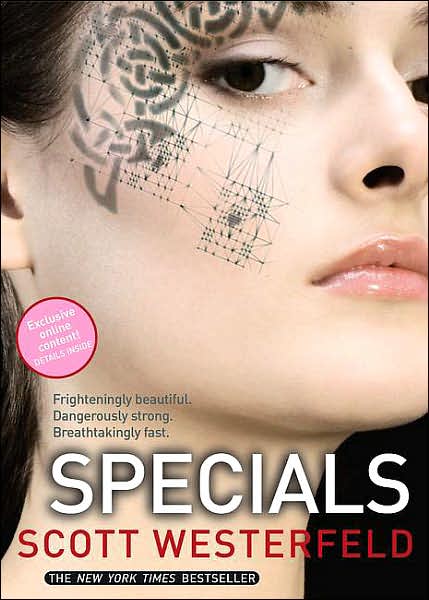
Specials, by Scott Westerfeld

specials1Humanity is a cancer, and we are the cure.
–Dr. Cable of Special Circumstances

I’ve thought for a long time how I can write this review without spoilers, and I’m sorry, I don’t think I can. So if you’re planning on reading this series, skip this review. It’ll be better if you do. I’ll do my best to keep spoilers to a minimum, but it’d be better if you skip altogether.

I hardly know what to say about this book. Tally has been turned into a member of Special Circumstances, in an elite group started by Shay, the Cutters. They are wired to live outside the city, have been made practically inhuman in their bodies, and cut themselves to keep their minds clear. They are alternately filled with anger and euphoria, and they think they’re superior to everyone. They have obviously had their brains screwed with as well as their bodies, the same way pretties do when they get their operation.

Tally loves being a Special and a Cutter (of course – she’s been wired to!). She loves the connection of their skintenna, which allows the Cutters to communicate with each other through their skin, so that a whisper will carry miles outwards to every member of the clique. She loves being unique, special, and connected to this group (funny – she makes fun of a pretty clique in Pretties that does the same thing). But there’s one thing that upsets her – her boyfriend from Pretties, Zane, has not been made into a Cutter like her. It’s unexpected, and when she finds out he’s returned to New Pretty Town, she goes to visit him. Even more unexpected is how she now sees Zane. Her re-mutilated brain makes her see him as average and pathetic, and with Zane, it’s worse than with other non-cutters. His brain damage from Pretties made him mildly crippled, with shaky movements and lapses in cognition. He’s trying to get better, but all Tally can see is his shakiness and damage. He nauseates her. She wants more than anything to help him escape the city – if he escapes, he’ll prove he’s tricky enough to become part of Special Circumstances, and once he’s made cruel and wolf-eyed and “perfect” like her, she’ll be able to look at him again.

A trek across North America follows, with an eventual lead to a new city free of pretty-brains, a bunch of new information, a cure for the specials that Tally rejects, and all out war between cities.

I hardly know what to make of these books. With most books, I read, absorb, and compartmentalize. With these, I know immediately that I love them, but can’t seem to organize my thoughts. There’s so much in them! In Specials, Westerfeld addresses the issues of self-mutilation, the need to fit in, environmentalism, war, violence, revenge, death, brain damage, etc. I could go on and on. There’s so much, it makes me dizzy. That’s not a bad thing – it actually feels quite amazing to have something I can’t fully tackle. Something that I’ll have to read multiple times to absorb fully. Something that broke through my recent numbness and made me feel something very strongly.

See, this book broke me apart – I hadn’t felt so strongly about a character in a long time. I loved Zane, and he didn’t make it. I didn’t expect him to die. I very rarely cry at books, but cried when he died. I not only cried, but when I finished the book, I went and reread both Pretties and Specials in order to spend more time with him, then cried the second time he died, too. Maybe that makes me pathetic, but I think the books have to be so well done in order to affect me like that. I will definitely own this series one day, and I will probably read it to pieces the same way I did Harry Potter.

Specials isn’t as good as the other two books, in my opinion, but it’s not far behind them. The biggest flaws in the book (I’ll get to them in a moment) are countered by the fact that the book affected me so strongly. I think eventually I will come to love it as much as the others.

Flaws. First and foremost, there is too much action in this book. There’s too much plot, and not enough characterization. There aren’t enough quiet moments. There’s a good balance in the first two books between action and quiet moments, and I appreciated that. The quiet moments weren’t slow, just quiet. I needed more of them here. I was relieved when Tally began to follow Zane and the other pretties across the continent – it provided a much needed break from constant stimulation. On the other hand, the book seemed to be written to match Tally’s state of being – as a Special, as a Cutter. Her world is a constant stream of stimulation, so it makes sense for the book to be. It’s not in first person, but the POV is limited and sticks solely with her.

Second, I can’t yet reconcile the ending. Not after two readings. I can’t make sense of Tally’s decision, or perhaps I can make too much sense of it. In the end, despite everything she’s done, and despite everything they’ve done to her, she rejects the cure. She decides she can and has rewired her own brain, and is no longer a special-head. She thinks she’s freed herself from all her anger, euphoria, and feelings of superiority. She believes she’s learned to control herself. And in some ways, I agree, she does seem to control herself better, she no longer cuts herself, and she’s not quite as angry. On the other hand, the feelings of superiority haven’t gone away. She thinks they have, because now she can look at other people without mocking them, but at the same time, the only reason she doesn’t want the cure is because she wants to be unique, special, above-average. Her worst fear is to be ground back into averageness.

In the end, people win. They escape from the “cure” that has been placed on them to stop the spread of a cancerous humanity. But at the same time, Tally loses. She’s still being manipulated, controlled, and pushed around by the things people have done to her. She won’t change, despite her vigilante decision to “protect the wild” at the end of the book. She’s not human anymore. I wanted so badly for someone to take her and force her eyes open! I wanted her to recover, to be free from this inhuman condition Shay and Special Circumstances forced her into in the first place. I wanted her to take responsibility for the fact that it was her Special condition that caused Zane to die and then to do something about it! I wanted her to reject being Special!! But, I suppose this is a dystopia, and the ending is mixed good and bad. There is no clear hope – humanity may be free, but it’s already starting to destroy the earth again – and there is no clear despair – Tally is partially human again. Such a confusing message. To me. Probably to others, the messages in these books are perfectly clear, but my brain can’t fully wrap around them yet. All I can say is, if anyone is reading this who hasn’t read this series (and you shouldn’t be!! Spoilers!!), this trilogy is extremely worth reading. These have been my favorite books in awhile. It’s rare that I actually buy books instead of getting them from the library, but these will definitely join me soon, and have a spot on my special shelf, too.

First book: Uglies
Second book: Pretties

Posted in 2009, Prose, Young Adult | Tagged , , , | 3 Comments

The Three Incestuous Sisters, by Audrey Niffenegger

2011_1_321_mSpoilers.

Honestly, I’m having a difficult time considering this a true book. It’s supposed to be a graphic novel, but it reminds me of an adult-level picture book, with huge pictures on one page, and small bits of text opposite. Normally I wouldn’t even review it (it took me all of 10 mins to read) but I chose it as part of my Graphic Novel Challenge, and thus need to write up this review. I’ll make it short.

There’s very little plot (at least that makes sense) in this book. Three sisters – Ophile, Clothilde, and Bettine – live together (though not incestuously. As far as I can tell, there’s no incest in this book at all, despite the title). Bettine falls in love with a man named Paris, Ophile is jealous and sends them away after Bettine gets pregnant, and Clothilde kind of sits off in her own little psychotic world that makes no sense at all. Ophile tries to get revenge on her sister, ends up getting her killed, Paris runs off all sad, and the baby is snatched up by circus people because he has wings (due to Clothilde giving him psychic instruction while he was in the womb). Ophile kills herself, the baby grows up, and the three remaining characters have a reunion. The ghosts join in, too.

Okay. Um. Well, I should say that I’m not in the least bit familiar with graphic novels. That’s why I’m taking the challenge. The only ones I’ve read are by Edward Gorey, and those aren’t normal. This was a lot like the Gorey books, minus the humor. I like Gorey’s humor – his creepy illustrations are balanced out by it. The sometimes-creepy illustrations in this book are not. Some of them are downright disturbing, though not at all in a realistic/graphic way. More like in a conceptual way. Like there’s a picture of a street exploding, including non-bleeding severed body parts of a baby. Yeah.

I got no pleasure out of this book. A couple of the illustrations were pretty, but not stunning, and I just kept thinking What? the whole time. I don’t get it. Niffenegger dedicated this to her sisters, and spent fourteen years putting it together, so it makes me wonder if some of these pages were inside jokes. Either way, I’m really hoping to have better luck with the other graphic novels I chose.

Posted in 2009, Adult, Visual | Tagged | Leave a comment

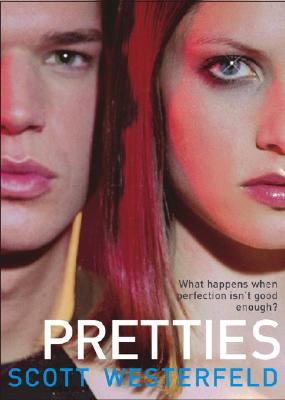
Pretties, by Scott Westerfeld

PrettiesPretties is the second in the Uglies trilogy. In this book, Tally has finally become pretty, and is struggling to fit into the pretty world. She has everything she wants, but can’t shake the feeling that something’s not right. That feeling is confirmed when a visitor from her past arrives and helps jar her memory awake. With the help of her new boyfriend, Zane, Tally attempts to cure herself and her friends of their pretty-brains without letting the authorities know what they’re up to. The authorities don’t want people to stop being pretty-brained, and they’ll stop at nothing to keep their world in order.

Once again, I’ll just say the book is fantastic. It is every bit as good as Uglies, and I’ve already moved on to the third book in the trilogy. In the first book, the order and harmony of the supposedly-Utopian society is contrasted with the wildness and unpredictability of a “normal” city in order to show how not-right the engineered society is. In this book, when Tally ends up back in the wild, this time among primitive human beings, she learns more about the violent and destructive tendencies of people, and begins to understand why her society was engineered in the first place. The correct path becomes less clear – is it worth keeping people vapid and empty-headed in order to prevent violence and destruction? The message is not so simple anymore. It certainly makes Tally – and the reader – think.

I don’t want to say too much and give away spoilers. The book is fast, brilliantly written, and convincing. Westerfeld immersed the reader in the world of the uglies and then into the primitive camp of the runaways in Uglies, and now does the same with the world of the pretties. In the next book, I’ll get to learn about the lives and culture of the specials. Each of these territories is unique and has different cultural rules, linguistic dialects, and so on, and each is equally well-done. The trilogy is well worth the read.

Revisited in 2010: Loved just as much, but did not write any further review. This book is my favorite of the series.

Posted in 2009, 2010, Prose, Young Adult | Tagged , , , , | 4 Comments

Ella Minnow Pea, by Mark Dunn

ella[For ease of reading this book review, every instance of the word “letter” will refer to notes people write to each other, and “character” will mean a letter of the alphabet. I won’t use the word “letter” to refer to the alphabet, nor will I use “character” to talk about the people in the book. It’ll be too confusing if I do.]

Eighteen-year-old Ella Minnow Pea lives off the South Carolina coast on the fictional island of Nollop. Nollop is so named after Nevin Nollop, creator of the immortal pangram: The quick brown fox jumps over the lazy dog. The island’s peaceful existence is interrupted, however, when one of the tiles (“Z”) falls from Nollop’s monument, and the High Council decides that this is Mr. Nollop’s way of speaking from the dead. They banish the character Z from all talking and writing. Other characters quickly follow as more tiles fall – Q, J, D… Islanders begin to leave, either voluntarily or due to expulsion for using the illegal characters. As the population thins down and the government becomes ever more totalitarian (intercepting mail, randomly searching houses, seizing property under flimsy pretenses), the Council agrees to stop interpreting the monument’s crumbling as a sign from the now-worshiped Mr. Nollop, but only under one condition – the islanders must come up with another pangram, using 32 characters or less. They have a deadline by which to do so, and as more tiles plunge (eventually leaving only LMNOP), the few remaining inhabitants (including Ella) scramble to accomplish a seemingly impossible task.

This was a really fascinating book. The whole thing is told in a series of letters back and forth between different people. As the alphabet thins, the letters become more creative. There are lots of lyrical twists to get around using illegal characters (they are not permitted to substitute legal phonetic alternatives until only 16 characters remain on the sign). I imagine it would have been near-impossible for this book to be written without a good word processor and searches for characters in each section! Dunn does an amazing job of writing the letters and still making them sound natural despite missing more and more characters all the time. Only after some vowels are dropped, as well as some major consonants, do the letters become almost ridiculous in their unnatural language. The writing is brilliant for its difficulty level alone!

Beyond the writing, Ella Minnow Pea touches on two very important themes: the loss of freedom by censorship, and the dangers of governing by religion. Nollop quickly becomes a totalitarian state as people lose their freedom of speech. All books are removed, which closes libraries and affects teaching. People of all ages are seized, humiliated, flogged, and exiled for slips of the tongue. Neighbors turn each other in for past grudges. Some people are killed or driven into hiding. Islanders end up in total despair, some losing their minds, some turning to alcoholic binges, some (quite creepy) flogging themselves for just thinking an illegal character. Dunn shows how quickly a simple act of censorship can eventually disintegrate an entire society.

And then there’s the Council’s interpretation of Nollop-Almighty’s will. These five men choose to see what they want to see in events which, in all reality, have natural, non-spiritual causes. Some are just power-hungry (they get the best abandoned properties to themselves!), while some truly believe Mr. Nollop is lording over them from the land of the dead. Either way, they become completely oblivious to the welfare of their people. Humanity ceases to exist with them. There’s a good passage in one of Ella’s letters:

The high priests generate their alpha-elisions, then return to their lairs to eat what tasties were put there, while praying to Nollop, paying homage to Nollop, stooping, prostrating, salaaming to Nollop. Ignoring all humanity in their Nollop-apotheosis.

Let us say Nollip were all-hallow preeminent Omnipotentate, why – still – shut out all those with whom one shares this planet? Were we put here on this earth only to worship? Exalting Nollop is to erase all that is non-Nollopian upon this isle. To utterly erase an upright, meritorious people. Genoerasure.

(This excerpt, btw, is from a letter restricted to seventeen characters of the alphabet.)

Dunn seems to be saying, in parallel, that worship and divine interpretation alone does not save us, rather attention to our fellow man. We need a sense of humanity and charity to truly be good people.

My copy of this book quotes the Christian Science Monitor as saying, “There’s a whiff of a classic about Ella Minnow Pea.” I have to say I agree. Sure, I’ve heard reviewers say the characterization is a little shallow, but frankly, it’s hard to get a glimpse of anyone’s personality through a series of letters. The people and letters seemed natural enough to me, especially given the increasing limitations as time went by. At times, I wished there was some exposition, so that I could see the things going on behind the scenes, but by the end, it no longer mattered. I began to fill in that information for myself, to read between the gaps. The minor irritations in form are completely made up for by content, and I recommend the book wholeheartedly.

Posted in 2009, Adult, Prose | Tagged , , , , | 3 Comments

The Lightning Thief, by Rick Riordan

lightning-thiefBetween ADHD, dyslexia, and a pretty defiant attitude, Percy Jackson has always had problems in school. In fact, he can’t make it more than a year in any single school. But in sixth grade, his problems get worse when mythological monsters start attacking him and no one seems to notice. Then, his mother insists that, for his own safety, he go to Camp Half-blood, where Percy finds out that he’s the son of a Greek god. He is charged with a quest – finding Zeus’s stolen master lightning bolt – and sets off on an adventure with two friends by his side.

I had a fun time reading this. It was like American Gods (only younger) and Harry Potter mixed together. Riordan does a really good job updating all the Greek gods to live in the modern world, but also keeping all the personality traits they had in the old myths. The plot was fast but not gimmicky, there was a fair amount of humor, and Riordan kept me guessing all the way to the end. Technically, I pegged the traitor near the beginning, but was later convinced that I’d been wrong, only to find out I’d been right after all. I hadn’t seen it coming. Nice.

The only thing that bothered me about this book was how long it took Percy to figure out which god was his father. It was obvious from the first chapter, and grew even more obvious as time went by, but it took him (and all the other campers and camp leaders observing him) a third of the book to put it together. I felt like screaming, “Duh!!”

Other than that, this was a really fun book, and a nice, light read coming off An American Tragedy. It closed up nicely, so that even though I know I’ll probably read the other books in this series, I don’t need to read them right away. Plus Riordan lives in San Antonio, which makes me wonder if I’ve seen him around and just not known who he is…hrm…

Posted in 2009, Children's, Prose | Tagged , | 4 Comments

An American Tragedy, by Theodore Dreiser

book-an_american_tragedy_theodore_dreiserI read this book the first time in 2001, and finished it within a few days. It made a strong impression on me, which makes rereading it for my book club now a little more difficult. It was not a book I needed to reread, for myself. That said, it certainly is an enjoyable book – just more enjoyable the first time, I think. It took me much longer to get through it this time. I apologize in advance for the very long review. I can’t offer anything less for a 900-page book full of stuff to talk about.

Spoilers.

Clyde Griffiths grows up in a poor, uber-religious household and longs to be part of the world. He is entranced by money, clothes, and women, but has no education or skills by which to improve his station. After he gets his first real job, he spends his money recklessly on material goods for himself and the women he courts, instead of saving or helping his family. An accident sends him running away from everyone he knows to take up in another city and begin again. Eventually, he connects with a rich uncle and begins to work for him in Lycurgus, NY. Loneliness pushes him to break company rules and date Roberta, a woman in his department, in secret. However, when Sondra Finchley, a high society girl, takes an interest in him and begins to invite him to functions with people far above his station, Clyde begins to neglect Roberta and tries to figure out a way to leave her. Unfortunately, Roberta discovers she’s pregnant, and when they fail to find a way to abort the baby, she insists that Clyde marry her, or she’ll expose him to his uncle and the society he’s running around with. He’ll lose his job and his place in the world just as he’s beginning to rise. Desperate, Clyde decides to emulate a drowning “accident” that he’s read about in the newspapers, and takes Roberta up to a secluded lake. The murder doesn’t go as planned, and though Roberta dies, Clyde is almost immediately captured, tried, convicted, and sentenced to death.

While there is tons to be learned from An American Tragedy, there were three things that really stood out to me in reading this book eight years ago, and those same still strike me as the most prominent themes/messages here.

The first centers around the consequences of growing up too sheltered. The book opens with a scene of Clyde’s family going out to a street corner to sing, preach, and hand out tracts. Clyde’s parents are evangelists. His father was a missionary prior to marriage, and then, as Dreiser so wonderfully puts it, his mother “had become inoculated with the virus of Evangelism” (that’s probably my favorite turn of phrase in the book) and joined the mission work. Missionary work does not pay well, however, and the family moves from city to city in search of better work. They never have enough to live on, their kids never get a proper education, and the Griffiths keep all worldly influences out of the home. Clyde knows nothing about proper social etiquette. He’s never owned anything nice, he doesn’t know how to save money, and he doesn’t know the pitfalls of worldly living. All he knows is that everything not devoted to God is a sin, and when everything is a sin, it’s hard to believe anything is really a sin. When Clyde first starts making a lot of money, his head gets completely turned. He can’t believe it’s a sin to own new clothes, or to dance, or to go out with his friends, no matter what his parents say. He rejects everything his parents taught him, because the world is so much more intriguing and fun than the life he grew up in.

I’ve known people who grew up in extremely strict and sheltered households, then in college went crazy with their new-found freedom. Some recover; some don’t. I’ve also heard people who grew up in sheltered, cult-like environments (religious compounds, that sort of thing) say that once they left, they figured they were going to hell anyway, so they might as well do it big. If everything’s a sin, equal in weight, what does it matter if you move from dancing to promiscuity? From caring about clothes to abortion? From swearing to murder? Without proper instruction on how to live in the world, rather than apart from it, Clyde finds it impossible to stick to a moral code. He scorns religion and morality, and thinks only of himself. This is not uncommon, and I believe Dreiser is making a statement on the advisability of sheltering children too much, so that they are unprepared for what they’ll meet when they leave home, and so that their heads will spin with the unexpected excess of life beyond their front door. At the end of the book, Dreiser goes back to the family singing on street corners, now in a new city, now with Mrs. Griffiths as the grandmother of a little boy. She thinks, she must be kind to him, more liberal with him, not restrain him too much, as maybe, maybe, she had— and the thought ends, but is obvious enough: “with Clyde.”

The second thing that struck me was the juxtaposition of religion and American values. Someone asked in a review I saw – What makes this book an American tragedy, rather than just a tragedy? The answer, to me, lies in what Dreiser lays out as the gods of America: money, possessions, and power. The “American Dream” itself becomes a god to worship. (Dreiser is quoted as saying “Fortune hunting became a disease.”) It is the cornerstone of our society, of capitalism. Work, scheme, climb that social ladder. If you succeed, you gain those top prizes – money, possessions, and power – and with these things, respect. Clyde rejects God and Christian religion in search of a new religion, a godless one, so to speak. And it’s not just him. Almost everyone in this book is the servant of one or another American god. Almost everyone rejects Christian teachings for the sake of worldly pleasures. Roberta, portrayed as the most moral of the characters, is willing to have sex with Clyde to keep him, and willing to have an abortion later to cover up her shame. She blackmails and threatens Clyde. Mason, the prosecutor in the case against Clyde, doesn’t really care if Clyde is convicted. All he cares about is winning the case so that he can gain a higher political position in an upcoming election. Sondra loves Clyde, but disappears once he’s accused of murder, in order to keep her place in society without scandal. Clyde willingly drops one girl he loves for another, solely due to the better station it’ll put him in. Clyde has multiple friends throughout the book that see he’s related to the rich Griffiths, and thus try to be his friend and ride his coattails to a better place in life. Everything is about money. Everything is about station. No one marries for love, but for money and position. The moral order has been dumped on its head.

Dreiser doesn’t, however, say that religion is any better, or that people are any better off if they continue to worship the Christian God as opposed to the American gods. Instead, he seems to say that there’s no such thing as a true moral order. Those characters who are the religious ones – the evangelist family, the priest who talks with Clyde on death row, the religious crowds that ask for Clyde’s head – are portrayed as lazy, weak-willed, vengeful, and/or indifferent. They are no better than those living without Christianity. In this light, morality becomes very relative.

Lastly, there’s the question of the murder itself, and whether or not Clyde is guilty. Extreme spoilers follow. Clyde plans to take Roberta on the lake, “accidentally” unbalance the boat, and leave Roberta to drown. Once on the lake, however, he finds he can’t do it. He’s a coward. The idea of murder is too much for him. He goes into a meditative, trance-like state, terrified and disgusted with himself and having no clue what to do next, since he still has no intention of marrying Roberta. She comes towards him, and he reaches out instinctively to push her away, not wanting her to touch him. He’s holding a camera, and it strikes her in the face. He immediately feels sorry, and gets up to try to help her, but his movement upsets the boat, and they go into the water. At this point, he’s done nothing wrong (legally at least, you can debate if his plotting is “wrong”). Part of him realizes at this point, though, that she is in the water and that if he just leaves her behind, she will drown, and he will be rid of her. The result is the same as if he’d pushed her into the water on purpose, like he’d originally planned.

So, he plots murder, then lets her die when there’s an accident, but he doesn’t push her into the water – is he, then, guilty of murder? Manslaughter, perhaps, sure, but murder? Is there a difference between what he actually did do, and what he’d planned to do? Is he less guilty, or is it the same as if he’d pushed her off the boat? Clyde doesn’t feel like he’s committed murder. He insists that he’s innocent all the way to the end of the book, though he confesses, eventually, that he’d planned to kill her, and that he let her die. But is letting someone die the same as killing them? Would it be different had he gone up there with a change of heart, as his lawyers contended in the trial, had an accident, and then let her drown? Where does the guilt lie? In the plotting, or the not-saving? It’s a really sticky question and the first time I read this book, I was very upset by the fact that everyone thought Clyde was guilty of murder. I didn’t agree that he was. Guilty, yes; murder, no. I still think that after my second time through. I feel sorry for the kid, and maybe that’s it. But really, it’s just that it doesn’t feel right that he’s convicted of something I don’t believe he did. I don’t believe abandoned intent makes guilt, even if the same result happens. Take an example – if two friends went up to the edge of a high building, and the first had plans to push the second over but chickened out, and then the second tripped and fell, is the first guilty of murder? He’d intended on murder, and the outcome was the same, but it was an accident that caused the fall. He can’t escape, though, the fact that the second friend would probably not have gone up there had the first not taken him. So it’s sticky, and I don’t think we’ll all agree in our evaluations. This’ll be a fun question to ask my book club in two weeks.

I think this is a very worthwhile read. There’s far more in it than I could ever cover here. Sorry again for the super-long book review.

Note: Review date is only an approximate of when this book was read/reviewed in 2009.

Note: Originally read in 2001.

Posted in 2009, Adult, Prose | Tagged , , | 3 Comments

The Red Pony, by John Steinbeck

The-Red-PonyOkay, today I had to take a break from rereading Dreiser’s 900-page An American Tragedy. Steinbeck’s short 100-page novella was a good afternoon diversion.

The Red Pony is a set of four stories about a young boy named Jody Tiflin and his family. He lives on a ranch in southern California with his parents and a farmhand named Billy. I read from various sources online that the stories were fairly autobiographical, but I have no proof of that. If they aren’t, Steinbeck at least calls on his experiences growing up in that area in writing these stories. As with every Steinbeck book that I’ve read, the details and characterizations are immaculate.

The stories center on the themes of death, life, aging, and family. The strongest and most prominent of these is probably death. In the first story, “The Gift,” Jody receives a pony from his father. The boy matures in the months that he owns this pony – going from a kid who neglects his chores and plays all day to a young adult disciplined in his work – but retains his youthful outlook of the world. He loves his horse and expects them to have a great life together. He believes Billy, the farmhand, is infallible and can cure any ailment. Jody is disillusioned on both accounts when he experiences the death of a loved one for the first time.

In “The Great Mountains,” death is seen in a different light: hopeful, triumphant, almost heroic. It takes on a third meaning in “The Promise,” where new life is coupled with death. And in the last story, “The Leader of the People,” death becomes symbolic – the death of a time period, of memories, of legend.

This novella, while well-written, doesn’t have the same depth as other Steinbeck books I’ve read. I didn’t relate to it as much as I did to The Grapes of Wrath, where the characters felt like they could have been from my own family history. But it was interesting to see a replica of the way a poor ranch family lived about a hundred years ago. I can’t imagine living like the mother of this family, constantly cooking or cleaning, tied to the house; nor can I imagine having children that disemboweled birds because they were bored, or collected reptiles in their lunch pails on the way home from school. The world I live in is so different, I have a hard time wrapping my head around the fact that people actually did live that way, and not so very long ago. This was the way some of my grandparents lived. That fact sort of brings home how much the world has changed. Honestly, I’m glad. I’m glad for my little luxuries, for not needing to raise and kill my own food, for doctors and vets. I don’t mind that I don’t possess the same knowledge my ancestors had (how to give a horse a tracheotomy, how to turn a breech colt fetus, how to cut open infected glands to drain the pus…). I far prefer living now, even if life has lost the simplicity that it might have once had (and honestly, I’m not sure things were all that “simple” then!). Books like The Red Pony help reinforce my thankfulness.

Posted in 2009, Adult, Prose | Tagged , | 1 Comment

Twilight, by Stephenie Meyer

twilight-book-coverIt’s hard to say what I think about this book. I read it over the past two days, when I’ve been sick, and when you’re in a medicine daze and have a low-grade fever, it’s not always the best time for reading. Overall, I can say I was pleasantly surprised that this was written far better than I expected. The mechanics – always an issue for me – were good. Her prose got me caught up in the plot, gently, the way I like. It was fun.

On the other hand, there were things that irritated or confused me. For example, there’s a big plot inconsistency surrounding Bella’s reaction to blood. There’s a scene where she gets faint because they do blood-typing in biology. A boy across the room bleeds a couple drops, and she has to go to the nurse. She claims it is the smell of blood that makes her sick. And yet, not long earlier, she was in the hospital after an accident and another kid involved is wheeled in right next to her bed. He’s covered in bloody rags and has a ton of slices in his forehead. She talks to him without a problem, and I’m sure she could smell his blood more than she could those drops across the room. Throughout the book, and even into the first chapter of New Moon that was at the back of this copy, there are multiple incidents where Bella comes in contact with blood without any of that fainting reaction. The inconsistency bugs me.

Another thing. Bella’s personality changes about a third of the way through the book. She starts out as the sort of person I might have hung out with in high school, but then suddenly becomes the sort of giggly moony-eyed girl I would have avoided like the plague. The change was jarring. Once I got used to the new personality, and forgot about the old one, I was okay, but the change bugged me. And her new personality just wasn’t that great. She was far too ordinary for me to believe Edward’s proclamations about her being unusual and fascinating. And frankly, when people threaten you with phrases like, “You need a healthy dose of fear,” and you stick around them, it really makes you seem like a weak, vapid sort of creature, and I’m afraid that’s exactly what Bella did. It’s unfortunate, because she didn’t start out as a weak, vapid airhead. That’s certainly how she ended. Thankfully, there were other characters I cared about, because by the end, I didn’t like Bella much at all.

I don’t know yet if I’ll continue reading this series. The problem with a series is that unless there’s an overarching plotline, started at the beginning of book 1 and ending at the end of the last book, each sequel will often feel like a copy of the first. Twilight is a fairly closed book. At the end, the romance is as concluded as it’s going to be (at least until book 4 I’m told), the bad guys are defeated, and everything goes back to normal. There’s a certain amount of how-will-Bella-and-Edward-work-out-their-unusual-relationship, but frankly I couldn’t deal with four books of these two characters making eyes at each other without further plot development. And I don’t want to read four books that vacillate between fitful romance and Bella-gets-saved-from-the-bad-guys. I suppose I also know enough spoilers from the other three books to not make me itch to read the next book. Plus, everyone says the books get worse over time, and that this one is the best. I liked this one – it was fun – but I’m not sure I liked it enough to keep going if they all just keep getting worse.

I don’t see the overarching theme. Harry Potter, for instance, has a plot started at the beginning and you know it won’t end until the final showdown between him and Voldemort. The first two books are nearly identical – Harry goes to Hogwarts, strange things happen, Harry meets-and-defeats bad guy – and if the books had continued in that vein with no variation, I wouldn’t have stuck through all 7 of them. Already, I think I like the second book less than I would have ordinarily because it felt too similar to the first. But the overall plot, laid out at the beginning of book 1, advances through each of the 7 books until the final showdown at the end of 7. I need this sort of forward progression in a series to feel satisfied, and I’m not yet sure if the Twilight books have that.

I do wish I’d read the book before knowing what the movie characters looked like. I hate having my imagination ruined by actors and actresses.

And please, oh please, let me never hear the word “smolder” again. It was clever the first time…only the first time.

Posted in 2009, Prose, Young Adult | Tagged | 3 Comments

Protected: The Notebook, by Nicholas Sparks

This content is password-protected. To view it, please enter the password below.

Posted in 2009, Adult, Prose | Tagged | Enter your password to view comments.

Uglies, by Scott Westerfeld

Uglies_bookThis is a spectacular book! I didn’t want to put it down. I’ve heard about this series for awhile now, but haven’t had a chance to pick up the first book until recently. I’m really happy that I did.

Uglies is a young adult dystopian novel. At one point, the world decided that the best way to end discrimination based on looks/age/race/etc was to make everyone pretty. Biologically pretty, with symmetrical features and cheekbones in the right place and wide eyes and fresh, unblemished skin. They perfected an operation which, when performed at age 16, will make everyone supermodel gorgeous. The Uglies – kids between ages 12 and 16 – long for their operation, after which they’ll stop being known by their Ugly nicknames (squint, fatty, zits, pignose…) and move to New Pretty Town, where their only job will be to have a good time.

Tally can’t wait to become a Pretty. Tally loves New Pretty Town, and all her friends have already gone on to be Pretty. In her last few months of waiting, though, Tally befriends a girl named Shay. Shay doesn’t want to be Pretty, and before her birthday, she runs away to a secret non-Pretty society called the Smoke. Tally promises not to tell, but is then confronted with an ultimatum: help the government find this secret society, or stay an Ugly for the rest of her life.

This book is beautifully written, and I can’t wait to read the others to see what happens next. It also is a very thoughtful book, and really ponders the definition of equality, the question of where beauty lies, and what humanity must do to save itself from its own folly. Highly recommended.

Posted in 2009, Prose, Young Adult | Tagged , , | 6 Comments