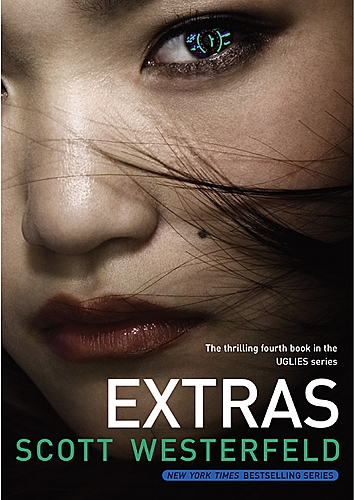
Extras, by Scott Westerfeld

extrasExtras is the fourth book in the Uglies trilogy. Yes, I did mean that. The dedication for Extras says, “To everyone who wrote me to reveal the secret definition of the word ‘trilogy.’” In other words, Westerfeld wrote this book at the request of fans, or so I read somewhere (can’t find the link at the moment, sorry). Either way, I’m happy he did, because while this book isn’t like the other three, it’s still a good read.

The book takes place several years after the collapse of the dystopia of the first three books. Humanity has become freethinking again. Without any structure or guidance, cities are going crazy, sort of like early teens seeking an identity for themselves. People have gone to extreme extremes, such as cliques that undergo surgery to turn their skin into leopard fur or fish scales, or kids who fashion their faces after old Japanese Manga characters. Extras takes place in a city of one million people in Japan. Resources are running low worldwide – turns out freethinkers are more demanding than bubbleheads – so this city implements a new form of currency: face ranking and merits. One receives merits by doing good things for the city. One ups their face rank by striving for popularity and fame. Both face rank and merits get you more stuff. Everyone has their own feed and cameras, so that their world is like a gigantic cross between Myspace, Blogger, and Youtube. Big feeds (think Cake Wrecks or The Daily Dish) far outshine the feeds of Extras – people with low face ranks – like my little corner of the blogosphere here.

Fifteen year old Aya Fuse is an Extra. Her face rank is nearly 500,000. Her older brother is famous, and she wants more than anything to find a story to post that will catapult her out of obscurity. She comes across a clique called the Sly Girls – girls who do crazy things like jump off bridges or surf on superfast trains but who also want to avoid fame at all costs. Aya tricks these girls into thinking she’s one of them, and plans to post their story all over the city, except that when she’s along for the ride, the girls accidentally discover a more important and more dangerous story. Aya may achieve her ambitions, but she’ll also have to pay the price for doing so.

There are two big themes in this book (that I’m going to talk about, at least). The first deals with fame and its consequences. Westerfeld mashes up an interesting hyperbole of current internet and Hollywood culture in order to create the layout for Aya’s city. There are paparazzi cameras that follow big faces around. Everyone knows everything about anybody. People compete for the most hits on their names, the most people watching their feeds. They compete for who can be the craziest, smartest, or most interesting. And those who aren’t famous covet what the famous have (except people like the Sly Girls, anyway). Aya’s so obsessed with fame that she’s blind. She knows her famous brother is a snob, and she makes fun of other famous people, but for some reason that doesn’t deter her. She’s willing to lie, cheat, or do whatever it takes to get her face rank up. When the paparazzi cams catch her talking to a big face when she’s covered in mud and slime, and her face rank goes up because everyone’s calling her Slime Queen, she’s outraged that secret pictures of her have been posted, and yet she doesn’t realize she’s doing the same thing to the Sly Girls. She feels lost without her camera or when she has to turn her feed off, like she no longer exists. She never changes. It was somewhat annoying, actually, but it gets the point across: emphasis on popularity in culture can be brainwashing and hypnotizing. The reader can see how easily this new city culture could devolve back into the dystopia of earlier, or into something worse.

Secondly, the book focuses a lot on honesty. Beyond the fact that everyone seems willing to lie to each other to get what they want, there’s one character who in particular emphasizes the value of truth. His name’s Frizz, and he’s the founder of a clique called Radical Honesty. He had brain surgery to disable his ability to lie, mislead, or deceive in any way. He can’t even keep secrets. This becomes quite a problem for the characters throughout the book, but it serves as an interesting foil to the blatant dishonesty shown by nearly every other character. I suppose the best way to show the harm of deception is to contrast it to pure truth.

Some other small notes about the book: Since this is set in Japan, there is a lot of Japanese cultural references. I don’t know much about Japanese culture myself, but I’ve known people who loved this one for all those references. Also, while this book is told from Aya’s POV, Tally Youngblood (the main character from the first three books) does come back into this one for the latter half. Seeing her from the outside confirms all the things I suspected about her in Specials. She still hasn’t completely rewired her brain, and she still thinks like a Cutter. It’s unfortunate, because I really liked Tally before, but in this book, she’s unstable, mean, selfish, and blind. But that wasn’t unexpected, because that’s exactly how she was in the last book, and she didn’t let them give her the cure. I’d hoped she’d gotten better, but it feels good in a way to have my suspicions about her confirmed.

There’s a lot more to this book than I can possibly say here. It was fun, and touched on a lot of things relevant to our current society, so I don’t feel like it’s too far off from being a warning. It’s not terribly related to the first three books of the trilogy (ha!), so I wouldn’t recommend reading it like it’s a sequel. It does, however, give a very insightful look at what might have happened within a few years of the dystopia’s downfall.

Book 1: Uglies
Book 2: Pretties
Book 3: Specials

Posted in 2009, Prose, Young Adult | Tagged , , | 2 Comments

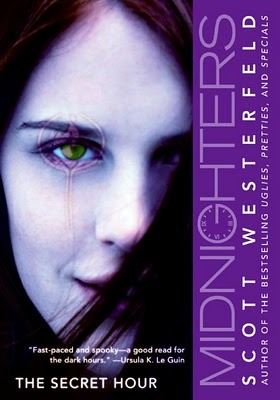
The Secret Hour, by Scott Westerfeld

secretIn the small town of Bixby, OK, everything freezes at midnight. For one hour, the only things that move are the creatures that belong to this secret hour, and the handful of teenagers that were born at the stroke of midnight, thus enabling them to exist within this time period. They call themselves Midnighters, and when a new Midnighter moves to town, oblivious of all this, the old Midnighters have to protect her from the creatures that seem to feel she’s intruded on their space.

I read this book way too fast. It is a real page-turner, and I let myself leap through it as fast as it would carry me, gobbling it within a few hours. As a consequence, I feel a little dazed thinking about it, and I’m going to have to read it again, I think, to take everything in. It was a really good book, though not as insightful or as masterful as the Uglies trilogy was. This was more action and plot than depth and character, whereas the Uglies trilogy had a good balance of those things. But I can’t complain. It was fun and satisfying, even if I do have to read it again. It also did a good job opening for the next book in the series, while still having closure on this book. Westerfeld is fast becoming one of my favorite authors, even if my reviews on his books tend to be really awful. Sorry about that.

Posted in 2009, Prose, Young Adult | Tagged | 2 Comments

Enchanted Night, by Steven Millhauser

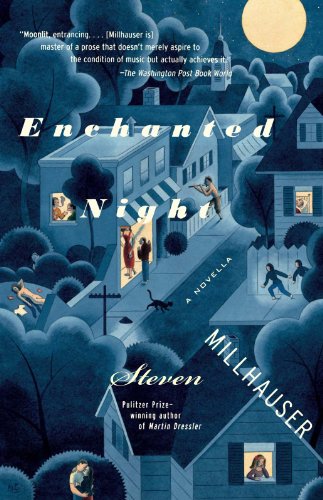
millhauserI’m a bit at a loss how to sum up this book. Basically, on a summer night under an almost-full moon, people of all ages (and dolls, and toys, and a mannequin) around a coastal town wake up and wander until dawn. Each has a different agenda and a different story to tell, and only in rare instances do they interact with each other. Music issues forth from a goat-legged piper in the woods, calling the characters from their beds. The whole thing is told in a series of somewhat interconnected vignettes, the largest three pages long, the shortest, seven words. It’s like Edward Gorey crossed with Salvador Dali, written in the style of House on Mango Street. Weird.

This is my second read by Steven Millhauser. I first read his short story collection The Barnum Museum two years ago, after the movie The Illusionist came out (it was based on one of Millhauser’s short stories). I really liked the collection, and in particular his story “A Game of Clue,” which has stuck with me strongly since I read it. I find myself recalling bits of it quite often. I chose Enchanted Night for my 2nds Challenge. I didn’t know, at the time, that it was a 100-page novella in vignettes. If I had, I would have chosen a different book. I’m not a big fan of the vignette form, at least not interconnected vignettes making up a full book. Indeed, despite the book’s short length, it took me two days to read. I didn’t think I liked it very much, but by the end, there was something about its peculiarity which endeared me to it. I can’t really say why I liked it, or what I liked in particular, but at the end, I was satisfied.

There are, I admit, many negatives to this book which should make me dislike it. I don’t really like the vignette style. There were far too many characters for such a short book. There is no climax, no action, no overarching plot, no real fiction form, actually, and no resolution (in fact, nothing to resolve, really). Or maybe that last part’s not too accurate, as perhaps many people had little things to resolve, and each got resolved, for better or for worse, in the end. But the story as a whole didn’t. I wonder, though, if that matters, because it wasn’t really a cohesive story, but something fragmented and clinging to each other by spiderlike threads. Almost experimental, with definite creepy and mildly sexual undertones. I don’t know. One way or another, though, I’m sure I don’t understand half of what Millhauser laid out, and I will probably remember each little moment distinctly. Perhaps over time I will grow to understand it more.

I don’t know if I recommend this to anyone, but it certainly was an interesting experience. I’ll bet it would be better to listen to than to read, with someone who would do all the voices…

Posted in 2009, Adult, Prose | Tagged , , | 2 Comments

Shadows on the Grass, by Isak Dinesen

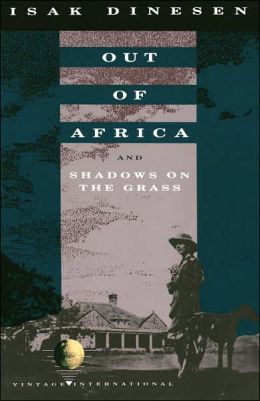
shadowsI read Out of Africa by Isak Dinesen (pen name for Baroness Karen Blixen) about a year ago. It was an interesting book, a memoir about Blixen’s experiences in Africa. She lived there nearly two decades, and had much interaction with the various African tribes around her. She also got to know the landscape and animal life in what is present-day Kenya. Shadows on the Grass is a continuation and an expansion of that memoir. It was written many years later (about 25, I believe), and includes information about the various people she’d left behind. I got to find out what happened to Farah and Kamante and many of the others after she left Africa. That was nice. Normally memoirs feel so unclosed, and this did a lot to help close it off.

Last summer I bought a copy of the Out of Africa at a library book sale, and it came coupled with Shadows on the Grass (makes a lot of sense to me now, considering how related the two were). I hadn’t realized, though, that of this 500-page book, Shadows only made up a fifth. It was very short in comparison. It took me weeks to read Out of Africa, but because of the length, and perhaps because I was already prepared for the dry style of Blixen’s writing, this didn’t take as long to read. It also wasn’t terribly interesting on its own. I wouldn’t recommend it if you hadn’t already read the first 4/5ths of the memoir. This really is an extension, not so much a standalone book. That isn’t to say it’s bad, I liked it, but I imagine it would be almost useless without Out of Africa. Half the stuff she talks about refers back to her original memoir.

Overall, I liked it, but can’t really say much more than I’ve already said about Out of Africa. I didn’t learn anything new about Africa. I pretty much just got caught up on what happened to everyone after Blixen left, plus heard a couple more stories from when she was there.

Posted in 2009, Adult, Prose | Tagged , , , | Leave a comment

13 Little Blue Envelopes, by Maureen Johnson

200px-13LittleBlueEnvelopescoverFrom Goodreads:

Inside little blue envelope 1 are $1,000 and instructions to buy a plane ticket.

In envelope 2 are directions to a specific London flat.

The note in envelope 3 tells Ginny: Find a starving artist.

Because of envelope 4, Ginny and a playwright/thief/ bloke–about–town called Keith go to Scotland together, with somewhat disastrous–though utterly romantic–results. But will she ever see him again?

Everything about Ginny will change this summer, and it’s all because of the 13 little blue envelopes.

There probably isn’t much in this book, depth-wise, but I really enjoyed it. It struck a chord with me. I loved seeing how Ginny changed and how much she learned about life and herself along the way. The things she did and saw during this trip were things she never would have done/saw without her aunt’s nudging, and while at times, she’s really frustrated with the whole situation, she does realize what a gift she’s received. This struck a chord with me specifically because in 1999, I took off for France on a six-week school summer program despite all obstacles (my boyfriend begging me not to go, the need to take out my first ever student loan, my fear that I wouldn’t know enough of the language, the fact that I have never been a risktaker of any sort…). I almost didn’t go to France that summer, but something told me I had to, I had to take that risk, and once I did, I ended up having so many adventures. Those six weeks abroad were probably the best time I’ve ever had in my life, and also contained some of the scariest moments. I could really understand all the fear and confusion Ginny experiences in this book, as well as the jubilation and fun.

As for negative points, I could only find one. At one point, Ginny and a couple friends she’s picked up along the way are headed towards a dock in Venice to take a boat to Greece. When the train arrives in Venice, they are in a big hurry, so they jump into a cab and speed through the roads to the dock. Wrong. Unless things have changed drastically since I was there in 1999, there are no cars in Venice. None. There are certainly no taxis, except for the water taxis (i.e. boats). Most of the “streets” are made of water. There is only one thoroughfare that I can remember that would even be big enough for a car to drive on, and it’s full of pedestrians. All the side streets that aren’t water aren’t much bigger than a sidewalk. I know Johnson has traveled around a lot, but I get the impression that she hadn’t been to Venice before writing this book. Or maybe she just didn’t expect people to know. Anyway, it’s a plothole, one that I didn’t appreciate in a book where every other city seems to be described in meticulous detail. I want to believe all those details are true, despite the single detail given about Venice being false. They felt real, anyway.

But really, that little negative isn’t such a big deal. Unfortunate, but it didn’t mar the book. If I hadn’t been to Venice, I wouldn’t have even noticed. I had a lot of fun with this. I liked Ginny, I liked a lot of the other characters, and I liked the things she came to realize about herself and her aunt by the end. It was an all around fun book, and I will probably read more by Johnson.

Posted in 2009, Prose, Young Adult | 2 Comments

Messenger, by Lois Lowry

messengerThis is the third book in the loosely-related trilogy including The Giver and Gathering Blue. It is more of a sequel to Gathering Blue, but ties The Giver in and answers all the questions I had at the end of both books. The protagonist, Matty, is Kira’s friend in Gathering Blue. He has left their community to live with Kira’s father in a community called Village. Village is a place where the wounded, abused, hungry, and outcast come for refuge. In the world where some sort of disaster has happened, allowing various communities with different rules to sprout all over the place in little mini-governments, it seems many communities are harsh and unforgiving. Almost primitive. But in Village, there is compassion and harmony.

That is, until about six years after Matty comes to Village. Something dark begins to seep into the community and its people. People begin to trade their “true selves” for material objects, leading to all sorts of cruelty among them. A band of them get together and vote to close Village to outsiders. Kira still lives outside the village, and Matty knows he must bring her back before the borders close, or she and her father will never see each other again. He sets off through an increasingly treacherous Forest on a dangerous and tragic mission.

I admit, I breathed a sigh of relief at the end of this book. The other two ended with so many questions left unanswered. Their endings felt rushed, as if another 5,000 words or so were needed to feel right. Messenger, while still rushed at the end, at least resolved itself. Sure, there were some questions unanswered – like what the role of Tradesman was, and how that interplayed with the selfishness and cruelty seeping throughout Village – but those questions were less important in the grand scheme of things. By the end, it’s clear this book is mostly metaphor, less grounded in reality than the other two were. Despite the fact that we don’t have all the answers, we do know what happens next, and where the future will go. I liked that. I liked the closure.

On the other hand, what I didn’t like about this book was the amount of mysticism in it. The other two had a certain amount of psychic fantastical elements. Jonas can “see beyond,” and psychically receives memories from his mentor in The Giver. In Gathering Blue, Kira can see the future through her weaving, and a couple other characters have similar abilities. In this book, Matty has the ability to heal. That, I can deal with. What bothered me was that in this book, Forest became a magic element. Plants grew at amazing speeds; twigs would visibly grow, sharpen, and attack people; swamps or rivers magically appeared where they’d never been before. When Forest decided villagers should no longer enter it, it gave them warnings, then “entrapped” them in vines, killing them, the next time they came in. At first, I thought this was all just superstition, and when people got lost/killed/hurt in the forest, people assumed it was due to magical properties. However, it becomes clear during Matty and Kira’s journey that the magic in Forest is not imagination or superstition. Forest is a living creature that can think and act for itself, hence worthy of a full name and not just a location (i.e. “the forest”). The book became too magical for me. Too fantastical. I was disappointed by it, because prior to that, the trilogy had obeyed primary logic, with only the psychic abilities thrown in. I liked that. I didn’t like this.

However, despite not really liking Forest and its role in the book, I still didn’t want to put the book down. Lowry is great at capturing my attention and demanding that I read all in one sitting. Her books are fairly short, which is good considering I probably wouldn’t sleep otherwise. Once I pick one of her books up, I don’t really put it down until I’m done. She is a really, really good writer.

Of the trilogy, I think I like The Giver the best, and it will be interesting to go back and reread it now that I know what happens to Jonas beyond the end.

Posted in 2009, Children's, Prose | Tagged | 1 Comment

A Thousand Splendid Suns, by Khaled Hosseini

200px-A_Thousand_Splendid_SunsThis book is about two women, Miriam and Laila, who are married to the same abusive man, Rasheed, in Kabul. The two women are about twenty years apart in age, and the book explores their lives prior to, during, and after their marriage to Rasheed, spanning several decades of Afghanistan’s turbulent history. Pretty much anything I say beyond that would be a spoiler, so I’ll stop there.

This is the first thing I’ve read by Hosseini. I don’t know how this one compares to his other book, The Kite Runner. I don’t know which people like better. I have heard this one called brilliant. While I think it was a good book, and certainly had me reading along pretty fast, I’m not sure I could call it brilliant. For one, the writing was average, and the author seemed to have a fascination with certain bodily functions (always a turnoff for me). Two, American idioms found their way into this book that is entirely about Afghan culture, and that kept throwing me off center. Three, there was a certain amount of sensationalism in it, which made it feel less poignant. The story was also a bit average for me, but I’ve read a lot of books about Afghanistan, so perhaps to others, this would feel more unique.

These drawbacks were relatively minor, though. For the most part, this was an interesting look at the political and social climate in Afghanistan through multiple governments. Things went from okay, to bad, to worse, to terrifying, to oppressive. It illustrated how terrible the Taliban is, and gave me another reason to be very thankful we aren’t ruled in our country by someone’s interpretation of a religious text. (Most of the time, anyway.) Hosseini also did a good job showing the terrible situation that many women faced in a country that cared very little about them. Instead of making them simple victims, he made both Miriam and Laila come alive, both with very different personalities, upbringings, and ways of dealing with their horrible homelife. They evolved over time, they grew, they learned. By the end of the book, I almost felt like I knew them, they were so real.

So all in all, this was a good book, and a decent characterization of a country very different from ours. I will probably read The Kite Runner at some point in the future.

Posted in 2009, Adult, Prose | Tagged , , | Leave a comment

Sky Burial, by Xinran

sky-burial-xinranThis book was surprisingly captivating, interesting, and fast. I began to read it last night, and within an hour, I’d gone through the first quarter. The book is sort of a memoir-in-proxy. Xinran is a journalist, and in 1994 met a woman named Shu Wen. Wen had just returned to China from Tibet, where she’d lived for over three decades after getting separated from her army unit in 1958. For two days, Wen told Xinran her story, then disappeared out of her life forever. At least as of the writing and publishing of this book, Xinran had not seen her again. I don’t know if they ever got in contact afterwards.

Wen originally went to Tibet with the Chinese army in order to look for her husband. They had only been married for 100 days, and he’d left with the army after only three weeks of marriage. The army claimed he’d died, but no details about his death were available. Wen left China in order to search for him, not wanting to believe he was dead, thinking he was perhaps only lost. Almost immediately coming across conflict, Wen and another woman, Zhouma, are rescued by a Tibetan family. Most of the time of the book passes with this family, isolated and nomadic, where Wen is completely ignorant of what is happening politically or socially across China or Tibet. The book paints an intimate portrait of nomadic, spiritual life on the plains in Tibet. To me, that was the most fascinating thing about the book. The old Tibetan nomad culture was really fascinating.

I won’t give away any spoilers, but I will say that most mysteries are resolved by the end of this book. Not all, though. Since Wen and Xinran parted after two days, Xinran has no idea what happened to her after that long interview. She doesn’t know what happened to the people Wen was traveling with, or if some of the answers they were seeking were ever found. She doesn’t know if Wen went back to Tibet or stayed in China. That’s the unfortunate thing about memoirs, in proxy or not: they inherently leave you hanging. However, the book gave enough closure that I’m not frustrated with it.

This is a very simple and easy to read book, and doesn’t take much time. There isn’t a lot of plot, adventure, or thrills, so don’t read this if that’s what you’re looking for. But if you’re interested in this culture, or in the more human side of the conflict between Tibet and China, this is a good book for you.

Posted in 2009, Adult, Prose | Tagged , , , , | Leave a comment

Around the World in Eighty Days, by Jules Verne

aroundIn summer of 2007, while visiting my brother in Chicago for his graduation, my dad told me that each time he traveled, he read this book. My dad’s a meticulous sort of person, just like the main character here, Phineas Fogg, and he gets ruffled easily when things don’t follow his schedule or plan. He hates delays of any sort, and gets real irritable. At least he used to. Now, he’s much less easily ruffled, and he attributes his newfound calmness to Around the World in Eighty Days. Phineas Fogg stays calm and collected on his journey, despite delays, and by reading this book, my dad says he’s been able to do the same.

It’s a silly little story, but it made me want to read this book, and I’ve finally gotten around to it. The basic premise is simple – Phineas Fogg bets that he can travel the world on a predetermined route in 80 days or less. The people he bets against don’t believe that’s possible, and indeed Mr. Fogg meets an incredible amount of delays along the way which attempt to stop him. I won’t say whether or not he succeeds, or what he learns on the way, but I will say I can see why my dad loves this book so much. It suits him.

For me, I enjoyed it, but honestly found it just a little boring. It’s an adventure novel, and I’m not really an adventure sort of person. I’m more into people, not plot. That’s not to say it isn’t good. It’s just not my cup of tea, so to speak. But, I do see why this is a classic and why it’s worth reading, and I can see why people love it. My eldest son loves it, and immediately started talking to me about the end as soon as I finished. He thought it was an exciting book.

I wish I could read this book in the original French. It’s simple enough, and I might try that one day.

Posted in 2009, Adult, Prose | Tagged , | Leave a comment

The Good Earth, by Pearl S. Buck

goodearthMinor spoilers.

Rather than post a plot summary of this book, I’d rather take you through my thoughts about the story as I went along.

This book blew all my expectations out of the water, simply put. I expected to read a great, miserable saga of poverty and survival. When Wang Lung buys his first addition to his family’s land, I saw it as a pivotal moment of folly, spending his last bit of money instead of saving, a gateway to a future of pain and degradation. For awhile, my suspicions were confirmed, but then the family’s fortunes reverse, and the sting of starvation wasn’t quite as harsh. As the family became wealthier, I had to change my reading perspective. I began to see that this wasn’t a book about the misery of poverty, but the misery of wealth – not a terribly common sentiment at the time. There were, of course, books like House of Mirth, which showed how miserable the upper echelons of society could be, but even House of Mirth concentrates on the misery of the lesser elements of rich society, the hangers-on, those trying to retain their wealth. Not those at the very top, in any case. I can’t recall a single pre-1930s book offhand (though I’m sure there are some) that discuss how horrible it is to be the very richest among one’s compatriots, and to have the ability to get whatever one desires. They are always about the struggle to get more, or the struggle to retain what one once had. Not so with The Good Earth.

So my expectation changed, and I read the book with my new point of view in mind, until near the end, when everything changed for me again. By the time I finished, I realized two things. Maybe not everyone will interpret The Good Earth this same way, but this is what I got out of the book. First, whether a person is rich or poor, they will have moments of happiness and moments of misery. Their lives will be complicated, and there will be little rest. Second, every person’s life is more important to themselves than to anyone else. Just as Wang Lung hardly notices his sons, for example, and thinks of them only in relation to him, they, at the end, hardly notice him, and even while taking care of him, only think of him in relation to them. We are an inherently self-focused species. It didn’t take a selfish character to make me see this, but rather only a contrast of ordinary people in different stages of life. It was brilliant.

There is so much that can be talked about in this book – the treatment of women in that time/place, the value of family, the value of land, poverty versus wealth, and more. It’ll be a fun book to discuss next month at my book club. The book is written with complete naked honesty, and in the end it’s neither miserable nor hopeful. It is simple in style, very realistic in everything it discusses, and universal in its themes. I’m glad I own this one, and will likely read it again someday.

Posted in 2009, Adult, Prose | Tagged , , , , , , , , , | 5 Comments