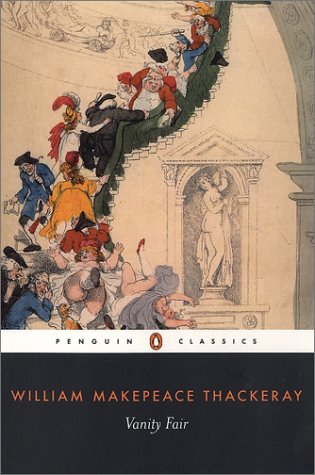
Vanity Fair, by William Makepeace Thackeray

vanity-fair-novel1Appropriately subtitled: A Novel Without a Hero.

I am so, so glad I’m done with this. I’ve been reading this book for weeks. That isn’t to say it’s a bad book, it’s not necessarily, but it really wore on me. I’m going to have to give this a double-review of sorts: my personal enjoyment factor and the importance of the book outside of enjoyment.

I’ll start with the (main) characters. It’s easier to lay out the book that way. Warning – there will be spoilers all throughout this review, however, the book is less about plot and more about social satire, so they don’t matter as much as other books. [Another warning – this review is long.]

Rebecca Sharp Crawley: One of the two main anti-heroines, Becky is a smart, witty, malicious, manipulative, greedy orphan. All she wants in life is lots of money and status. When she fails to get Joseph Sedley (see below) to propose to her, she goes to work for a hick-ish gentleman, Sir Pitt Crawley, as a governess. Almost everyone in the family loves her, but they all turn on her once she secretly marries Sir Pitt’s second son, Rawdon. Rawdon’s aunt (who has all the money in the family) disinherits her nephew and his governess-wife, and Becky spends the rest of their marriage manipulating the people around her in order to get by on nothing, while running around in better and better circles. More on Becky later.

Amelia Sedley Osborne: The other main anti-heroine, Amelia went to school with Becky and is her complete opposite in personality: quiet, loving, self-sacrificing, humble, soft-spoken, and passive. She marries George Osborne, to whom she’s been betrothed since childhood, despite the break her family has recently had with his. George’s father disowns him, leaving George, Amelia, and their son Georgy in poverty, which gets worse when George dies in battle only six weeks after his marriage. Amelia gives everything up for her son and parents, and stays in mourning nearly 20 years for her husband. More on Amelia later.

Rawdon Crawley: The younger son of Sir Pitt Crawley, the favorite of his aunt, Rawdon is careless, carefree, and not the brightest. He’s good at gambling, gets money from his aunt whenever he wants, owes a lot of money, and in general is a layabout. However, he’s devoted to Becky once they marry, and tenderly loves their son, Rawdon Jr. As he gets older, he becomes calmer, gambles less, tries to pay back his debts, and in general becomes a much more likable guy. Eventually, he separates from his wife because he catches her in the web of her manipulations. He’s one of the only characters in the book I grew to like.

George Osborne: The husband of Amelia, whose character is not very well defined (see notes on serial structure below). Sometimes he’s devoted, sometimes he’s too self-assured and neglects Amelia, sometimes he’s a lot like Rawdon and gambles (only is bad at it). After marriage, he pines after Becky, and is planning to run away with her before he has to go to battle, where he’s killed. He exists mostly in this book as a memory, glossed over and perfected through time.

William Dobbin: The best friend of George Osborne, protector of Amelia and her son, Dobbin is a bumbling but kind fool. He cherishes a secret love for Amelia that he only makes known to her near the end of the book. Amelia takes him for granted, and Dobbin allows himself to be a doormat to her. By the end of the book, he’s the only other character I liked.

Joseph Sedley: The fat, pompous, ridiculously shy brother of Amelia, who almost gets engaged to Becky at the beginning of the book, and who is ensnared by her at the end. He’s often used for comic relief.

The stories all intertwine, with a fabulous amount of subplots and sideplots, over the course of 800+ pages. For years, Becky and Rawdon are separated from Amelia/George/Dobbin/Joseph, only to come back together again eventually.

There’s a lot I could talk about in the way of social satire, but the thing that stood out to me the most was the contrast of Becky to Amelia, and how neither is better than the other. It seems obvious, from reading about their characters, that Amelia should be the heroine while Becky the villain. Not so. Thackeray is every bit as biting and cynical about Amelia’s character. For example, at one point he describes her in the following way:

She was voted…rather a pleasing young person – not much in her, but pleasing, and that sort of thing.

It’s the amount of casual indifference in the tone, in the “and that sort of thing,” that really cuts here. She’s worthless. Forgettable. Practically non-existent. Amelia is purity defined, and yet, all that innocent sweetness is not a good thing. At first, it seems fine. Then, it becomes so sweet almost as to be unbearable. By midbook, I wanted to scream at her. Maybe Becky was a manipulative witch but at least she was doing something. Amelia refused to take charge of her life. She swayed with the wind, wherever it chanced to blow her, and never, ever spoke up for herself. She was a doormat, plain and simple, and a doormat is never a hero. And yet she persists in her weakness, crying every few pages, pining for nearly 20 years after the picture of a husband who wasn’t even faithful to her. And in the end? Thackeray shows she’s every bit as selfish and awful as Becky. She knows Dobbin loves her, she knows he’s provided for her for years, and yet, she won’t marry him.

He had placed himself at her feet so long that the poor little woman had been accustomed to trample upon him. She didn’t wish to marry him, but she wished to keep him. She wished to give him nothing, but that he should give her all.

Personally, I prefer Becky’s selfishness. In all her dishonesty, at least she was honest with herself about what she wanted. Amelia kept her selfishness masked under a veil of piety. To me, that’s the worst sort of behavior. Thackeray seems to reserve his most biting and caustic remarks for her. After Amelia refuses Dobbin for the last time and the poor guy finally leaves, the author has only this to say:

As for Emmy, had she not done her duty? She had her picture of George for a consolation.

Woah.

He’s not terrible polite about Becky, either, but Becky’s horrible path is so blatant that it requires a lot less satire to bring it to light. She works her way up by ingratiating herself to people. She enchants the men, unfortunately making enemies of their wives, and wheedles money out of them in ingenious ways. As soon as she makes acquaintances in a higher circle, she drops the old ones, making more enemies. In the Crawley family, she could have kept her good name, except for her awful treatment of Rawdon Jr. Here’s my favorite quote regarding him, probably because they revamped it for The Crow:

Mother is the name for God on the lips and hearts of little children; and here was one who was worshipping a stone!

Yes, if it had not been for her awful treatment of Rawdon, perhaps Rebecca could have gone on longer in her game. Of course, such games generally fail, in the end, and Becky crashes as spectacularly as she rose. It reminds me of “On Your Way Down” by Stabbing Westward, actually. It’s kind of fun to have high school songs come back to you when you’re reading.

Thackeray published this book over the course of 20 serials. While I love what he did with the book, and I enjoy social satire in general, I think it was the format that gave me problems. I didn’t feel like Thackeray had thought out his plot and characters well enough. As I said above, George flipflops and seems to be a whole multitude of different people. The footnotes point out inconsistencies in Dobbin’s family makeup, saying that Thackeray’s ideas about the Dobbin family were “slow to develop.” I felt like this would have been much better had it all been planned and ordered ahead of time. When you come up with an idea about where a plot should go, you can’t go back and change what’s already been published. Instead, you end up manipulating characters in ways that don’t always make sense, and that’s how I felt for at least the first half of the book.

Personally, I didn’t enjoy Vanity Fair very much. There were times when it was very funny, and when I loved the writing, but it desperately needed to be thinned. Besides the inconsistencies mentioned above, there was just a lot of pointless meandering that I attribute to the publishing format. I got irritated after awhile with the negativity. I know it’s a satire and it’s supposed to be negative, and I wouldn’t have minded at all had it stuck with the characters the whole time, but when Thackeray would go off talking about people who mattered little (if at all) to the book with the same condescending tone, it got old. Perhaps it would have been better in 20 separate installments. I was also irritated by the all-too-frequent repetition of the term “Vanity Fair.” I understand that that’s the title, and that we’re referring back to Pilgrim’s Progress, but a handful of repetitions would have done just fine. You don’t need 100 or more. Please.

Altogether, I do feel like it’s a book worth reading. I’m glad I read it. I do wish it could have been edited, polished, and put together a little better. Then I could say I enjoyed it as well as feeling it was worthwhile.

Posted in 2009, Adult, Prose | Tagged , | 2 Comments

The Epic of Gilgamesh, by Anonymous

gilgameshMost of today I’ve been practically an invalid, and have had to leave off reading Vanity Fair because it’s too heavy to carry in one hand. So, I pulled Gilgamesh off the shelf for a short, lighter read while I laid on the couch with an ice pack on my neck. So, despite probably not being the best day for reading in general, given my condition, this was actually surprisingly easy to read. As Jason said in his review, it’s very short, but I was expecting to struggle through it because it’s epic poetry, or at least “verse narrative.” That’s why I chose this for my out-of-my-comfort-zone selection for the 9 in ’09 Challenge. I’m very happy to say it wasn’t as difficult as I thought.

Gilgamesh is a king, part god and part man. He meets another part-god-part-man, Enkidu, and the two become very good friends. When Enkidu dies, Gilgamesh is nearly destroyed by the loss of his friend, and goes on an epic journey in search of the ability to bring Enkidu back from the dead.

What interested me most about this tale is the story behind it. Archaeologists discovered tablets with part of this story engraved on them in the 19th century, in ancient Nineveh. They were estimated to come from two to three thousand B.C., the oldest written work we know of, according to the notes in the back of my edition. [Note – my edition is from 1972, so something else may have been discovered or the information changed in the last 37 years.] It’s older than the bible, older than any of the old Greek classics, plus they believe this story had been carried on orally for a long time before being recorded on these tablets. More pieces of the story have been found in ruins all around the Middle East. Some have even been found in Palestine, where the translator of this version, Herbert Mason, says it’s possible the writers of the bible were familiar with it. I wonder, now, if more has been discovered since Mason published his translation. It makes me want to look at Barnes & Nobles for the newest version.

The interesting thing is – despite this story being four to five thousand years old, or older, it’s so familiar. It’s not just the translation that makes it feel modern. The stories and emotions in it were just so easy to relate to. Perhaps part of that is because of how biblical some of the stories sounded. For example, one immortal tells Gilgamesh about his time as a mortal, how the gods told him to build a boat and bring aboard seeds of every living thing, and then the rains came down and flooded everything for seven days, which caused everyone and everything except those on the boat to die. Just like Noah, except for a week instead of forty days. There were little stories like this all over the text. In fact, whoever owned this before me wrote in the margins any time they found something they thought was related to the bible, pointing out the Garden of Eden and the ten commandments and such (though I believe most of their notes were pretty far fetched, honestly).

It’s not just the stories, either. Gilgamesh’s tale is just so expressive. Despite several thousand years of time and abundant cultural differences, there are some things that remain constant in human beings: love in friendship, pain in loss, and the inability or unwillingness to accept death. That’s what I took from this.

Posted in 2009, Adult, Poetry | Tagged , , | Leave a comment

The Plain Janes, by Cecil Castellucci

plainjanesOf all the graphic novels I’ve read this year, this is by far my favorite. It surpasses Persepolis. It’s short – I read it through twice today before posting this – but has so much in it. It deals with post traumatic stress disorder, friendships, the blurring of social lines, the modern fear of terrorism, love, family, artistic expression, and identity.

Art or crime?
These girls believe they are beautifying their town with these art projects, but the police call it vandalism and criminal attacks. Both have good points. The art varies from building pyramids in the middle of a construction site, to hanging bottles with messages in them from trees. The teenagers all seem to love it, and even begin to emulate it; the adults are terrified and disturbed. Indeed, the Janes are often trespassing on private property, but they are also not putting up permanent graffiti on walls. So when does artistic expression slip over into criminal activity? When do harmless – sometimes even helpful – acts become a public nuisance?

Terror
Ever since the attacks on the World Trade Center, our country has become increasingly paranoid about safety and terrorists. I’m not saying that paranoia isn’t in some ways justified. We do tend to take it to extremes, though. Periodically I hear the most ridiculous stories about lunches blown up by bomb squads because an office worker accidentally left their lunch bag on a bus, or about six-year-old kids getting interrogated at the airport because their name matches one on the terrorist watch list. We seem to have lost our common sense. It makes sense, it really does – the old saying goes that one bad act ruins things for the rest of us – but that doesn’t make the situation any better. And the more we fear, the more we live with fear, the worse off we’re going to get. At some point, we have to forget fear and just live again. We need to learn to see the beauty in life.

If there’s anything I didn’t like about this book, it’s the end. It ended too abruptly. I wanted to know more. Perhaps there will be some sort of sequel. It wasn’t that anything was left unanswered so much as I wanted to know what would happen next, where these girls would go. I wanted to know what happened with John Doe. I wanted more. [***in looking for images for this post, I found out there is a sequel. I’ll definitely be looking into that!] But beyond that, I really loved this book. The artwork is gorgeous, the story of poignant and heartfelt, and I really like the idea of the nerdy outcasts in the school banding together to make something beautiful.

And in the end, there seems to be one statement that rises above all the others: ART SAVES.

Posted in 2009, Visual, Young Adult | Leave a comment

The Alchemist, by Paulo Coelho

alchemistI imagine this book isn’t for everyone. It’s more of a parable than a story, the language is almost semi-Biblical in tone (it’s a translation from Portuguese, but I imagine the tone is similar in the original), the events are near-impossible, and the characters are archetypes rather than actual people. The whole thing uses a mash of multiple religions, and there are philosophical nutshells thrown out on every page. It’s very different from most novels, and in truth at times borders on cheesy.

However, I enjoyed the book. For some reason, the things that normally I would roll my eyes at, all those cheeseball heavy-handed “Soul of the World”s and “his Personal Legend”s, didn’t bother me. The parable-like tone was so complete, that I never felt like this was supposed to be a real story, just a metaphor. A huge metaphor, but nonetheless a lesson (or lessons) learned. And I liked what it spoke to. I like that it says to always pursue your dream, even if you don’t always know how to get there, and to remember to learn things on the way. There’s a particular story told near the beginning of the book that struck me as a metaphor for this book:

(paraphrased) A boy goes to a wise man to learn the secret of happiness. The wise man agrees to explain in a few hours, and in the meantime asks the boy to look around the palace at all the wonders the wise man owned. The boy is also asked to carry a spoon with some oil drops in it, and to not spill the oil as he wanders. The boy wanders the palace for a couple hours, but is so nervous about the oil that he doesn’t see anything around him. When the wise man asks what he thinks about all the treasures, the boys admits he didn’t see any of them. He goes back to try again, and sees all the glories around him. However, when he describes them to the wise man, the man asks where the oil is, and the boy realizes he’s lost the oil. The man says, “Well, there is only one piece of advice I can give you. The secret of happiness is to see all the marvels of the world, and never to forget the drops of oil on the spoon.”

That, to me, encompasses this book. By the end, Santiago the shepherd learns to see the things around him on his journey, but not to forget what he has and what his purpose is in life.

Posted in 2009, Adult, Prose | Tagged , , | 3 Comments

Bogus to Bubbly, by Scott Westerfeld

boguscoverSubtitled: An Insider’s Guide to the World of Uglies.

Originally, I didn’t plan to review this book. I mean, it’s a guide book to a fictional series – not really all that interesting to those who haven’t read the series, and there isn’t exactly a plot/characters/depth/themes/etc. However, after the first part of the book, which mostly just recapped things I knew from reading the books, this became interesting enough for its own post. I’m sure this will only be interesting to Westerfeld and/or Uglies fans, so feel free to skip this review. I’m just going to list out my favorite highlights from the book.

*Hearing where the original idea came from (“officially,” at least) – it has to do with dentistry!

*Reading about the various studies of beauty that went into the creation of this world.

*Learning the science, real or fictional, that went into all the little gadgets. My particular favorites were:

—the “Little Men” from Pretties, which were stick figure men that hung from trees at the boundaries of the pre-Rusty reservation, to keep the “savages” from escaping into the world. They had neural scramblers in them, and the tribes on the reservation thought this was the end of the earth. When I read about them the first time, I immediately thought of The Blair Witch Project. Nice to know that’s what Westerfeld had in mind, too.

—Sneak Suit technology, where Westerfeld, in his description, sends us to YouTube to look up octopus camouflage. Quote: (That person sitting next to you? Secretly an octopus.) – I read that out loud to Laurence and he giggled over it for fifteen minutes.

*Reading the original beginning of Extras, told from Hiro’s point of view instead of Aya’s.

*Reading the first two chapters of Westerfeld’s new book, Leviathan, which is due out later this year.

So this is worth picking up if you’re already an Uglies fan.

Posted in 2009, Prose, Young Adult | Tagged , | 1 Comment

Protected: The Time Traveler’s Wife, by Audrey Niffenegger

This content is password-protected. To view it, please enter the password below.

Posted in 2009, Adult, Prose | Tagged | Enter your password to view comments.

American Born Chinese, by Gene Luen Yang

abcThis is one of the most bizarre books I’ve read in a long time. I’m not quite sure what to say about it. It’s a graphic novel that intertwines three separate stories in a way I never would have guessed ahead of time. I mean, the cover said there was a twist, but it wasn’t at all what I expected.

The first story is about a monkey king that wants to be excepted as a deity by the gods. These sections are told in a mythological/fable-like voice.

The second story is about a Chinese-American kid named Jin Wang who moves to a new school where he’s one of the only Asian kids around. He wants to fit in, but the people around him single him out because of his ethnicity. These sections are standard storytelling.

The third story is about a popular, American high school kid who has to transfer schools every year because of the shame a visiting cousin brings on him. The cousin is named Chin-kee, and is, as the jacket of the book so perfectly describes him, the “ultimate negative Chinese stereotype.” He’s Danny’s worst nightmare. All the sections telling this story are done in slapstick TV sitcom style, complete with subtitled “hahaha”s and applause.

I won’t say how these three intertwine. My initial thoughts were that the first story was something Jin’s parents told him as a kid, and the third story was a TV show (Chin-kee was just too unbelievable to be a real person!), and between the two, Jin somehow comes to terms with his role in life. Nope. Not even close. I would never in a million years have guessed how these three were related. The plot twists blindsided me.

This was a strange book. I’m not sure how much I liked it, but I didn’t dislike it. It was interesting, fast, and easy to read, but there was also a lot of crude, potty-joke humor in it, which I can’t stand. On the other hand, by the end, the lessons learned by each character were nice. And the plot twists are just so outrageous that I’m impressed by the author’s skill and imagination. I’m not sure what age group this was written for, but I’d guess middle-grade to YA. I wouldn’t give it to my kids to read, though, because of the amount of crudeness and a couple scenes of violence. Even mythological violence seems worse when illustrated. Plus, despite the message of the book, I imagine kids would be quick to pick up on how “funny” Chin-kee is, and personally I don’t find stereotyped versions of people very funny, nor do I want my kids to. I understand why the stereotype was necessary – the end reveals all – but still, it was uncomfortable up until the revelation.

So…um…yeah. I’m not sure what else to say. Strange book. Definitely out of my comfort zone.

Posted in 2009, Visual, Young Adult | Tagged , | Leave a comment

The Bermudez Triangle, by Maureen Johnson

bermudezThis is a character-driven book. It deals with relationships, friendship, sexuality, loyalty, and love. It deals with what happens to people when they let the world know they’re gay (both the good and the bad). It deals with long distance relationships, with forgiveness and letting go, with heartbreak and joy, and the discovery of self. There may not be a lot of “plot” apart from these girls’ struggles with their lives and relationships (which sounds very soap opera when I write it here but doesn’t feel at all soap opera when reading), but the book is deep and honest. It felt real, and was very well written. Life and people are a strange mix of messy and neat, and so was this.

My description can’t give it justice without filling in plot points, and I don’t want to do that. I don’t want to ruin this for anyone who might be interested in reading. It was a beautiful book, one of the first treatments of sexuality, especially learning one’s sexuality, that I’ve enjoyed and felt was real and honest. Yes, I know, I’m repeating adjectives here. What else can I say? It was good. It transcends YA. You should read it. It was painful and sweet and everything else all mixed up. I’m glad I bought it. I will definitely read it again. The book was everything I expected but didn’t receive from November Ever After last year.

This is my second book by Maureen Johnson, and I so far have really enjoyed her writing. I like the way she thinks and talks. Anyone who can make her characters casually toss out references to Seventh Heaven deserves praise. 🙂

Posted in 2009, Prose, Young Adult | Tagged | 2 Comments

Habibi, by Naomi Shihab Nye

habibi

Did people who committed acts of violence think their victims and their victims’ relatives would just forget?

Didn’t people see? How violence went on and on like a terrible wheel? Could you stand in front of a wheel to make it stop?

Fourteen-year-old Liyana’s world is turned upside down the day her parents announce that the family is moving across the ocean to Palestine, where her father, Poppy, grew up. Poppy wants his wife and children to know the place of his youth, to experience his culture, and to meet his family, who have been complete strangers to them until now. But moving to a new world is difficult on Liyana and her younger brother, Rafik. It isn’t until Liyana meets Omer that she begins to feel more at home again. Unfortunately, Omer is Jewish, Liyana is Arab, and their friendship is next to impossible in this part of the world.

This was a really good book, one of the best I’ve read in awhile. For the first half, I enjoyed it for purely for personal reasons. I could relate to Liyana’s feelings about moving because I moved from one world to another when I was ten, and it was devastating. Took me years to cope. And my worlds were much closer together than hers! Then, once her family was living in Jerusalem and traveling around the West Bank, I had so much fun reliving my own memories from my visit there last year. I can’t say whether or not all the descriptions and touchpoints would affect those who hadn’t been there, but Nye does describe them all so well, so that I could feel and hear and smell everything all over again.

The second half of the book goes deeper, though, out of the waves of moving and learning a new world, into a boiling mix of culture clash and war. The Israeli-Palestinian conflict has not gotten any easier over time. Religion divides whole segments of the populations – Christians, Muslims, Jews, Coptics, and so on. Jerusalem is a holy city for so many religions, and many want it for themselves. Liyana and Omer discuss religion. The former is from a very non-denominational Christian sort of family, the latter is a not-terribly-orthodox Jew. The two of them agree about religion, and the things they tell each other about their views and their families’ views really struck a chord with me.

Liyana says about Poppy:

Poppy said every religion contained some shining ideas and plenty of foolishness, too. “The worst foolish thing is when a religion wants you to say it’s the only right one. Or the best one.” … “Does it make sense that any God would choose some people and leave the others out? If only Christians or Jews are right, what about most of Asia and the Middle East? All these millions of people are just–extras? Ridiculous! God’s bigger than that!”

I love Poppy. Liyana builds on this and says:

Why would any God want to be only large enough to fit inside a certain group of hearts? God was a Big God.

Really, this is exactly how I feel about religion, almost to the letter. It made me very happy to read.

More important than the issue of religion is the conflict itself. While there were some people, like Liyana and Omer, who didn’t care about each other’s ethnicity, most people did. Nye shows a lot of the terrible human rights abuses and flat-out bullying that goes on towards Palestinians by Israelis. She also shows that the conflict isn’t one-sided. For example, a Palestinian leaves a bomb in a Jewish marketplace. Of course, the Israeli soldiers react, and end up shooting an innocent kid from a refugee camp in the leg, and when Poppy tries to interfere, he is thrown in jail for a short time.

Liyana becomes extremely frustrated by the cycle of violence. I began to see the Israeli-Palestinian conflict in a very different light while reading her frustrations – suddenly, it resembled a gang war. A member of gang A yells an insult at a member of gang B. Gang B retaliates by beating up the A member. Gang A retaliates by shooting those who beat the guy up. Gang B retaliates by killing the family members of the murderers from Gang A. And so on. We heard all about gang wars in school. We had whole assemblies devoted to trying to stop this wheel of violence, to convince gang members to turn the other cheek and to not try to get the last “word” in. It all becomes a chicken-egg cycle, and it’s the same thing with the Israelis and the Palestinians. Personal politics aside, the Israelis imprison, kill, oppress, attack, and badger Palestinians because of the bombings, shootings, rocket attacks, etc, against them, and the Palestinians bomb, shoot, and attack because the Israelis imprison, kill, oppress, attack…yeah. Neverending.

And then, when everything seems so grim, like nothing can make this situation any better at all, there are examples of extreme generosity:

[Poppy]’d come home from jail at 11 pm in a taxi and the driver refused to take a cent from him.

That gesture brought me to tears more than any of the rest of the frustrating cycle of pain.

The only thing that didn’t sit well with me in this book was how unresolved it was at the end. Like when I read memoirs, I wanted to know what happened next. The characters became so real to me. I never found out what happened with Liyana and her family. I don’t know where she’ll go or how long they’ll stay or if her friendship with Omer will work out. But then again, I look at it and wonder what could happen? The conflict is still going on over there, more than a decade since this book was published. It’s nowhere near a resolution. Without a resolution, without people willing to stand in front of that wheel of violence in order to make it stop, how will we ever move forward?

Posted in 2009, Prose, Young Adult | Tagged , , | 1 Comment

Quidditch Through the Ages, by JK Rowling

200px-QuidditchthroughtheagesIn honor of my son’s Harry Potter birthday party today, I read the last of the Harry Potter accessories that I hadn’t yet read. Quidditch Through the Ages comes packaged in a two-book set with Fantastic Beasts and Where to Find Them, which I read about a year ago. I’ve had the set forever, but as they are very short (this one is only 55 pages) and aren’t terribly significant to the HP series itself, I didn’t bother to gulp them both down right away. Surprisingly, Quidditch is an interesting read, all about the history and evolution of the wizarding sport. It’s humorous in places, and explained some references in the series that aren’t necessary to know, but are fun for an HP trivia buff like me to pick up. They aren’t all related to Quidditch, either. For example, I now know the origins of the name of the ward Mr. Weasley recovers in around Christmas of the fifth book (“Dangerous” Dai Llewellyn Ward: Serious Bites). Totally not necessary to know for plot, totally great to know for my own pleasure.

There’s not much more to say about this tiny book. I liked it more than Fantastic Beasts, and I can’t imagine any but serious HP fans wanting to pick it up. I’d feel guilty reviewing it, except I needed a “Q” selection for my A-Z Challenge. 🙂

The double book set was written and published for the purposes of raising money for Comic Relief, a children’s charity in the U.K.

Posted in 2009, Children's, Prose | Tagged , | Leave a comment