
Books:
Archive:
Favorite Reviews:
I have reviewed many books over the years, and some reviews have been more interesting or fun to write than others. The below list were my favorites to write.
• Ada, or Ardor
• Choose Your Own Autobiography
• Dr. Jekyll and Mr. Hyde
• If Not, Winter
• Jonathan Strange & Mr. Norrell
• The Kid Table
• Like Water for Chocolate
• Lolita
• The Monk
• The Night Circus
• Oathbringer
• Return of the Native
• Rhythm of War
• S
• Things Fall Apart
• The Unit
• The Woods Are Always WatchingCategories:
Tags:
- abandoned
- Africa
- Asia
- atmospheric
- audio
- BBAW
- body image
- callback
- circus horror
- classics
- collection
- comfort
- Cosmere
- cruise
- divinity
- dream-invader
- education
- end of year
- fanfiction
- favorite
- fitness
- food
- gender studies
- goals
- good omens
- Harry Potter
- health
- historical
- house
- humor
- I made a thing.
- joint review
- KonMari
- Latin America
- LGBTQIA
- lists
- memorable
- Middle East
- mini-review
- multi-read
- nonfiction
- photography
- place-character
- POC
- portentous
- psychology
- quarantine
- race report
- readathon
- reread
- revisiting
- RIP-worthy
- running
- shredded me
- speculative
- Sunday Coffee
- tarot
- tattoo
- the ferals
- translation
- travel
- Wellness Wednesday
- WTF moments
- Yarn Art


-


Summer, by Edith Wharton
 Spoilers.
Charity Royall is the child of “mountain people” adopted by a lawyer in the nearby small, poor town of North Dormer. One summer, she has an affair with Lucius Harney, an educated visitor to the town. Bad stuff follows.
This is, I believe, the third book by Edith Wharton I’ve read after Ethan Frome (in high school) and The House of Mirth. While it is the best of the three I’ve read, I honestly don’t think Wharton is my type of writer. I keep trying to give her more chances, but I think this is the end for me.
That’s not to say Summer was bad. It actually wasn’t a terrible book. Charity was an interesting character, a combination of uneducated but aware of her own existence. She knew enough about the world to understand why things would never work out between her and Harney, even if he wanted to make them work. She was aware of her feelings and her passions, and about her situation in life. This is actually the first book by Wharton I’ve read where I felt she had an investment in the characters. They felt real, whereas in the other books I’ve read, they’ve felt like soulless caricatures to me. The other characters were less real (particularly Charity’s adoptive father), but Charity was round.
On the other hand, Wharton’s prose is nearly as flowery and too-descriptive in this novella as it is in her novels, and that gets really tedious to me. My mind always wanders as she spends pages describing architecture or design or nature. But as this was a shorter work, there was proportionately less description. Thankfully.
This book seemed to be primarily about women and the choices they have to make, plus their constraints when it came to their sexuality in contrast to the lack of constraints on men. Let me just say I’m happy I don’t live back then. I’m allowed to think and make decisions for myself. I’m not pressured by what people are going to think about me. Living back then would have been awful.
But while that is the primary focus of the book, that’s not really what I took from it. The one thing that I really got out of this book was the comparison of three different classes of people, and not in the way Wharton intended. There was Lucius Harney, who represented the educated classes. Then there were all the people in North Dormer, the uneducated but at least “civilized” town. And then there were the mountain people, who lived by very animalistic tendencies (according to Wharton’s descriptions of them anyway), in filth and rags, disregarding the law altogether. I don’t know how accurate this portrayal of these people is, but what it really made me feel was this:
No matter how much I try, I cannot understand everyone. I try really hard to learn about various cultures, groups, ethnicities, backgrounds, socioeconomic situations, etc. But reading this book made me realize that I simply cannot know everything. And if I can’t really experience something, I can’t really understand it. It made me feel hopeless and tired, and like I should just give up trying. And I don’t like that it made me feel like that. Rarely do I feel like I should just give up everything that I’m working toward, and that my efforts are pointless. It’s probably for that reason (well, and the messed up ending where Charity marries her adoptive father?? Ew! Creepy!) that I really turned against the book.
So I’m just going to leave Ms. Wharton here. The two of us, we apparently don’t get along. I don’t regret reading Summer, but I look forward to leaving it behind.
Matchless, by Gregory Maguire
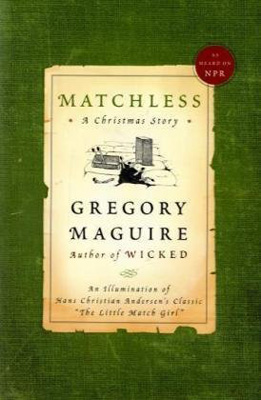 This was my first book of 2010. I bought it for Jason, who loves “The Little Match Girl,” and read it before I’d read the fairy tale. It’s a retelling and an expansion of “The Little Match Girl,” split into four parts. Part 2 is almost a direct translation of the fairy tale, the other three parts are built around it.
Matchless was an interesting experience, so I’m just going to walk through how I felt as I read. At first, I wasn’t sure. The story seemed choppy and like Maguire was leaving a lot out. It jumped around a lot, and felt far too short. I wasn’t sure I liked the style. When I got to part 2, the retelling of “The Little Match Girl” felt the same way – choppy and thinned out. At the time, I didn’t know it was nearly a direct translation. I only found that out while reading the notes at the end of Matchless, and after reading the fairy tale itself.
Parts 3 and 4, however, came together for me. While they retained the same short, choppy style, the story dove deeper and I began to care about the characters. I got immediate chills and tears came to my eyes at one specific place in Part 4. I hadn’t been expecting the book to end so beautifully, but it did. Just like the fairy tale itself, there was beauty and sadness all mixed together, though probably a bit more happiness than in the original. It’s bittersweet.
Immediately afterwards, I pulled out our copy of Anderson’s Fairy Tales, and read “The Little Match Girl.” I was surprised to see how short, choppy, and thinned out the fairy tale felt. And then, I understood – Maguire was using the same writing style as the original tale. That made Matchless even better for me. I’m not familiar with original fairy tales, so the writing style is new to me. Maybe someone who knows more and who has read more would disagree, but I thought Maguire did an excellent job of recapturing that same feel. I loved this story and will likely read it again. Perhaps at Christmas. Maybe it’ll become a tradition.
2009 in Books
It’s been a good year for books. I read far more than I’ve ever read in a single year – before 2009, I thought 100 books in a year was nearly impossible – and a great deal of them were really good. I did get a little tired out reading at that pace, and I worry I won’t remember some of my books, so I’m making it a goal for 2010 to read at about half that rate. I’d like to still hit 100 books, but not much more than 100.
Also, before I move on to the wrap-up, I suppose I should mention I do have some reading goals for 2010.
- I want to make sure that 20-25% of my books are either written by GLBT authors or are GLBT-themed.
- I want at least 50% of my books to come from my shelves. They have to be on my shelves as of today in order to count for this. New acquisitions don’t count. The ones I’ve already ordered but haven’t come to me yet do count.
- I want to read two books per month off my Fill in the Gaps list.
But that’s all. I’m trying to take things real easy in 2010. Now, to move on to the summary for the year. Here is my wrap-up:
Total books: 184
Subcategories (on finished reads only):
First-time reads: 167
Rereads: 17
Novels/Novellas: 161
–Speculative: 86
–Realistic: 75
Nonfiction: 17
Collections: 4
Drama: 1
Poetry: 2
Graphic Novels: 23
Classics: 38
YA: 74
Children’s: 30
GLBT: 15
In translation: 23 (from 11 different languages, French being the most common by far)
Chunksters (500+ pages): 15
New to me authors: 109
By men: 72
By women: 111
Anonymous author: 1
Biggest reading month: June – 21
Smallest reading month: November – 8
Best reading month: February, with 9 books that I liked (several making my top reads of the year), 6 neutrals, and only 1 I disliked
Worst reading month: June, with 6 books I disliked, only 5 (of 21) that I liked, and 10 I was neutral about.
Challenges participated in: 25
Completed: 18
Failed/Quit: 2
Ongoing/Perpetual: 5
Best Book-Related Discoveries:
First – graphic novels. I’d never read any graphic novels before this year and when I began, I wasn’t sure I was going to like them. I read a couple I was lukewarm about before I got to the ones I loved. I’m still not sure I really understand them entirely (and I’m terrible at reviewing them), but I definitely want to read more and I’m glad this world was opened up to me.
Second – YA. I hated the YA that existed when I was a teen. Babysitter’s Club. RL Stine. Sweet Valley High. Ugh. It was because of those books that I decided I didn’t like books for a long time. Last year, I began reading some award-winning middle grade fiction (I’d previously only read classic lit), and then in December I read Airman by Eoin Colfer. It was my first modern YA book and I loved it. I’ve read so many this year – it’s completely dominated my reading list. I’ve read enough to know which types of YA that I dislike and which I like, and to differentiate between various genres within. No, YA is NOT a genre!! It is an age group, with multiple subgenres within it, just like adult or children’s fiction. So many of my favorite authors have been found here, including Scott Westerfeld and Deb Caletti. I adore both of them and have been soaking up everything they write.
Now, I present the best and worst books of 2009:
I’ll start with the worst, and get that out of the way. Before I begin, please allow this disclaimer: This is only my opinion. I’m in no way saying that these book are bad – I just didn’t like them. I know some of these books are on other peoples’ favorites lists, and I’m sorry. They just didn’t work for me.
Okay, now that that’s out of the way, here are my top 5 Worst Reads of 2009. These will not include abandoned books (otherwise Tobacco Road would be near the top of the list). Though I’m only presenting the top 5 worst books of the year, I will first mention several runner-ups: Dreaming Anastasia by Joy Preble, The Three Incestuous Sisters by Audrey Niffenegger, Kampung Boy by Lat, Wings by Aprilynne Pike, Atonement by Ian McEwan, and In a Perfect World by Laura Kasischke.
Of the top 5, these are in approximately descending order, with the least bad on top and the worst at the bottom.
- Tithe by Holly Black – Vapid and badly written, plus it rubbed on a bunch of my pet peeves and had horrible role-model characters.
- The Notebook by Nicholas Sparks – A complete groaner. This was my first – and last – Sparks novel. The last line of the book clenched that.
- New Moon by Stephenie Meyer – I didn’t mind Twilight, but I hated New Moon. Everything about it either sickened me or made me roll my eyes.
- Austenland by Shannon Hale – When this one wasn’t just vapid chick-lit, it turned into offensive stereotyping. Ugh.
- The Time Traveler’s Wife by Audrey Niffenegger – This is hands down the worst book I’ve read this year, possibly the worst book I’ve ever read in my life. I know, I know – I’m going to get pummeled under the collective weight of Book Bloggers crying “heresy!” but I really, really hated this book. I tried so hard to love it. I even gave it a kind review, trying to see the positive. I’m sorry, but I don’t see any romance or love in this book at all. I see lots of gratuitous p*rn, about 250 pages of unnecessary description of things like food and clothing details, gratuitous alcoholism, gratuitous drug use, gratuitous vomiting, gratuitous repetition of the same things over and over again (like this clause), pedophilia, wooden characters that weren’t at all realistic, stilted writing, unbelievable dialog, and unpunished criminal violence. To me, there was nothing redeeming about the plot, the characters, or the writing. I’m sorry. I know it’s heresy, but I just hate this book with a passion and as time passes, I keep hating it worse. Every year I seem to have one book that I loathe and that grates on my memory until something worse takes its place. This is my 2009 Worst Book. I wish it wasn’t, but it is.
So. Interesting pattern. Two are fantasy-fluff YA books (plus two more in the runner-ups) and three are modern adult fiction (plus three more in the runner-ups). In fact, of the 5 worst and 6 runner-ups, only one book didn’t fit into one of those two categories, and five of six of those modern adult fiction books are American. Yeah. That’s not surprising, is it?
Anyway, I hope no one hates me now…
On a happier note, here are the top 20 books that I read in 2009. Except for the first three, these are in no particular order. The first three are the best of the best.
- Between Mom and Jo by Julie Anne Peters – It was a tough choice, but I’m naming Between Mom and Jo as my top book of 2009. You guys have heard me rave about this one enough, so I won’t go on about it.
- The Hunger Games by Suzanne Collins – Is this any surprise? No? I didn’t think so. Any book that I can read three times in 4 months, crying each time, deserves to be up this high on the list. For the better part of the year, I didn’t think anything would beat this book into my top slot.
- Rebecca by Daphne du Maurier – This is also no surprise. This book was surprisingly wonderful. I can’t believe it took me so long to get to it. The richness of the prose and beauty of atmosphere are perfect.
- The Housekeeper and the Professor by Yoko Ogawa – I’m all about the richness, I guess. The prose was so beautiful in this book, even in translation. I loved the characters and the way math turned into poetry.
- Ella Minnow Pea by Mark Dunn – I didn’t expect this quirky dystopia to stick with me the way it has, but the longer I’m away from it, the more I want to reread it. It’s excellently done. The author had some real talent, and though at first glance, the book may seem shallow, it has a deep current that runs underneath. I loved the message.
- Harry, a History by Melissa Anelli – It’s not usual for a nonfiction book to end up in my favorite reads for a year, but this one was so much fun to read for a huge Potter fan like me.
- The Good Earth by Pearl S. Buck – Once more, beautiful, rich prose, perfect atmosphere, well developed characters – this gets me every time.
- The Nature of Jade by Deb Caletti – This was a surprise, because I wasn’t sure I even liked the book for the first half. It blossomed into something I loved, and less than a year later, I’ve already reread it. When I thought of making a top books list, this one automatically came to mind.
- Never Let Me Go by Kazuo Ishiguro – Another surprise. I was really neutral about it when I read it. In fact, the review still rates it as 3 stars. However, this book has stuck in my mind more than almost any other, and it has really grown into something I loved. It’s the sort of book whose impact wasn’t immediately felt, but definitely built a web in me. I really want to reread it now.
- After by Amy Efaw – This book is so marvelously written and researched, and Efaw made a monster of a narrator completely sympathetic. That took incredible talent.
- Baking Cakes in Kigali by Gaile Parkin – This was one of the best feel-good books I read this year. It was all about very heavy subjects (primarily, the genocide in Rwanda) without being descriptive in a way that I can’t stomach. I really appreciated that, and I loved the narrator, Angel, to death.
- Leviathan by Scott Westerfeld – It was really hard to choose which Westerfeld books to pick for this list, since I really loved a lot of them – I could really fill up this list with Westerfeld. Leviathan was particularly good, despite my original trepidation. I wasn’t sure I was going to like it – it’s not my normal type of book – but I really enjoyed it.
- The Arrival by Shaun Tan – Oh so beautiful. Beautiful art, beautiful story, exquisite atmosphere. I had no idea someone could say so much without a word. Must get more Shaun Tan.
- Crossed Wires by Rosy Thornton – This is another of my favorite feel-good books of the year. The story is nothing special – it’s just a romance – but it’s so realistic and the characters were so human! Plus, their long-distance relationship held a special place in my heart, as that’s how Jason and I got to know each other, too.
- Like Water for Chocolate by Laura Esquivel – This book was so different from anything I’ve ever read and I really enjoyed it. I wouldn’t hesitate to recommend this one to everyone, plus it was just so much fun reading and reviewing it with Jason.
- Wild Roses by Deb Caletti – This one affected me so strongly that I blocked most of it out afterwards. It earned its place here because at the time I was shaking and crazy for a couple days, and considered it the best book I’d read in years. I need to go back and reread it to regain a feel for it.
- The Woman in White by Wilkie Collins – This was my first taste of Collins and it was fabulous! Such a well put together mystery.
- Cry, the Beloved Country by Alan Paton – This was a beautifully written book about South Africa that opened up a whole world of culture and history to me.
- The Trial by Franz Kafka (illustrated classics, Montellier and Mairowitz) – While The Trial itself was not one of my favorite classics this year, the GN version was brilliant. Somehow the people who adapted this managed to cut out all the clutter from Kafka’s unfinished novella and really bring out the surreal, Kafkaesque tone in the art.
- the Uglies series by Scott Westerfeld, which includes Uglies, Pretties, Specials, and Extras – Okay, that’s sort of cheating, but I couldn’t pick just one! I think it’s because the books feel like one cohesive piece for me and it’s difficult for me to separate them. How can I say which is better? So I’m honoring the whole series here.
So, in the end, it turns out 7 YA titles made my list (counting the Uglies series as 1), 4 classics, 1 nonfiction book, 2 graphic novels, and 6 modern adult novels. The large number of modern adult books is actually a huge surprise for me…but I guess 5 of them are non-US books, which is less surprising. Three of my top books are in translation, 1 is a GLBT book, 7 are by/about POC, and 10 are by non-US authors. Eight of the books on my mid-year top 10 list made it to the top 20 now. I read 10 of these books in the first half of the year, and 10 in the second half.
For the most part, it was a wonderful year of books this year. Here’s to a great 2010!
Wake, by Lisa McMann
 Short summary: Ever since she was young, Janie has suffered from a condition that forces her to experience other peoples’ dreams. When she moves from observer to participant, however, her life spins drastically out of control.
I’m in two minds about this one. First and foremost, it sucked me in. It took me only a few hours to read. It captivated me and I found it fascinating. I even went and read the short story about Janie’s love interest, Cabel, online afterwards. However, it is not so terribly well-written. It feels like the NaNoWriMo version of a good book, the quickly tossed out bones of a wonderful story that had such a good premise that it got published before it was ready. There is some terrible writing in it, but the story is so fascinating that I loved it anyway.
Honestly, I hate when that happens. When I love a book, I want to love it wholly. I don’t want there to be that “I loved it but…” clause. Because really, with some work, this could be a fabulous book instead of just a good one. As it is, I had a lot of fun with it, and probably won’t remember it in a few months. It definitely made for a fun afternoon, though.
Alice’s Adventures in Wonderland, by Lewis Carroll
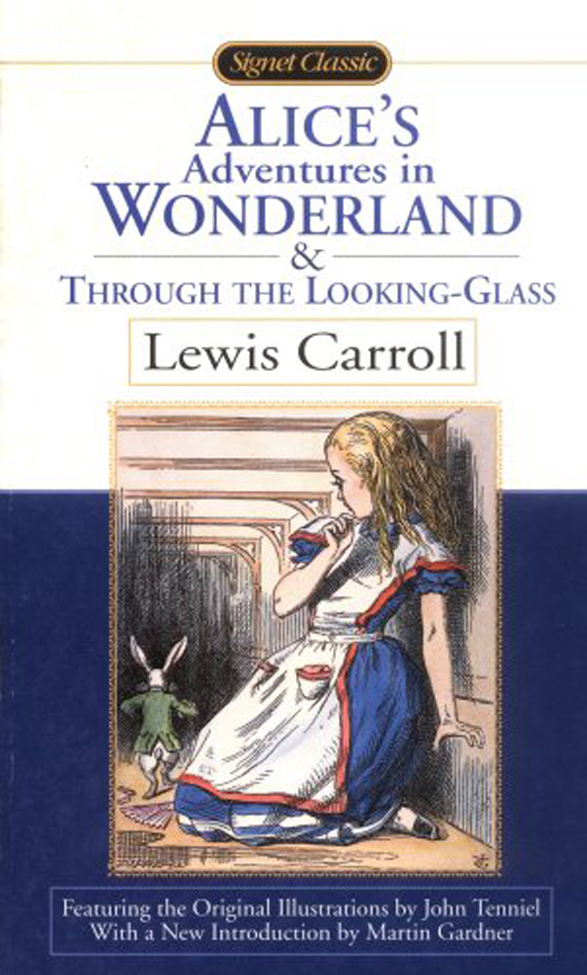 There’s no need to tell you the plot to this. First, it’s famous enough. Second, there isn’t really a plot. In fact, that’s one of the things that bothered me so much. I don’t understand this book at all. Maybe I’d have liked it had I read it as a kid, but I even doubt that (I hated the movie as a kid). I don’t like books where people and animals talk to each other, where absurd things happen for no identifiable reason, and/or where there is no internal logic. I can read Kafka – it’s absurd and surreal, but it has its own internal logic. This? Nothing. I just don’t get it. I know people love this book, but it didn’t work for me.
I would have abandoned it early on, except that it’s my book club selection in January and I have to moderate a meeting about it. Most of our group is going to also read Through the Looking Glass, but that was optional and I am not going to subject myself to another 100 pages of Carroll. Funny thing is, I’m the one who chose this book. I figured it’d be a short, easy read over Christmas, and get us all geared up for the new movie coming out (which I hope I like far better than the book or the old movie).
Anyway, that’s all for that. Sorry it didn’t work for me. Hopefully I’ll understand it better when I do some research before my book club.
The Painted Veil, by William Somerset Maugham
 I’m reviewing this book together with my good friend Karen of Books and Chocolate.
Amanda: Hi Karen! Thanks for buddy-reviewing with me!
I think I want to start out by talking about William Somerset Maugham. I first read one of his books in January 2001 – Mrs. Craddock – and fell in love with it. I’ve since read 12-15 of his books, several of them more than once. He’s one of my favorite classic authors. His books are easy to read and well thought out. The Painted Veil is one of my favorites of his. This is the third time I’ve read it, and I think I love it just a little bit more with each reread! So how did you discover Maugham?
Karen: I discovered Maugham back when I was a freshman in college. I had a huge crush on a boy in my dorm who had read Maugham the year before in a lit class. He insisted on lending me Of Human Bondage to read during the winter break. Of course, since I was crushing on him, I had to read it, and I loved it. It was one of the first classics I read for pleasure. I didn’t read any more Maugham until I met the man who is now my husband, also a Maugham fan — The Razor’s Edge is one of his favorite books. (Obviously, I’m attracted to men with great taste in literature!) So I read Razor’s Edge, and a couple others, but then I didn’t read hardly any more Maugham for quite awhile. Then, in 2008, our classics reading group chose the books for this year, but The Painted Veil wasn’t scheduled for almost a year! I couldn’t wait that long and read it right away. It’s just as good the second time around.
I agree, Maugham’s works are not difficult reads. I’ve been reading quite a few Victorian authors this year, so he’s really a refreshing change. I remember that I was pleasantly surprised at how easy Of Human Bondage was — it’s quite long, more than 600 pages (depending on the edition), yet it’s pretty fast for such a long book. The Painted Veil is much shorter, only about 250 pages, and I could probably read the whole thing in one day.
Amanda: One of the things I find most fascinating about Maugham was how little respected he was amongst his fellow authors. He was a pulp novelist. Often his writing tended more toward the cliche, and his prose was straightforward. With people like Hemingway, Faulkner, and Woolf as contemporaries, he was looked down on for not being experimental like them. He was old fashioned. But really, it was his straightforward, easy prose that hooked me on classics. Without him, I’m not sure what sort of reader I’d be today, or if I’d be a reader at all.
So. The Painted Veil. I loved it. All three times. One of my favorite things about it is the characterization. Each character is so round. None of them are all good or all evil. I personally find Kitty obnoxious, and really sympathize with her husband, but others might find Walter cruel and callous. Personally, I understood him and while I didn’t think he always made the best of judgments, I really admired his dedication to the people he was taking care of. What did you think of the characters?
Karen: There aren’t that many characters, but I agree, they’re well-rounded, especially Kitty. When I started the book, I really wanted to smack her, but I kept on reading — which just shows what a great writer Maugham was. These are seriously flawed people, yet the story is so fascinating that it holds the reader. Unlike other books with annoying heroines (like Cathy in Wuthering Heights, whom I wanted to kill personally. Seriously, if I’d have been able to jump into the book and kill her myself, I would have been very tempted. I apologize to all you Bronte fans.)
Anyway, I’ve really been thinking about some of these flawed characters lately, I’ll probably write a blog entry about it soon. I always think of them as Fascinating Train Wrecks. However, I’m not sure if I’d put Kitty in this category, because she actually makes changes to try and improve the situation. She’s proactive, and as annoying as she was, I actually ended up respecting her. Not that she’s perfect, she still makes mistakes, but you can see at the end that there’s hope for her.
So, Amanda, what did you think of Walter? Did he deserve Kitty?
Amanda: I think the real question is – did Kitty deserve Walter? Taking them back, prior to the affair and him taking her to the cholera epidemic. Walter is smart, hardworking, and sensitive. He has a very hard time relating to other people, and he has no patience for frivolity and social customs. Kitty, on the other hand, is empty-headed, self-centered, and a bit of a bimbo. Why he ever fell in love with her is beyond me – I suppose we can’t always explain why we fall in love with someone – but I think it’s interesting that he went into the whole marriage with his eyes open. He knew what she was. He knew she was like a doll – beautiful but empty. He was willing to put up with that in order to be near her, and he was always very kind. I don’t think Kitty ever realized – not even at the end – how badly she hurt him. She kept thinking it was pride, that her infidelity didn’t matter, shouldn’t matter, but to him, it killed his love.
I do think she became a better person, to a certain degree, but even at the end, she’s still selfish. I hope she’ll be better, and I do like that she plans to have daughters and raise them to be strong and smart, unlike her. That brings up another point, though – I thought this book said a lot of interesting things about the role of women at the time. It seems to take place in a very transitional time when women were gaining some independence but could not entirely be strong. Did you feel Maugham had a feminist slant in mind when he wrote it?
Karen: I think Kitty’s definitely less selfish at the end than at the beginning. Without spoilers, there are several instances when she tries deliberately not to hurt people. And she’s much better at reading people, and reacting to them.
The feminist angle didn’t strike me at all when I read it, but I can see it as a possibility. There are some strong female characters — even the Mother Superior, and Charlie’s wife Dorothy. They’re in traditional roles, nun and wife, but they’re a lot stronger than Charlie and maybe even Walter. I wish Maugham had developed Walter a little more. I think he was the least developed of the main characters. My favorite male character was definitely Waddington, but he was also tragic in his own way. Do you think in general the male characters were as well developed as the female?
Amanda: I actually thought Walter was very well developed, but that might be because of how much I could understand him. He wasn’t traditionally developed – it was just a brushstroke of information spattered here and there throughout the novel, leading to a whole picture. I think about things and feel things in very much the same way he does, so it was easy for me to relate to him and make a full picture of him in my mind, I suppose. I could see other people relating to him less, though, because he’s the sort of personality that many people have trouble relating to in real life. I think Maugham wrote the social awkwardness well.
I have read, though, that Maugham tended to understand women better than men in his own life, so it’s possible that’s why the women characters felt more developed. I loved the Mother Superior. I don’t normally like reading about Catholics, having grown up Catholic, but the Sisters in that convent were so different from traditional Catholics. Take, for example, one of my favorite quotes from the book:
Beauty is also a gift of God, one of the most rare and precious, and we should be thankful if we are happy enough to possess it and thankful, if we are not, that others possess it for our pleasure.
I love this. This goes against most traditional viewpoints of beauty. Most books treat beauty either as a precursor to emptyheadedness, or as a great evil. To hear someone speak this way – especially the head of a Catholic convent – is just amazing. I loved that the Sisters were so open, forgiving, and loving. They were the very picture of charity. Even though normally I don’t like to read much about religion in books, the passages with the Sisters just blew me away and I think they played an integral role in how much Kitty changed. What do you think?
Karen: I completely agree! They’re much more forgiving than Catholics are usually portrayed. It’s no wonder Kitty was really drawn to them. I wish I knew them! And I loved that quote also. I don’t normally make notes when I write, but I think I have to go back with sticky notes and tab all the passages I loved in this book.
One thing that did bother me about this book was the racist way in which the Chinese are portrayed, mostly the way they’re described — ugly, yellow, etc. That’s the one thing that really put me off in this book. But it’s possible that Maugham was merely reflecting the attitude of the British of that time, or Kitty’s attitude. What do you think?
Amanda: I do think that was reflective of Kitty’s attitude. It’s possible there was a certain amount of British superiority to it – I think that’s almost a given in that time period – but the main characters other than Kitty seemed to have compassion for the Chinese. The nuns, Waddington, Walter. They saw past the racial differences and did everything they could to help. The Chinese were just other people to them, not some strange foreign race that repulsed them. Even Kitty tried to get over her prejudice against them once she was surrounded by the children every day. I liked that. I thought it was a good message – that to overcome prejudice, one must spend time with those one is prejudiced against.
Without giving away spoilers, what did you think about the fate of Walter and Kitty’s relationship? Do you think, given the chance, they could have ever come to live together peacefully? Or were they, as Kitty says at one point, “Two little drops in the river that flowed silently towards the unknown; two little drops that to themselves had so much individuality and to the onlooker were but an indistinguishable part of the water?” (That’s my other favorite quote.)
Karen: That’s going to be tough without giving away the ending. I went back and forth as I read the book. Kitty seemed to really be growing and maturing as a person, so I began to feel hopeful, but then I didn’t know if Walter would ever forgive her. It sort of bothered me that Walter was so unforgiving, though he was surrounding by people dying horrible deaths. I would have thought it might have put her transgression in perspective somewhat — but that also relates to him deliberately bringing her into a situation where she might get infected and die, which is so bitter and vengeful. I saw Kitty changing as a person more than Walter, and I began to actually like her better than him.
This book has so many issues that are great for discussion, but it’s really hard without giving away major plot points — and I reaaaallly hate spoilers. I would highly recommend this book for a face-to-face discussion group — not too long, an easy read, a great plot and interesting characters. This was a great choice, and I am so looking forward to reading more by Maugham. There are three more on my to-read bookshelf right now, and I am so tempted to go back and reread Of Human Bondage.
So, I know you’ve read most of the Maugham oeuvre. How does this compare to the others? Is it one of your favorites? Definitely one of mine.
Amanda: Well, I haven’t read his entire works – he was an extremely prolific author. Wikipedia has 54 entries for him under the “Novels, Travel, Criticism, and Assorted Pamphlets” section, plus another 24 plays, 187 periodical contributions, and 123 short stories. I’ve only read a mere glancing of that. I haven’t read a single play or short story, though I hope to fix that next year. Of the novels I’ve read, though, I count The Painted Veil among my favorites, alongside Mrs. Craddock. Some other good ones are The Razor’s Edge, Of Human Bondage, and Theatre. In fact, there have only been two Maugham novels I disliked (The Magician, and The Moon and the Sixpence). I would definitely recommend his books as easy-to-read classics that are fun but also deep.
Thanks again for doing this review with me, Karen! I was having such a hard time figuring out how to review this book, since I love it so much.
Karen: Thank you, Amanda, for inviting me! It was really fun! We’ll have to do it again soon.
The Elegance of the Hedgehog, by Muriel Barbery
 Renee is a concierge in her mid-50s. She’s spent most of her life maintaining her invisibility, hiding her intelligence under a mask of stereotypical peasant ignorance. Paloma is a super-smart twelve year old girl who lives in the building where Renee is the concierge. She has decided that on the day she turns thirteen, she’s going to kill herself and set fire to her family’s flat. Her reasoning: life is meaningless, and she’s accepted it as such. Through a shared love of all things Japanese and a catalyst of a new wealthy Japanese resident in the building, both Renee and Paloma’s lives are changed.
I’ve been reading this book for months. I started it back in the early fall when random.org picked it off my shelves for the Random Reading Challenge. After about 40 pages, I put it aside for awhile. It was…too much for me at that moment. The prose is…not dense. Dense is the wrong word. It’s not wordy, either. But…it’s almost Nabokovian in the thickness of language. I found myself bombarded with a vocabulary I couldn’t keep up with. I have a decent vocabulary, but this book was a little beyond me at the beginning. I kept falling into a stupor while trying to read. I thought the idea behind the book was interesting, but I got a little tired of word play. And I like word play.
A few weeks ago, I picked it back up. I needed something quiet and thick, so I figured this would be a good one. While I read, I kept trying to figure out how I felt. Was all this word play merely pretentious drivel? Or was it just the innocuous voices of two intelligent narrators? I couldn’t tell if the author was being snarky towards the reader or not. I suspected not, most of the time, but I had my doubts. More than once, I almost gave up reading altogether, particularly in long chapters filled with philosophical notes. Sorry, but I’m not big into philosophy presented that way.
But after Mr. Ozu, the Japanese man, arrived, the book began to come together for me. I wonder, actually, if the narrative was framed in such a way to make a reader feel the same isolated unsurity that the characters had in the beginning, and then to allow them to make sense of things and come together in the second half. If so, it was subtly done. Brilliantly so. If not, then I guess I’m just making things up again. Reading too much into it.
I did like the second half of the book a lot. I loved the message: No matter how much we look, we never really see each other except in little moments. To free ourselves from the burdens that bind us, we need to be seen, really seen, just once. That’s what I took from the book, at least. I’m sure other readers would each have their own interpretation. I was really struck, though, with this concept of vision and blindness.
The ending made me cry. It came out of nowhere, but not jarringly so, and I didn’t expect to care as much as I did. But I got teary-eyed and decided, yes, it was worth slogging through the difficult chapters in order to get to this.
Here are some of my favorite passages. Three from Paloma:
Every time, it’s the same thing, I feel like crying, my throat goes all tight and I do the best I can to control myself but sometimes it gets close: I can hardly keep myself from sobbing. So when they sing a canon I look down at the ground because it’s just too much emotion at once: it’s too beautiful, and everyone singing together, this marvelous sharing. I’m no longer myself. I am just one part of a sublime whole, to which the others also belong, and I always wonder at such moments why this cannot be the rule of everyday life, instead of being an exceptional moment, during a choir.
*
Thinking back on it, this evening, with my heart and my stomach all like jelly, I have finally concluded, maybe that’s what life is about: there’s a lot of despair, but also the odd moment of beauty, where time is no longer the same. It’s as if those strains of music created a sort of interlude in time, something suspended, an elsewhere that had come to us, an always within never.
*
So here is my profound thought for the day: this is the first time I have met someone who seeks out people and who sees beyond. That may seem trivial but I think it is profound all the same. We never look beyond our assumptions and, what’s worse, we have given up trying to meet others; we just meet ourselves.
And two from Renee:
Quite abruptly I realize I am sitting in my kitchen, in Paris, in this other world where I have made my invisible little niche, a world with which I have been careful never to mix, and I am weeping great warm tears while a little girl with an incredibly warm gaze is holding my hand, gently caressing my knuckles. And I also realize that I have said it all, told her everything: …I am weeping plump, hot, long, good tears, sobbing tears, and while I am troubled, I am also incomprehensibly happy to see the transfiguration of Paloma’s sad, severe gaze into a well of warmth where I can soften my sobs.
*
…I am struck with incredible force by this proof that sight is like a hand that tries to seize flowing water. Yes, our eyes may perceive, yet they do not observe; they may believe, yet they do not question; they may receive yet they do not search: they are emptied of desire, with neither hunger nor passion.
A Tree Grows in Brooklyn, by Betty Smith
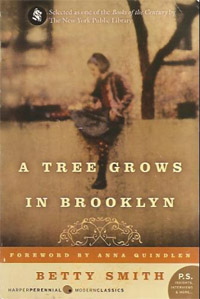 A Tree Grows in Brooklyn is a classic coming of age story set around the turn of the century in immigrant-heavy Brooklyn. It’s so much more than a coming of age story, though. This is the third time I’ve read this book, and like with most books I reread many times because I love them to pieces, I’m having a hard time figuring out how to review this book. So instead of writing a real review, I’m simply going to list out the things that I love so much about this book and encourage everyone to try it out!
1. Katie Rommely Nolan. Katie is the mother of the main character, Francie. She fell in love with a hopeless dreamer (Johnny Nolan) and spends most of her married life poor and working to keep her family alive. She scrubs flats in order to pay their rent. She knows how to stretch every cent and every bit of food they have. She keeps the children healthy and clean as best as she can. She loves her son, Neeley, more than Francie, but she tries very hard to be fair, though she’s not always successful.
I love Katie very much because she reminds me a lot of my own mother. Though my mom’s situation was very different from Katie’s, they have the same attitudes about a lot of things. My mom, like Katie, is tough, straightforward, blunt, and hardworking. There is no romance about her. Whatever romance she might have had when she was young wore off long before I was old enough to know about it. Reading about Katie is like getting to know my mother better, and it reminds me of my childhood (even though my childhood, again, was very different from Francie’s). Francie describes her as being made of “thin, invisible steel.” That’s such a perfect description.
2. Johnny Nolan. He should be easy to hate. Johnny’s a drunk, a drifter, an absolutely no-good provider for the family. But somehow, I can’t hate him. Before I read the book for the first time, Jason told me he liked the way Johnny was portrayed because normally alcoholics are painted completely black in books, and when children are involved there is always abuse and meanness. A Tree Grows in Brooklyn is not like that, though. Johnny can’t provide for his family, but he’s never once mean to them. He never hits his wife or his children. He tries to love them the best he knows how. And despite his excessive drinking, he’s not a bad person.
Take, for example, a passage from when he’s out walking with Francie and they encounter a prostitute.
“Was that a bad lady, Papa?” [Francie] asked eagerly.
“No.”
“But she looked bad.”
“There are very few bad people. There are just a lot of people that are unlucky.”
To me, this showed Johnny’s fairness and understanding. Was he a good man? No, not really. But he wasn’t a bad man, either. He was just unfortunate, and a slave to his addictions and his dreams.
3. Currency. For much of the book, the Nolan family lives on a few dollars a week. Slowly, I got immersed in their world, learning the way money works the same way I would in another country with a foreign currency. I got used to Francie going to the butcher and the baker and paying with a penny or at most a nickel. When later there was mention of a $10/week salary, it felt enormous. When I heard of another character’s $10,000 yearly salary, it was like riches. Stepping back from the book, I think – wow, $10,000 is not that much. But in this book, it’s practically like being a millionaire, and Betty Smith did a great job wrapping me into this world so well that it felt rich before I stopped to think how little that is.
4. Brooklyn. I know Brooklyn’s not the same now, but I still wish I knew someone who knew Brooklyn well and could give me a tour when I’m next up in NYC.
5. The library scenes. There are scenes with the librarian both at the beginning and end of the book, and I loved the contrast. Actually, I’ll just include any scenes that are revisited near the end of the book, and how Francie deals with the people she interacted with as a child after she’s grown up.
6. She heard the word “oxygen.” I don’t want to spoil this scene for anyone who hasn’t read the book, but once you read it, you’ll know exactly what I’m talking about. It’s such a good, triumphant scene!
7. Lessons on humanity and compassion. I couldn’t give examples for every single truth Betty Smith wrote into this book. Every few pages, she demonstrates how some people learn compassion from their suffering and others learn to taunt those beneath them. When the children are taking junk to the junk man, other children yell “Rag picker!” at them, even though they just dropped off their own junk. An intern doctor at a clinic talks about how filthy and disgusting the poor children are, and his nurse, once a poor immigrant child herself, agrees with him. Children at school taunt the kids for having lice and being sent home from school, even if they themselves had the same problem the week before. There’s one quote from all this that in particular stands out to me:
They learned no compassion from their own anguish. Thus their suffering was wasted.
8. The passage of time. When I read this with my book club two years ago, one of the main complaints people had was the uneven passage of time. The early part, when Francie is 11 years old, takes up a huge chunk of the book. As she grows older, time passes faster, and months go by without any details about them. Everything comes together so fast. Five years will pass in the book in the same space as a month or two earlier on. Personally, I like this. At one point, Francie herself starts to notice how holidays don’t seem too far away anymore. She sees beyond a week in front of her. Time starts to move fast and things are changing. When she asks Johnny what’s happening, he feels her forehead with the back of his hand and tells her she has a bad case of “growing up.”
I remember being about that age and when I started thinking time was moving faster each year. I remember when I really gained awareness of time in general. Things moved and changed so fast, I couldn’t keep up. I was forced into maturity before I was ready. This is the way it happens as a child turns to a young adult, and I think Betty Smith’s integration of that impression into the text was magnificent. I didn’t mind that it made things feel uneven. I felt closer to the book for that imbalance. It felt honest.
9. All the Christmas scenes. Each Christmas scene is special, from the tree-throwing man to the gilded pennies. For some reason, even though this book takes place over many years and isn’t necessarily about Christmas, it feels like a Christmas book for me. Maybe it’s because it’s so hopeful, or because Christmas is such an important thematic element, a touchstone for each year. I don’t know. But for some reason, when I think about holiday books, this one immediately comes to mind, which is why I just read the book for the third time.
It’s a good book. It’s not perfect, but I am able to look past the things that would irritate me in another book because I love the story so much.
Note: Review date is only an approximate of when this book was read/reviewed in 2009.
Note: Originally read in August 2007, and once again after that (probably December 2007).
Posted in 2009, Prose, Young Adult
Tagged classics, comfort, favorite, memorable, place-character, reread
2 Comments
Asleep, by Banana Yoshimoto
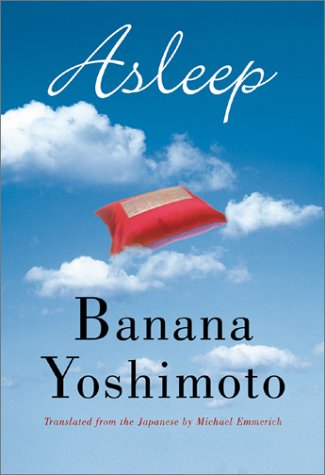 Included in Asleep are three longer short stories by Banana Yoshimoto, translated from the Japanese by Michael Emmerich. Each in some way deal with sleep (whether physical or metaphorical). This is my first read by Yoshimoto, and I’m delighted to be reviewing the book with Kelly of The Written World.
Amanda: Hi Kelly! Well I suppose I’ll just start this thing by asking what your overall thoughts are on the whole book before we split into talking about individual stories.
Kelly: Hi! I have to say that I wanted to love this book. There was just something about it that made me think I would, but then I finished it earlier today (Tuesday) and promptly the stories have left my head. I honestly will have to have the book close by to remember what happened, which is really bad! The third story probably stuck with me the best. There were aspects of the stories that I really enjoyed, but otherwise I probably will forget I have even read this book in the future. There was just nothing about it that was so amazing that it will stick with me forever. How about you?
Amanda: Well…let me just say, first, that I rescued this book from the throwaway pile at Half Price Books not long ago. I’d heard other people talking about Banana Yoshimoto in the past, but had never been interested in trying her books. I’ve not read a lot of Japanese literature. After reading The Housekeeper and the Professor, though, which I loved to pieces, I was really looking forward to trying more Japanese authors. This seemed short and quick, easy to read, and I’d heard it was simple and good. I wanted to like it. I expected to like it. But then I started reading, and was just bored. Sometimes almost offended by some of the things in the stories. By the end, I admit, I was skimming. I doubt I’ll remember anything from these stories. I don’t even remember anyone’s names at this point, and I just read them.
I suppose we ought to break into sections for the individual stories? Or would you like to add anything else about the book in general?
Kelly: I have to be honest and admit that I saw you were going to be reading this book soon, so I added it to my library pile because I am in the Japanese reading challenge and am having a hard time finding books to read for it!
The first story is called ‘Night and Night’s Travelers’. I found this story a bit random. I think she was trying for some suspense by not telling everything right away, but I was just uninterested by it all. What did you think about it?
Amanda: Okay. Night and Night’s Travelers. First let me say – since I’m not sure we have the same edition – that the back of my book was very misleading. What it said was that all three stories were about women who were bewitched into spiritual sleep. What it said about this story in particular was that a woman mourning for a lost lover starts sleepwalking. Maybe I just completely misunderstood the story, but I don’t remember any sleepwalking at all! I mean, the narrator’s cousin stays awake a lot at night, but she’s not sleepwalking!
Because that was the first story in the book, it was the one I paid the most attention to. At this point, I still was assuming it was automatic that I’d like the book. I’m not sure why I just assumed that, but I did. It was a quick read, but in the end, I didn’t feel like anything happened. The story didn’t go anywhere, and I had no emotional response to it at all. And again, there was no bewitching, no “spiritual sleep,” no “Kafkaesque surrealism” (which the back of the book also misleadingly said). I was disappointed. I wanted those things, especially the surrealism. I wonder if my disappointment was greater because of the misleading blurb? How about you? Did you have conflict with the back of your version?
Kelly: First I should say that I am weird and never read the back of the book. I was totally not sure what this book was about at all. I had heard of the author, so that was really all my criteria was for reading this book. I watched the first part of your response show up on my screen, though, so while you were typing I read my own back of the book. It says the exact same thing! So, yes, that is very misleading because if there was sleepwalking going on I entirely missed it. Unless it was a metaphor. Otherwise, that description makes no sense. So, I went into this book not really knowing what to expect and I was still disappointed.
Like you, since this was the first story in the book, I paid a lot of attention to what was going on. I knew we were going to be reviewing it, so I wanted it to be clear in my mind. Also, like you, I was less than enthused. I didn’t feel like there was really anything going on and I couldn’t sympathize with the characters at all. I just didn’t care… It was just there and I read it and that is really all there is for me to say about it. It isn’t even as if I can say I hated the story. I just didn’t care enough to like it or hate it.
Amanda: I know what you mean. I didn’t hate it either. I just didn’t care. Which is strange, because many of the characters in it ought to have been interesting. I skimmed back through for their names – I’m bad with Japanese names, plus the characters just didn’t stand out for me – and really, Mari, Yoshihiro, and Sarah were all interesting characters. Or they could have been. The problem, I think, was Shibami – the narrator. She was completely uninteresting, and since this was all told from her point of view, the other characters just kind of died out. For me, at least. I wonder if maybe this had been told from Mari or Sarah’s point of view, would it have been more interesting? Maybe. I don’t know. But as it was, it’s already fading from my mind.
However – if it’s okay to move on to the second story, “Love Songs,” – I didn’t find “Night and Night’s Travelers” offensive. It was just there. “Love Songs,” on the other hand, was plain awful to me. What did you think?
Kelly: I know what you mean about the narrator. Mari or Sarah might have made it more interesting, but otherwise it was nothing special.
Moving on to “Love Songs”. I am finding it hard to come up with what I want to say about this story. I don’t know what the author was even thinking with this one. It was just strange! I don’t know if I would call if awful because, like with the first story, I didn’t care enough to come up with a strong emotional response, but there was something wrong with this story. I consider myself pretty open-minded, but you have to be extremely easy-going to appreciate this story and I am not sure if I really am. I am having one of those moments where I know what I want to say, but don’t know how to say it. Maybe you should take over. You can probably say why you found it awful better than I am capable of at the moment.
Amanda: For me, it was really the lack of tact or any decent human being in the story that made it awful. The narrator is an atrocious drunk. Personally, I don’t like to read stories that are centered on the act of drinking. It’s just not my thing. I was terrified that any minute I would get to see some descriptive passages about her getting sick or something. Thankfully that didn’t happen (I’d have put the book down and said never mind if it had). But what comes of her drinking? She somehow decides that an ex-rival that she had some mild lesbian thoughts about – and only in hindsight – is haunting her, so she goes to a midget (blatantly calling him a midget over and over, which I found jarringly untactful), has a spiritual trance where the ex-rival basically tells her everything she wants to hear, and then it’s all happy again. WTF? Sorry, but I found everything about this story offensive, from the alcoholism to the untactful way of treating the midget character to the frivolous way that homosexuality was treated. I’m just glad that it was the shortest story by far in the book.
Did I touch on what you didn’t like at all? Or was there something more?
Kelly: No, you pretty much got everything. I didn’t think this story was handled well at all! I don’t think it had any redeeming features.
Shall we just move on to the third story, or is there something more you want to say about this one?
Amanda: Sounds good. I really don’t have anything more to say.
I have to make a confession about the third story (“Asleep”), though. After talking with you earlier on Twitter and seeing that you also found the whole book fairly forgettable, I mostly skimmed the last story. I started reading it, but after a few pages of that obnoxious-no-paragraph-flashback-thing, my mind completely settled into a fog. I read each page at a quick glance, stopped in a couple places that looked more interesting, but really didn’t retain anything at all about it. I caught that the girlfriend was sleeping a lot (according to the back of the book, that’s because her lover’s wife is in a coma), but that’s about all. Sorry! What did you think about it? You said above it was the most memorable story for you, right?
Kelly: I have to admit that I liked the ending of this story. It was nothing ground-breaking, but it was kind of a nice image. It is probably the only thing that will stick with me from the story. Not so much the exact scene, but the sense of the scene. It was something that I could relate to. We live in a crazy world and when things are going on you sort of feel like things are passing you by and you are standing still. For the couple at the end of the book, they really were letting the world pass them by and the narrator was at peace with it. I think in my own hectic world I sometimes don’t stop to enjoy the moments and tend to rush along with everyone else.
For the rest of the story, though, there was not a lot going on. The main character slept a lot and it was said to be the fault of the woman in the coma. She was sleeping through days and losing track of time. She had a few moments where she sporadically connected with friends and there was her boyfriend. Then, there was her connection with a dead friend and her reminiscences of what their friendship was like together. There was one spiritual moment that was rather strange, but all the stories were supposed to have a touch of the spiritual in them. Otherwise, there really isn’t anything to talk about.
I thought all three of the stories were strange, though. They are not what I normally read at all. I couldn’t relate with them or connect with them at all with the exception to the ending of the third story and that might have just been my mood at the time. Any final thoughts on them from you?
Amanda: Hmm. Maybe when I’m in a different mood I’ll go back and reread that one. I feel bad that I skimmed through it, but the second story upset me so much that I didn’t want to go through that sort of experience again. That, and it really just bugs me when back of the book blurbs are misleading, like I said above. Particularly when it compares one author to another, the way this was compared to Kafka. It wasn’t at all like Kafka! It’s like last year, when I read Oracle Night by Paul Auster, which was supposedly Nabokovian, and was offended on Nabokov’s behalf that the comparison was ever made!
Maybe I just went into this with too high of hopes. After The Housekeeper and the Professor, I expected something amazing, I guess. It’s sad that it didn’t work out. I guess that happens sometimes, though. Thanks for reviewing it with me anyway!
Kelly: I want to read The Housekeeper and the Professor, but my library doesn’t have it! I am glad we reviewed it together, though. I look forward to our next buddy review!
Posted in 2009, Adult, Prose
Tagged Asia, collection, joint review, POC, translation
Leave a comment

