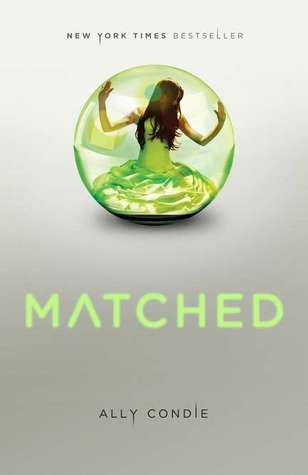
Matched, by Ally Condie

7735333Cassia lives in a future world where the government controls all aspects of life, from your job to the number of kids you can have to the date of your death. Most importantly, the government is also responsible for choosing your perfect Match. People are usually Matched with others from different cities throughout Society, so Cassia is surprised when her best friend’s face comes up on the screen during her Match ceremony. She’s even more surprised, however, when a second face briefly appears in a “malfunction,” a face she also recognizes.

I need to say, up front, that I can’t review this book in an unbiased way. Many of my readers know, but some new ones may not, that I wrote a book in 2008 called MatchMakers Incorporated, which had a eerily similar premise and very similar world-building to Ms Condie’s. My book was out at agents when Matched was announced, and was actually rejected by some agents because the book was so similar in premise. It took me months to cope with this, and once I got to a stable level again, I took steps to try to make myself feel better about Matched. I talked to Ms. Condie, first through comments on her blog and later in person at BEA. I also got an ARC of the book and read it before I even left NYC. These things helped me process the situation, and will hopefully help me change my book around so that our two books can both comfortably sit on the market one day without crowding each other.

Ally Condie is a very sweet person and I wish her all the best with this book. Selfishly, I actually want Matched to do well. Very well. There’s a good possibility that my book will never be picked up because of Matched, and if that’s so, these concepts and this world that was so intimate and dear to me – well, I want them to be out in the world, garnering support, becoming loved by readers. I was scared, when I started the book, that I would have issues with the writing or I would find the book shallow or hasty or any number of other things that bother me in books. I can’t tell you how great my relief was to find none of these things.

The book is very well written. Great characterization, great world-building, great prose. It’s a bit on the surface-level-side of YA, where there’s more high concept than deep philosophy, but it works for this book. There’s tension and the book makes you want to keep reading. There’s a cliffhanger, but it’s not one of those books that end on such an abrupt note that you’re unsatisfied. It’s a good balance between closure and wanting more.

I’m sort of at a loss on how to review the book, coming from my particular situation, but I do want to say that it’s good. I really enjoyed reading it, even if I wished I’d found the world Cassia lived in to be more different from the world I’d built. And of course, I have to admit it still hurts to know what might have been. At the same time, I’m really glad this was so well done. In an odd way, that comforts me.

One more note: The cover of this book is absolutely fantastic, one of the best covers I’ve seen in a long time.

Note: I originally read this book in May 2010 but held the review until the release date in November 2010. I no longer have the date of my original post, so I’m simply posting it on the date I finished reading.
Posted in 2010, Prose, Young Adult | Tagged | 3 Comments

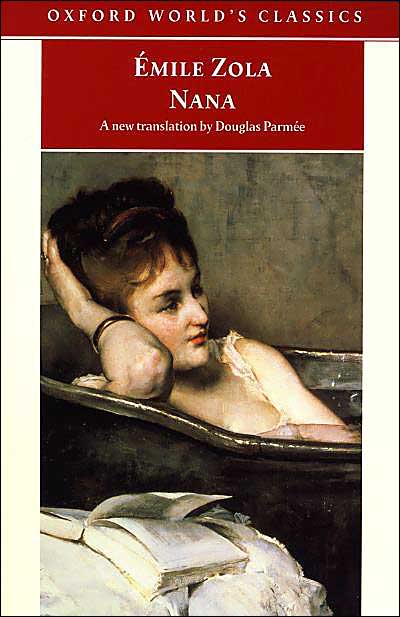
Nana, by Émile Zola

nanaNana doesn’t really have a plot I can describe. It involves a woman named Nana, a cheap “tart” as she’s called who sells her body for money but not on the streets like a prostitute. She’s picked up by a theatre even though she can’t act or sing, simply because she is so seductive that men can’t resist her. Through the theatre, her world grows, until she becomes one of the richest women in Paris, with many men at her feet. Her wealth is unsatisfying, though – she can never be satisfied. One want leads to the next, ever growing, ever more greedy.

I have to say first off that my second foray into Zola was not nearly as satisfying as my first. While Germinal was a brilliantly-written novel, full of passion and pain and hope and despair, Nana was just sort of blasé for most of the book. Part of it, I could tell, was the translation, which was far dryer than that of Germinal. Oh how I wish Leonard Tancock had translated all of Zola’s books! But it wasn’t just the translation. Part of it was the story itself.

I get really bored of classic novels about rich people. Maybe I’ve just read too many of them, but this book struck me as, “Yep, they’re rich, they’re depraved under their fine suits, and they’re destined for downfall, what’s new?” The details of the theatre production, which went on for 30 pages, felt like 200 pages of detail. Tedious, long-winded, boring. So many characters were introduced – I think that’s one of Zola’s signatures – that I couldn’t keep them straight, though by the end of the book I knew everyone intimately. And this is where I can say that Zola truly shines: his characters aren’t like characters. They’re people. Even if at the beginning it’s so confusing – it’s so hard to keep them straight, without ever describing those people – by the end of the book you know who is who and exactly their personalities. Zola is the ultimate voice in show-not-tell. He’s a wonderful example of what an author can put into a reader’s brain without ever saying a word.

I did end up enjoying the book, not nearly as much as Germinal, of course, but enjoyable anyway. I would think I was getting tired of it and I’d put it away, only to have an almost nostalgic feeling of wanting to go back to the story and see what happens next. When I wasn’t reading it, it felt like an old friend I wanted to go revisit. I could tell that Zola was carving open new paths in my brain and filling them with stuff, even if I didn’t necessarily see all that stuff at the time. It was fabulous. This is another thing that Zola seems to be brilliant at.

At some point while I was reading the novel, I read somewhere that Nana is Zola’s most challenged/banned book, and I kept wondering why. Germinal is far more racy, both in sex and violence, even though Nana is essentially a book about a high-class prostitute. But then came the scenes when Nana suddenly starts having an affair with her friend Satin, another prostitute, and then I understood. Because of some vaguely-worded allusions to lesbian sex, this book is more banned than the one where…well, I won’t say, for spoiler’s sake, but yeah. Germinal. It’s…racy. Far more racy than Nana. But Nana? Well, it has a bisexual character, that means we should ban it, right? Ugh.

There was another thing that struck me as I read through Nana. During the Classics Circuit Zola tour, I saw several people mention that they thought Zola made derogatory comments toward women, and I think nothing could be further from the truth. There were certainly lots of derogatory comments towards women made in this book; those comments reflected not on Zola, however, but on the male characters about whom he was writing. For instance, at a party where several men are scheming to get a big dinner party together which will include Nana, Zola says:

However, under his breath he contrived to whisper to Fauchery that they’d be getting Tatan Néné – the finest tits going in Paris that winter – and Maria Blond, the one who’d just made her début at the Folies Dramatiques.

Comments like this are dropped a lot – both about men and about women – and I can see some people getting real reactionary to them. However, the reaction is misplaced if it is against Zola, who obviously finds the people who think this way absolutely disgusting. He presents this sort of talk to get a reaction, to make people see just how horrible, base, and degrading this way of thinking is. He wants you to think this is disgusting. He wants you to think the people who speak like this are disgusting. It’s no secret that Zola is fairly negative about many of the people he presents in his books, both men and women. It’s important to see that it isn’t Zola himself who thinks this way, but the people he despises that do, and I think that’s a point often missed by readers.

Even though Nana wasn’t as good as Germinal, I’m still looking forward to more Zola. Next up will probably be Thérèse Raquin, La Bête Humaine, or Le Rêve.

Posted in 2010, Adult, Prose | Tagged , , | 2 Comments

The First Part Last, by Angela Johnson

200px-The_First_Part_Last_(Angela_Johnson_novel)_cover_artBobby is a sixteen year old parent, struggling to take care of his newborn daughter, Feather. He wants to do the right thing for her, but he’s not perfect. All he can do is keep trying.

I loved this book from page 1. It’s told in interspersed chapters, past events from the time Bobby finds out his girlfriend, Nia, is pregnant, and current events as Bobby struggles to take care of Feather. Bobby is such a real person and I just wanted to hug him the whole time. I loved all of the conflict he goes through, how he struggles between being a parent and being a teenager. His parents were also wonderfully written, defying all mother and father stereotypes. Mom was strict and stubborn, Dad was sensitive and overprotective.

The whole time I read, I kept waiting to figure out why Bobby was a single dad. I wondered if Nia died or if she simply didn’t want anything to do with the baby. I wondered why the couple didn’t give Feather up for adoption. Slowly as the book goes on, all that information is given to the reader in layers, one by one. Slowly it builds up to a powerful climax, where the end of the past sections meets the beginning of the current sections. I cried. It was beautifully written and completely unexpected.

I’m not sure what else to say about this book. It’s little and takes almost no time to read, but it’s gut-wrenchingly powerful. It’s an amazing book about responsible teenage fatherhood, an unfortunately unusual situation (the responsible part, I mean). This is the sort of book I’d love for all teenagers to read, especially those who are faced with teen pregnancy. It well deserved its 2004 Printz Award.

Posted in 2010, Prose, Young Adult | Tagged | Leave a comment

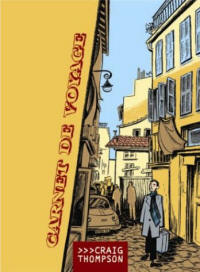
Carnet de Voyage, by Craig Thompson

Carnet_de_voyageCarnet de Voyage is Craig Thompson’s illustrated travelogue/travel journal over two months visiting France, Spain, and Morocco. He was partly doing research for his upcoming book Habibi (which I’m very much looking forward to) and partly on tour for international releases of Blankets. He warns up front that the book is a bit self-indulgent and that he doesn’t think it’s terribly well-done. Apparently he was rushed for time by the end, with a time limit and a page limit.

There is no real story to this book. Thompson travels, his hand hurts from all the signing and drawing, he gets sick a lot, especially in Morocco, and he’s homesick and lonely. Honestly, I agree with him – it is a bit self-indulgent. I guess I was just expecting more from this. I don’t know. Most of the drawing was absolutely beautiful, exactly what I’d expect from Thompson. That wasn’t disappointing. It was when he did more writing than drawing, and when he became obsessive about the grosser parts of illness, that I lost interest.

I liked the full-page drawings, the simplicity of them, the genuine seeing of the things around him, and liked less the self-centered pages of whining. I understand that it’s hard to travel, and especially to travel alone. But after awhile you have to get over yourself, and at times I lost patience, especially when Thompson was in Morocco. That was the part I was most interested in, wanting to really see Morocco come alive. That showed up in some places, but he spent most of his time there talking about how horrible all the native people were. I have no doubt many of the people he encountered were horrible, but the generalizations kind of put a bad taste in my mouth.

I’m not sorry I read Carnet. It was an interesting read and like I said, there were some beautiful drawings in it. I think I just wanted more from it, more insight into the things he saw, maybe. More like what I got in French Milk. But I guess when you’re doing a combination of research and touring on a crippled hand and an injured foot, maybe you’re not in the best headspace to be terribly insightful. This book in no way lessened my love for Thompson’s work, and I’m still very much looking forward to Habibi, but I don’t really recommend Carnet.

Posted in 2010, Adult, Visual | Tagged , , | Leave a comment

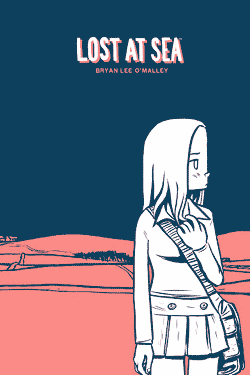
Lost At Sea, by Bryan Lee O’Malley

Lost_At_SeaIn Lost at Sea, four teenagers are on a road trip through California. Raleigh is the outsider, picked up almost by random, and she’s suffering through a problem: she thinks she doesn’t have a soul. As the trip goes on, she becomes increasingly convinced that her soul was stolen and placed in a cat. The cats are torturing her, and she’s having a mental breakdown.

Unfortunately, Lost at Sea didn’t work for me. I loved the drawing and I thought the plot was beautiful, but then it ended so unresolved and broken. The climax contained a big pet peeve of mine – an unopened letter. I hate when books or movies or anything have an unopened letter or a diary entry that the main character never reads or pretty much any situation where enlightenment is sacrificed in some way. I know I shouldn’t hate this, that it’s a device used for a very specific purpose, but I’m an intensely curious person and it drives me nuts not to know. Those books/movies/etc leave me extremely unsatisfied because I feel like I don’t have all the information, and then I’m just angry with the author. And that’s exactly how I felt at the end of Lost at Sea. I’m left unable to appreciate the rest of this book, because of the unopened letter. Grr.

And actually, I have to admit, that wasn’t the only reason Lost at Sea disappointed me. From the very beginning of the narrative, I got a very distinct impression about what I was going to find out in the climax. For some reason, I thought I was going to discover that Raleigh’s best girl-friend, who had moved away four years ago, was the same person as the boyfriend she’d gone to California to meet. I thought this was going to be a transgendered story. I have no idea why, but I really thought it. Of course, that isn’t at all what happened, despite what I thought was heavy hinting, and in a way, that disappointed me too. Stupid to let your expectations get the better of you, but I guess we all do that, don’t we?

I wish I’d liked this one better. The art was beautiful and I really enjoyed reading the first 90% of it. It’s possible my dislike and disappointment had a lot to do with my mood. There were a string of books I read that just came across as meh to me after reading a really wonderful book, so perhaps I simply read this one at a bad time.

Posted in 2010, Visual, Young Adult | Leave a comment

Shortcomings, by Adrian Tomine

shortcomings-adrian-tomine-hardcover-cover-artI hardly know how to describe this graphic novel. I suppose it’s about two Asian-Americans who are dating each other, Ben and Miko. Ben is cynical and pessimistic. He’s also obsessed with non-Asian culture (ie he likes to fantasize about white women and that sort of thing). Miko is the exact opposite, enthusiastic about everything, especially about her heritage and roots. The two have been together for several years, but don’t have a very good relationship.

They decide to take a break from each other, and Miko travels from California to NYC. While she’s gone, Ben decides to date and/or sleep with some white girls. His best friend, a promiscuous Korean lesbian named Alice, both praises him and picks on him for this. Ben is unsatisfied (what else is new?) and eventually wants to reconnect with Miko, who has made her own new connections in New York.

Originally when I saw Aarti’s review of this book, I wasn’t sure if this would be a book I’d like. I put it on hold from the library in order to preview it. However, when I got it home to flip through, I ended up reading the entire thing. It was very captivating and I flew through it in less than an hour. Ben was awful in every way, denying his heritage and at the same time playing off white stereotypes, which really grated on me. I kept waiting for him to grow up. I was also exposed to a lot of Asian stereotypes that I’d actually never heard before.

Anyway, the end of this book really didn’t work for me. Nothing happens. Ben doesn’t change. Miko doesn’t change. No one learns how to appreciate other people better. No one realizes that people are the same no matter their background, culture, race, or heritage. Ironically, it felt like the book was trying to show exactly what its title says: Shortcomings. None of these people lived up to my expectations for them, and at the end, I guess I don’t know what the point was. Which is sad, because up until the end, I really, really liked the book.

Shortcomings made me very uncomfortable with how many stereotypes it upheld. Ben continued to shun Asian women in preference for the “far superior” white women, while simultaneously holding himself “unworthy” of them because he was Asian. Miko was the complete opposite, shunning everything not-Asian in order to assert herself, which is an attitude I can’t stand no matter which culture a person is from. I believe in integrated social atmosphere, where we all interact and realize we’re all the same despite physical differences. I don’t like stereotypes upheld or one culture held higher than another – be it Ben’s idea of “white is better” or Miko’s of “Asian is better.” In fact, the only character I really connected to was Alice, who was wonderfully indiscriminate and perfectly at ease with herself and her heritage.

I don’t know. I think I missed the point of this novel. I really want to understand, but it just frustrated me, especially because it was so well-written. The art is beautiful and I really enjoyed 95% of the book. I just wish the characters had learned something and grown as people. Since they didn’t, I almost felt like I wasted my time.

Posted in 2010, Adult, Visual | Tagged | Leave a comment

Voodoo Season, by Jewell Parker Rhodes

voodoo-seasonMarie Levant moves from Chicago to New Orleans during her medical residency. Once there, she begins to have strange dreams that haunt her, and her knowledge of the patients that come into the emergency room border on sixth sense. Indeed, several of the other ER doctors/nurses seem to think that she has the Sight, and is perhaps the descendant of famous voodoo priestess Marie Leveau.

Girls start to show up in the emergency room, dead but with no trace of being killed, all pregnant. Marie is haunted by them. She knows she’s connected with them in some way, especially after she discovers the pregnancy and rescues one fetus from death. What she doesn’t realize is just how deep into magic and faux-magic the investigation into these deaths will go.

I loved this book from page 1. It’s so gloriously, sensually written. I’ve never lived in New Orleans but I’ve been there twice in my life, and this book captures the feel of the city so well. This book could take place nowhere else. I loved how character-driven the book is, even while a very intriguing plot ripples outwards one wave at a time. I expected the book to take me a few days to read, but I gobbled it up in a day as it thunder-stormed outside. Perfect weather for this atmosphere!

I’m afraid the second half of the book, however, did not work as well for me. Once Marie starts to face the possibility that she is connected with Marie Leveau, and once she starts to embrace the true religion of voodoo (not at all like the Hollywood style), the book became very confusing for me. So much information was introduced so quickly, mixing present and history in long passages of italics that left me reeling. I had the feeling that if I could just slow down, I would understand better, but I was so intrigued that I couldn’t slow down. In some ways it left me every bit as worn out as The Knife of Never Letting Go did. I need my down moments. Instead, all the way to the end of the book, I felt like I was being dragged behind a fast moving vehicle, gripping tightly and trying to keep up.

As it turns out, there was a reason for my confusion – this is the second book in a series. Voodoo Dreams was published about a decade before Voodoo Season, and it was all about Marie Leveau. If I’d read that first, the recap and integration of Leveau’s life into the modern day life of Marie Levant would not have been so confusing. I would not have been lost when characters from the first book appeared without warning, that sort of thing. I’m a bit angry at myself for not realizing this was the second in a series! Because like I said, it’s a gorgeously written book and I absolutely loved it. I’m sure I would have loved it even better had I read the first book first. Voodoo Season can be a standalone, but I think it would be a million times better with the background of the first book to go on.

I really do recommend Voodoo Season, despite the fact that the second half completely unraveled for me. Yes, I think it felt too fast and too scattered, but that’s a reflection on me and my ignorance more than on the book. I think if you read the books in order, it will be a much better experience than mine. Indeed, I felt TONS better after discovering why I felt so tired and confused after such a beautiful beginning.

Posted in 2010, Adult, Prose | Tagged , , , , , | Leave a comment

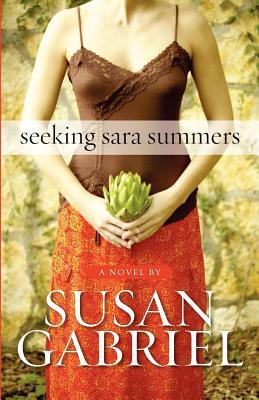
Seeking Sara Summers, by Susan Gabriel

susanSara’s life as a middle-aged mom, wife, and teacher is thrown into upheaval when she gets breast cancer. Over the last year, she’s fought the illness, continually apologized to her husband for being sick, and downplayed the seriousness of the situation to her adult children. When she suddenly receives an invitation to Italy from a friend named Julia that she hasn’t spoken to for 30 years, Sara decides to break out of the rut of her life and go. She expects to feel free in Italy, but she doesn’t expect to suddenly fall in love with Julia.

I’ve been looking forward to this book forever. I can’t even remember where I first heard about it, but it’s been on my list for over a year. I got it back in December through a special deal, signed by the author. I liked it immediately when I started, hearing this 40-something woman wonder about her life and whether or not she was really living. It’s a subject I’ve been thinking and reading a lot about lately. It was well-written and Sara’s quiet desperation seeps through to the reader.

Unfortunately, that’s where the good ended for me. The rest of the book turned out to be a big disappointment, which makes me really sad. It’s not that the rest was badly done. It’s more like from the moment Sara has her first stirring twinge of feeling for Julia, I felt like I was in a different book altogether. That twinge came literally out of nowhere. The two girls have been hanging out for a few days after not seeing each other for 30 years. They were best friends as kids and they hit it off immediately when Sara came to Italy. I didn’t expect it to take weeks for a romantic interest to spark up, but I did expect some sort of foreshadowing. Instead it was just – the girls went on a walk, they talked about the scenery, and suddenly Sara’s hit with a desire she hasn’t felt since she first got married. It was abrupt and awkward.

I love the concept of this book. I love the idea that two women who have never had a relationship with other women before can fall in love with each other because of their bond. I love that. I loved the relationship that formed between Julia and Sara. But I didn’t buy HOW it formed, not in the beginning, anyway. From that change onwards, the writing became more awkward, jumping weeks or even months very quickly, leaving out key details, almost as if it was more of a sketch of a story rather than the full story.

I hate to say all this. I really wanted to love this book and I think the message it sends is so important. I love the acceptance and the struggle with one’s past. I love the idea that true love transcends gender. I just…wish it had been executed differently, or that the transition Sara makes had felt more natural and realistic. Maybe I just set my hopes too high. I don’t know. Sadly, it just didn’t work for me.

Posted in 2010, Adult, Prose | Tagged | Leave a comment

Little Children, by Tom Perrotta

little-children-novel-tom-perrotta-paperback-cover-artSarah doesn’t fit in. She takes her daughter to the playground near her home in an upper-middle class suburb, but she knows she’s different from the other moms there. While they talk about fatigue, sex, and their daily schedules, conversation led by confident super-mom Mary Ann, Sarah feels like she’s dying inside. Then she meets Todd, a stay at home dad nicknamed “the Prom King” by the other women. The two begin an affair more out of desperation than attraction. In their summer fling, the two are momentarily free from the demands and quirks of their spouses, as well as from worrying about the child molester that has just moved into their community.

My description makes this book sound sordid, but really, it isn’t. It’s hard to describe. Perrotta paints a picture of suburban life and the expectations that come with it. I personally find that sort of life – with perfect houses and perfect lawns and perfect exercise routines and always keeping everything together – absolutely terrifying. Sinister and oppressive. And that’s exactly how it feels in this book. I wasn’t sure I was going to connect with it when I started it, but after five pages, Perrotta captured that feeling of underlying wrongness so well that I couldn’t put the book down.

Little Children isn’t about an affair. It’s not about sex, and it’s not about immorality. It’s about desperation, freedom, responsibility, and class and gender expectations. You meet every sort of character you’d expect in a white upper class suburb: the man with the internet sex fetishes, the woman who schedules everything down to the weekly night in bed with her husband, the crazy guy who will go out of his way to try to run the recent neighborhood threat out of the area, the middle-aged guys who try to recapture their youth with violent sports, the retired teachers who get together to discuss classic literature, the old lady who is too poor for the area but has owned her house since before the neighborhood was rich. Every couple has marital problems of varying degrees. Every person has their own issue. No one is as perfect as they pretend to be on the surface.

What I loved about Little Children is that it addressed the subject of oppression in our modern world. It doesn’t seem as if we should be oppressed, with all the conveniences and modern technology we have. And yet, the more we have, the emptier we seem to feel. On the surface, you may look like you have the perfect family and the perfect life, but beneath the surface you are slowly eating away at yourself, plastering on a mask of a smile so that no one sees that you’re drowning. There are couples who can’t connect to each other. Parents who can’t connect with their children. People who can’t connect with anyone around them, so that when the tiniest spark of a connection flares up, they can’t help but be drawn into the flames.

I think everyone knows that feeling of emptiness. Probably everyone has experienced it at one time or another. Maybe it’s the amount of freedoms we have. Maybe it’s our leisure time or our education. Maybe it’s our disconnect from the earth. Maybe it’s our abandonment of religion or faith. Maybe it’s just changing hormones or brain chemistry. There’s all sorts of theories about what causes this hole to open up inside us, but theories don’t change the fact: Many of us feel – or have felt – hollow, aching, and yearning.

This aching oppression was at the heart of Little Children, and it reminded me a lot of The Awakening by Kate Chopin. Of course, The Awakening primarily addressed class and gender expectations for women, while Little Children addresses those expectations in both genders, but still, the similarities were uncanny. The characters spiral further and further out of control in an attempt to repress the feeling of powerlessness in their lives. They want to live, but are subject to a society that tells them they must be automatons. When they break out of the mold – Sarah and Todd’s affair, Sarah’s husband’s internet fetish, Larry’s crazy obsession with the child molester, even the child molester himself – they are crushed by a tidal wave of judgement. Guilt boxes them in. Fear keeps them quiet. Pain snuffs out their little flame.

The book wasn’t perfect. I personally would have preferred more focus on Mary Ann and less on the child molester’s life, simply because I thought Mary Ann’s power-mom lifestyle fit stronger along the themes of the book. But other than that, I loved the book. Unlike with most modern American adult literature, I was not disappointed by pointless sex, vomiting, language/dialogue that didn’t match the characters, or any other grit. The characters were marvelously painted, so real I feel like I know them. There were no happy or tragic endings – just endings. Little Children resonated with me strongly, and I can tell it’s going to stick with me for a long time.

Posted in 2010, Adult, Prose | Tagged , , , , , , | 3 Comments

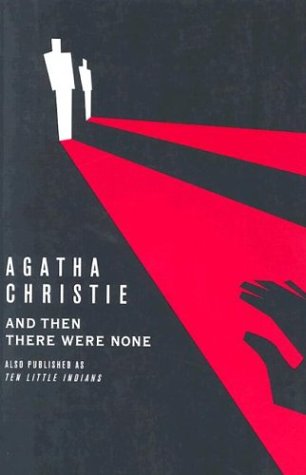
And Then There Were None, by Agatha Christie

and-then-there-were-none1Ten strangers with guilty consciences are invited for different reasons out to Indian Island. They don’t expect to be suddenly called out on their crimes, or to begin dying off one by one. Now they’re in a race against time, and no one knows who the madman is that they’re up against.

This is my very first ever Agatha Christie novel. I’ve never been much interested in Christie because I’m not a huge mystery novel fan. However, I read Lula’s review of And Then There Was None, which said that the movie Clue is loosely based on this book. Clue is one of my all-time favorite movies. I first saw it when I was 10 years old, and I’ve watched it hundreds of times since then. I have the movie nearly memorized down to the various noises the characters make, the musical cues, the vocal inflections, etc. Give me a line, or even a few words, from Clue, and I will reel off the next 20 lines, in voice, from the movie. Needless to say, when I heard that this book was the loose basis for Clue, I knew I had to read it. When the Golden Age of Detective Fiction Classics Circuit Tour came up, I knew this was the perfect opportunity.

So, what was my first experience with Christie like? Well, at the very beginning, I was a little disappointed. The writing seemed dry as she introduced each of the characters one by one, and I had a really hard time keeping them all straight. Of course, character confusion is fairly normal at the beginning of a book, especially when so many characters are introduced. Ten seemed a little excessive to me, though. Too much for my brain to take in.

Once everyone was introduced and out on Indian Island, however, the book just took off. I had all sorts of plans the morning that I sat down to read, but instead found myself unable to put the book down for several hours. Christie knows exactly how to hook a reader and keep them reading nonstop! I was very impressed with the amount of tension she built up. I kept trying to figure out who the killer was, using not only my own sleuthing skills (which are none too great) but also my knowledge of Clue. Neither helped me. I had all sorts of wild ideas and none of them panned out. In fact, the only thing I figured out was how the murderer was doing all this, even though I had no idea who he/she was.

I loved the psychological aspect of this book. The mind trip it takes you on. A couple people on Twitter told me this book had scared them, and I’m not sure so much that it scared me as gave me chills and made me slightly paranoid. It’s the sort of book that made me want to look over my shoulder, even though 1) I haven’t committed a crime and 2) I was alone in my house. I just got so into the plot, that I got jumpy. I loved that.

In fact, the only thing I didn’t like about this book was the end. One of the things I find very important about mystery novels is that a reader can catch the clues and figure things out along the way. What I don’t like is when the “how and why” is laid out in a single chapter monologue. That’s a technique I’ve never approved of in any book, mystery or not (for example: the “King’s Cross” chapter in Deathly Hallows). I don’t like info-dumps, and that’s what the end of this book felt like to me. I don’t mind the solution given away at the end. In Clue, for example, the whole thing is wrapped up in the last 20 mins of the film. But it’s unwrapped bit by bit, by multiple characters, using clues from along the way. It’s not a big info-dump. The last chapter of And Then There Were None felt like Christie was saying, “Now that I’ve gotten you all thoroughly confused with this book, let me just tell you the solution.” It was disappointing. The solution itself was awesome. The presentation of the solution – not so hot.

I’m not sure I’m going to read more Christie, simply because, as I said before, I’m not really a mystery sort of person. However, I will keep her in mind for those rare moods when I feel like reading a mystery. She seems to be a master at what she does! I’m glad for the chance to have read this (though I admit, I still like Clue better).

Posted in 2010, Adult, Prose | Tagged , | 3 Comments