
Books:
Archive:
Favorite Reviews:
I have reviewed many books over the years, and some reviews have been more interesting or fun to write than others. The below list were my favorites to write.
• Ada, or Ardor
• Choose Your Own Autobiography
• Dr. Jekyll and Mr. Hyde
• If Not, Winter
• Jonathan Strange & Mr. Norrell
• The Kid Table
• Like Water for Chocolate
• Lolita
• The Monk
• The Night Circus
• Oathbringer
• Return of the Native
• Rhythm of War
• S
• Things Fall Apart
• The Unit
• The Woods Are Always WatchingCategories:
Tags:
- abandoned
- Africa
- Asia
- atmospheric
- audio
- BBAW
- body image
- callback
- circus horror
- classics
- collection
- comfort
- Cosmere
- cruise
- divinity
- dream-invader
- education
- end of year
- fanfiction
- favorite
- fitness
- food
- gender studies
- goals
- good omens
- Harry Potter
- health
- historical
- house
- humor
- I made a thing.
- joint review
- KonMari
- Latin America
- LGBTQIA
- lists
- memorable
- Middle East
- mini-review
- multi-read
- nonfiction
- photography
- place-character
- POC
- portentous
- psychology
- quarantine
- race report
- readathon
- reread
- revisiting
- RIP-worthy
- running
- shredded me
- speculative
- Sunday Coffee
- tarot
- tattoo
- the ferals
- translation
- travel
- Wellness Wednesday
- WTF moments
- Yarn Art


-


Protected: The Dark Between, by Sonia Gensler
Posted in 2013, Prose, Young Adult
Tagged historical, speculative
Enter your password to view comments.
Cooked, by Michael Pollan (audio)
 Took me forever to listen to this one because I did it over NaNoWriMo!
This is Michael Pollan’s nonfiction book about cooking – the origins, the methods, etc. It’s split into four parts roughly coordinating with the four elements, so I’m going to split this review into four parts as well.
1 – Fire
In this section, Pollan talked about barbecue. You know, fire. And he pretty much spent the entire section making fun of southerners. I learned very little about the process of grilling or cooking meat with fire, except that people are really particular about how they do it, that the word “barbecue” can cause massive conflict from one person to the next, and that it takes a lot of time to grill meat correctly. But mostly, I learned that Michael Pollan is a snob when it comes to southerners, a fact which was made worse by him being the narrator and trying to imitate – in pure stereotypical fashion – their accents. Yeah…
2 – Water
So, I nearly quit listening to the book in the Fire section, it was so bad. I decided to try a little bit of the Water section, which dealt with what I’ll just call “regular” cooking (cook-pots), before giving it up completely. I ended up really liking this section. Since Pollan is not at all a snob about slow cooking, gourmet cooking, or techniques involved in this sort of cooking, he gave it proper respect, and actually got me thinking that it would be best for me to learn more about cooking in the future. So thumbs up for this section.
3 – Air
This section dealt with bread, where Pollan did spend a bunch of time showing how crazy both professional and amateur bakers could be, but not quite as bad as the Fire section. He also discussed the bread-making process, particularly from sourdough cultures, in some detail, and I was very interested in learning about the chemical processes that go on in bread-making. It was especially interesting because he talked about Celiac Disease and gluten-intolerance (without any anti-gluten-free-living snide comments, which would have made me abandon the book altogether), and some of the reasons scientists believe the condition is becoming more common. One has to do with the amount of time (or lack of it) used in making bread products now, so that there’s much more gluten left in the bread as an end-product. Also, apparently Italy has a very high percentage of Celiac. Didn’t know that.
4 – Earth
This section dealt with fermentation, and personally I think it was more of a continuation of Air than really anything to do with Earth. Lots of interesting things in here, though I have no desire to, say, make my own pickles or alcohol or cheese even after learning about the various processes. Most interesting thing: apparently the removal of bacteria from our foods might be contributing to the obesity epidemic, based on studies done with mice. So it might be a good idea to have more fermented foods around, even if I don’t want to actually make them myself.
That’s about it. As a Pollan book, it was just meh, particularly because I was uncomfortable for a huge chunk of the book. I may or may not indulge in any sort of cooking in the future, so it didn’t really change my life the way other books of his have, either. In the end, it was just okay.
Kid Cyclone Fights the Devil, by Xavier Garza
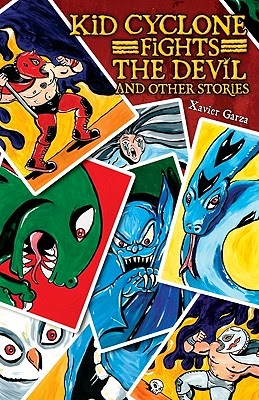 This is a collection of folktales and creepy children’s stories out of Mexico (and out of Mexican-American communities in southern Texas). There are 14 stories in the collection, which is a bilingual collection – Spanish one direction for half the book, then flip it over for the English version on the other side. It is illustrated as well.
The stories, I admit, were not the best written. They felt like they talked down to children, but maybe I’m just not a fan of stories written for the 5-7 age group. It was a bit strange to have Young Reader level writing mixed with the horror that was in a lot of these stories, a lot of blood and shooting and fear.
Laurence read this collection in Spanish last year and still remembers a lot of it (thank you book reports!). He and I both agreed that many of the stories were strange, or had very abrupt endings, sometimes unexpected (and not necessarily in a good way). But we both also found a few of the stories creepy, in particular Llorona911 and Giggles the Clown. Laurence still finds the latter one creepy a year after reading the book. So I guess it was very effective that way.
It was a fun read, easy to read between chapters I was writing for NaNoWriMo. Not something I’ll remember forever, but an interesting look at some of the stories I’ve heard bits of over the years but never a full story. And it’s cool that my friend Joseph is friends with the author.
Posted in 2013, Children's, Prose
Tagged collection, Latin America, POC, RIP-worthy, speculative
Leave a comment
Perfect Ruin, by Lauren Destefano
 Major spoilers.
Young adult fantasy dystopia. Morgan lives on Internment, a floating city in the sky. Everything there is rigidly controlled, but relatively peaceful. The only problem is the Edge, which lures people to it, and often they’ll jump. Jumping off the edge doesn’t work – it causes injuries and disabilities, sometimes death, but the jumper will remain on Internment. Morgan doesn’t question any of this – even though her older brother became a jumper three years ago – until a girl near her age is found murdered on the train tracks one afternoon.
Fascinating book. I loved the writing from the beginning, and I couldn’t wait to find out the truth of this world. The idea of a floating city that doesn’t let people leave was just so ridiculous, so completely fantastical. It couldn’t be real. It had to be something – anything from a section of the world manipulated to look like it was floating in the sky, to a Matrix-like situation. (That latter one, heh, was even obliquely referenced!) But then, in the last quarter of the book, everything went wacky, and Morgan and Pen end up kidnapped by the King’s kids, getting away, and then they all go to the ground after all. Book ends with them getting off the spacecraft on the ground, being told to halt by whoever is there to meet them.
WTF? They definitely aren’t on Internment anymore, and they flew down from the sky, watching it out the windows, so…I guess they really were in the sky? And it’s a trilogy, of course, so I don’t know yet.
I can’t decide if I’m intrigued or so disappointed that I don’t want to read the next book. I’m glad there wasn’t a love triangle or anything – there was hints that there might be – and I’m really hoping the series doesn’t devolve. I’m not sure I want to read further. But maybe I do? Not sure.
Bang, by Lisa McMann
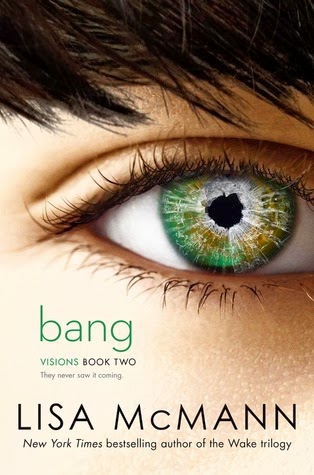 It’s Sawyer’s turn for visions, and Jules (and her brother Trey, and later her sister Ro) have to help him prevent a disaster: a anti-gay school shooting at a nearby university.
Not much to say about this book. I liked it as much as Crash. The characters were fun, the plot was fun, the writing has its not-for-me moments as is usual for Lisa McMann. It only took a day to read, because that’s how these books work. I do look forward to the next one, especially since we don’t know who will be having visions yet. Also looking forward to knowing if Dad has visions, too. That’s about it.
More Than This, by Patrick Ness
 Major spoilers.
Seth dies. He remembers dying, but then he wakes up in a strange place that’s sort of familiar, but also not. The world seems to be dead and empty, and he wonders if this is his own personal hell. Every time he falls asleep, he dreams of the things that led up to his death, like nightmares that he can’t control.
At first glance, the book appears to be about someone who has died and who is sorting out their life and dealing with their death and their grief and their loss. It was an interesting book, filled with only a single character in the present, but multiple characters sketched out in memories. There were interesting plot developments in the past, and I loved that the world was completely dead, and that Seth was having to survive alone.
That was Part I. Then I got to Part II, and suddenly, it was like I’d dived into a version of the Matrix. I mean, except for the fact that people were living in coffins instead of pods, it was pretty much exactly like the Matrix. I kept hoping, all the way to the last page, that it would be something better, but no. So disappointing. The first part of the book was so interesting, and then it just turned into some action-adventure book with some pseudo-philosophy about death, dying, and loneliness thrown in every once in awhile. That just ruined the book for me. Boo.
Anansi Boys, by Neil Gaiman (audio)
 Charles Nancy aka Fat Charlie has always lived in the shadow of his father, and is relieved when his father dies. Then, at the funeral, he’s told that his father was a god, and that he has a brother named Spider that he knows nothing about. In a drunken fit, Fat Charlie calls his brother to visit him, and ends up completely ruining his life.
Karen’s been after me to listen to this book for years now, but I really didn’t want to, because I really just didn’t like American Gods (to which this is a loose sequel)! But eventually, I listened, and it turned out to be a pretty good book. It wasn’t anything like American Gods, but far more like Good Omens, a book I really loved. There were good twists and turns, and the supernatural stuff wasn’t too far-fetched, and I liked all the characters. The audio narration was also pretty good.
I forgot to write about this one right after I finished listening to it, so I don’t have a lot of impressions to write down. In general, I enjoyed it, and I’m glad I gave it a chance. The end.
Posted in 2013, Adult, Prose
Tagged atmospheric, audio, divinity, humor, POC, RIP-worthy, speculative
Leave a comment
The Mad Scientist’s Daughter, by Cassandra Rose Clarke
 Finn is an android, but human in appearance, and nearly human in the way he behaves. From the time Cat is five years old, Finn acts as her tutor, but as she grows, he becomes her friend. Eventually, she has fallen in love with him, and knows that though he can physically respond to her when she asks him to, he will never be emotionally tied to her, nor will it ever be “right” to be in love with a robot.
This was an interesting book. I worried about the whole robot bit, but it was pulled off well. While there was definitely some suspension of disbelief in the whole situation, it was a familiar enough concept, and the same could have been written about, say, a southern white family in the early 1900s and a daughter who fell in love with a black servant. Even society’s attitude toward various forms of robots and androids changes throughout the book, and by the end, many new laws are enacted to protect them. In some ways, the metaphor was almost too strong, but honestly, I didn’t mind. The story was interesting.
I appreciated the exploration of whether a non-human can feel the same way a human can feel. Again, it’s the same as a person trying to confront their own prejudices about how other races/genders/religions/orientations etc feel. With Finn being an actual robot, the dynamic was even more interesting.
The writing was good. I was surprised just how sensual and evocative the human/robot sex could be, but it was.
The book wasn’t all perfect. There were some strange personality shifts that didn’t seem to quite mesh 100% of the time, and I have a hard time believe Richard would never find out about his son. But for the most part, it was well-written. I wish it had been published by a bigger publisher. It needed some copyediting and consistency checking. A professional team of editors would have shaped it into even better shape than it already is. But for being small press, they did very well – I noticed far fewer errors than I normally see in small press printings.
Steelheart, by Brandon Sanderson
 Major spoilers.
A decade ago, a red star called Calamity appeared in the sky, and certain people were granted supernatural powers. These Epics are practically invincible, and with invincibility and power, they become corrupt. Chicago is taken over by an Epic called Steelheart, and David was in the bank that Steelheart attacked on the day of the takeover. He was a small boy, and he watched Steelheart kill his father. He also saw something important: he saw Steelheart bleed. For years, he has watched Epics and gathered information, with the intent to join an underground group called the Reckoners, the only people left who still fight against the Epics. He will join them, and fight, and eventually get his revenge on the man who killed his father.
I admit, after The Rithmatist, I was a little leery about reading another of Brandon Sanderson’s YA novels, even though he’s one of my favorite authors. The Rithmatist just felt too young to be YA, and his 16-year-old main character, Joel, acted more like a 12-year-old. I was not terribly impressed, even though I liked the book. Steelheart was different. From the very beginning, it was far more grown up. David is 18 at the start of the book, and he acts more like an adult than a child. There is violence – not so much gore, but very disturbing scenes – right from the beginning. All throughout the book, there were little moments that felt more YA, but I think the book could have easily passed for an adult novel. It’s right on the brink between the two age groups.
I was sucked into this world and the story immediately, barely putting the book down. The pacing was perfect, and Sanderson once again excelled at character and the dynamics of a close-knit group. There were many things I didn’t expect, many twists I didn’t anticipate. There were moments that nearly brought me to tears. There were parts that made me angry, and then made me see things more clearly. I kept guessing all the way through. And sometimes, I was nearly right! I was convinced that Steelheart’s weakness came when someone believed he was a good person, and so he set about doing evil things – and fabricating evil things – in order to show himself to be a bad person. I wondered if perhaps we were going to get a classic Sanderson twist of discovering that the person we thought of as evil was not so bad after all. But in the end, it was a lack of fear, rather than a belief in him, that was the weakness, and I thought David was clever in how he eventually brought about Steelheart’s demise.
One thing I wasn’t sure about right away was Megan’s reappearance after her death. I get annoyed when people die and come back to life in books, and Megan’s death was particularly poignant. But discovering that 1) she was actually Firefight, 2) she had died many times and that part of her power was resurrection, with loss of memory, a day later, and 3) she was actually herself for a lot of the time, rather than an Epic – these things helped me to cope, and I hope we get to know her better in the next book. Considering it’s called Firefight, I imagine much of it will revolve around her.
I cannot wait to read the next book. This was absolutely fantastic. I only regret that it’s a bit too old to read to my boys (at least the two younger boys), and I know they were looking forward to it. Sanderson completely redeemed himself for me re: YA with this book.

