This year has been extremely difficult for me. In my personal world, I’ve dealt with illnesses, death, betrayals, libel, psychos, financial difficulties, health issues, severe depression, a huge upheaval in my writing world, and the stress of three months spent in the process of preparing for a cross-country move that, in the end, didn’t happen. In other words, this year sucked. Horribly. It’s been the worst year I’ve had in quite a long time and I’ll be glad to put it behind me. Unfortunately, that omnipresent awfulness found its way into my reading year as well. I did read some wonderful books, oh yes, but considering I spent most of the year reading only what I wanted, not to mention trying about 300 books only to discard them, I’ve not had a good reading year. The first quarter of the year was the worst. Book after book was mediocre to bad. None of my favorites of the year came from that quarter, and six of my fifteen worst books of the year were read then. How’s that for awful? Second and third quarters were better, particularly in July when I hit a brief spell of wonderful books all in a row. The last quarter of the year was mixed. The beginning of October and most of December were wonderful, but the 6-7 weeks in between? Same as that first quarter, mediocre to awful. Bleagh. Most of my 5-star books were concentrated into three parts of the year: a week in July, two weeks in late Sept/early October, and a week in December. I’d rather they be spread out a bit more!!
I’m really hoping that 2011 will be better. I don’t know what to blame the rut on. I can’t blame them on challenges or “should” reads, since I quit my challenges and read what I wanted most of the year. I can’t blame them on reading too many books too quickly, because some of my best months were when I was reading tons. I can’t blame them on modern lit or classics or adult or YA lit, because the blahness was across the board. And I really don’t think that my own blah mood was the problem. None of these were books that I could tell I’d like better if I was in the right mood, and for instance in July, when I had the great spell, I was in the middle of horrible stress and depression. So it’s not mood either. I’m blaming it on 2010. Bad year. It’s time to leave it behind!!
So, in the spirit of getting it all behind me, here is my end-of-year stat report! Yes, I’m a complete stat nerd!!
General stats:
Total books: 217
Full reviews: 197
Mini reviews: 18
Individual Short Stories: 88
First-time reads: 196
Rereads: 21
Just for fun: 86
Read deliberately: 131
Source stats:
Bought: 102
Gift/Win: 25
Swap Site: 16
Borrowed/Library/Web: 50
Review copy: 24 (11 from BEA)
Note: That “bought” category does not mean bought in 2010. Many of them were bought years ago. They were bought from a whole variety of sources, from full price at a chain store to 50 cents at a library sale. I’m glad that over half of my books this year were ones I didn’t pay for…I wish I’d gotten more use out of my swap sites though. Hopefully I will going forward!
Type stats:
Novels/Novellas: 179
–Speculative: 81
–Realistic: 98
Nonfiction: 21
Collections/Anthologies: 6
Plays: 5
Poetry: 6
Text: 179 (including 3 eBooks)
Graphic/Photo/Art: 30
Audio: 8
No real surprises here. I’m happy that I read the equivalent of nearly 2 nonfiction books per month. That’s definitely up from previous years. I also read more poetry and plays, and listened to more audiobooks. Collections are about the same for the last two years, and GNs are about the same as last year (the first year I read them). I’m satisfied with these stats, though I expect the GNs will go down and audiobooks will go up in 2011.
Time stats:
Classics: 64
Contemporary: 153
2000s: 133
1900s: 63
1800s: 17
pre-1800s: 4
Oldest book: If Not, Winter by Sappho (~600 BC)
Newest book: Matched by Ally Condie (Nov 30, 2010)
I’m very happy with my classics stats this year! Nearly a third of my books were classics, and I read more than one per week. I’m back to the percentage I was reading in 2008, and far better than the 20% classics of 2009. Of course, I expect my classic-to-contemporary ratio to drastically change this year with the whole Classic Weekly project. I’m also very happy with my range of reading. Without planning it at all, I read at least one book from every decade from the 1840s to present, plus books from the 1810s, 1790s, 1760s, 1750s, and BC era. That’s pretty awesome.
Age stats:
Adult: 108
YA: 73
Juvenile: 36
This is about on par with what I read in 2009 for YA and children’s fiction, but my adult fiction reading has increased a lot, probably because of the increased concentration on classics. In 2008, there was a far greater percentage of children’s books on my list and only 2-3 YA books total. I’d guess my stats in 2011 will be heavily adult-centered. I have very little YA left on my TBR, and now that my kids are getting into that middle grade age, I’ve found I don’t really want to spend time with that age group in books.
Place stats:
World-lit: 47
Countries visited: US, UK, Canada, Brazil, Australia, Russia, Mali, Senegal, Ecuador, Germany, Palestine, Denmark, France, Greenland, Czech Republic, Italy, Nigeria, Spain, Morocco, India, Nepal, Suriname, Paraguay, Turkey, Mexico, Portugal, Lebanon, Jordan, Malawi, Hungary, Switzerland, Ireland, Colombia, Argentina, Israel, Japan, Norway, Iran, Iraq, Egypt, Greece, and Kuwait
I made a map for this, because I love maps!!

I think I need to read more from Africa and Asia next year. This map and countries listed above, btw, are based solely on book setting, not on author’s country. I might change this stat for next year to include author origin too.
Author stats:
New to me authors: 112
Total authors: 157
By men: 83
By women: 130
Mixed team: 4
Most read authors:
JK Rowling – 8
Suzanne Collins – 7
Francesca Lia Block – 5 (the Dangerous Angels series)
Laurie Faria Stolarz – 5 (the Blue is for Nightmares series)
David Levithan – 5 (standalone novels & collaborations)
William Somerset Maugham – 5 (standalone novels/nonfiction)
My ratio of men to women authors (40/60) is about the same as last year (didn’t track it in ’08). I imagine it’s the high modern book content that tips the scale towards the women’s side. Next year there will probably be more balance, or perhaps a tip towards the men’s side. I bet there’ll be less new-to-me authors as well in 2011.
Other stats:
GLBT: 49
POC: 65
Chunksters: 20
In translation: 20
Languages: French (8), Russian (3), Arabic (3), German (2), Hungarian (1), Norwegian (1), Portuguese (1), Ancient Greek (1)
My GLBT reading is far up from previous years, as well as my POC reading and chunksters. I’m really happy with all of those numbers! Translations are slightly up, but interestingly come from far fewer languages…
Wrap Up:
Best reading month: I didn’t really have an overall “good” month, but instead those three small spurts of good in July, October, and December.
Worst reading month: March!!!!! (Was that emphatic enough?) March was horrible, followed closely by November’s awfulness.
Best book-related discoveries: It’s been a tradition since I first started blogging to include my best book-related discoveries here in my year in review post. In 2008, it was Lois Lowry. In 2009, it was YA and graphic novels. In 2010, I also have a double answer.
1) Émile Zola. What an amazing discovery it was to find out that he was not dry and boring like I expected him to be for years, but instead one of the best authors I’ve ever come across. I’ve read three of his novels now, with a bunch more on my shelves, and have yet to be disappointed.
2) Audiobooks. I used to think I didn’t like audiobooks, but after listening Return of the Native read by Alan Rickman, I fell completely in love. It still takes me a long time to listen to most of them, but I love what listening to them does for my reading experience. I’ve gotten to the point where I can physically read most books quickly, often in a single day, and when I read books like that, they tend to fall away from my memory after awhile. Listening to a book over a few weeks takes them to a whole new level, and many of my favorite books of the year have come from audiobooks, even though I only listened to eight altogether. I remember them all so much better, and I get more out of them. I’m so happy to make this discovery!
So that’s all for my stats. Now for my best of 2010 lists!
People have been putting up Best of 2010 lists for nearly two months now, but I just couldn’t do it until I was officially done reading/reviewing books in 2010! Now, I’m done, so it’s time to evaluate my 217 (yikes!) books of 2010 to decide my “best of.”
This survey comes from Jamie at The Perpetual Page-Turner. Despite the way the questions are worded, I simply can’t limit myself to one book per answer! Sorry!
1. Best books of 2010? This is a big question in a year where I read 217 books! I had a very difficult time narrowing my list down to 15. I had to drop some very good books from the list so I didn’t have too many on there, and that makes me a little sad. But I narrowed it down. Rather than list them all here, I’ll list them with the reasons why they made the list after this survey.
2. Worst book of 2010? I’ve read fifteen books this year that I’d consider “horrible” instead of just “bad.” These round out the bottom five of those: Daddy-Long-Legs, because I felt it was shallow and degrading to women; Bleak House, for the caricatures and the fact that 75% of the prose could have been comfortably cut; African Sojourn, because it was degrading and stereotypical; Market Day, because the end horribly ruined what would otherwise have been a gorgeous 5-star graphic novel; and the very worst – the GN adaptation of Crime & Punishment, because nearly a year later, I still can’t even see the cover of this book without getting sick to my stomach, and I now have no desire to ever read the actual version of C&P.
3. Most Disappointing Book of 2010? Fingersmith. I really expected to love it, but I disliked every minute even though I forced myself to read all 700ish pages. 😦
4. Most surprising (in a good way!) book of 2010? Liar, entirely because of how much the twist surprised me; Rowan the Strange, because with that cover, I expected to hate the book!; and Germinal, because I’d avoided Zola for years and expected him to be a cross between Flaubert and Wharton, two authors I really dislike
5. Book you recommended to people most in 2010? No surprises here: Germinal, Little Children, The Kid Table, Crossed Wires, and The Painted Veil by Maugham. That last one I didn’t even read this year, but have read three times in the past, and is usually my go-to suggestion for Maugham. Since I’ve read a lot of Maugham this year, I’ve ended up recommending this one a lot.
6. Best series you discovered in 2010? I rarely read through a full series, but this year one really captivated me: The Blue is for Nightmares series by Laurie Faria Stolarz. I read the five books back to back, unable to gulp it down fast enough.
7. Favorite new authors you discovered in 2010? Zola!!!!!!! Gosh I’m so predictable. I also confirmed Rosy Thornton as one of my favs.
8. Most hilarious read of 2010? I’m giggling just thinking of this list: Good Omens, Gothic Charm School, Cold Comfort Farm, and Dick and Jane and Vampires.
9. Most thrilling, unputdownable book in 2010? This has to be Mockingjay because not only could I not stop reading, but immediately read it a second time, and then read the entire series again because I still hadn’t had enough.
10. Book you most anticipated in 2010? Matched, because of the personal connection, and Mockingjay, because…well, it was Mockingjay!!
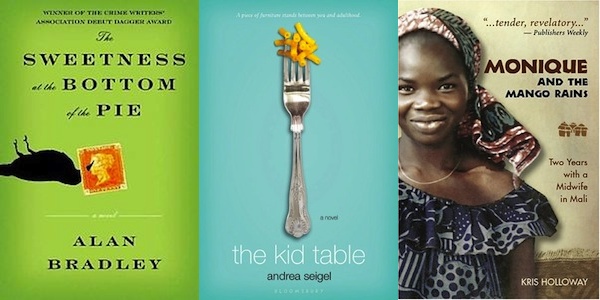
11. Favorite cover of a book you read in 2010?


12. Most memorable character in 2010? Ah! Too many. Hm, let’s see: Humbert Humbert, Barbara (Notes on a Scandal), Katniss Everdeen, Eustacia Vye (Return of the Native), Merrycat (We Have Always Lived in the Castle), and…can I just add the entire cast of Good Omens?
13. Most beautifully written book in 2010? Going by language alone? Lolita, Sonnets from the Portuguese, and Notes on a Scandal.
14. Book that had the greatest impact on you in 2010? Sonnets from the Portuguese, because it showed me for the first time ever that there IS some poetry out there that I love, and The Return of the Native, because it started my love affair with audiobooks.
15. Book you can’t believe you waited UNTIL 2010 to finally read? There are very few books left on my TBR that are ones I’ve put off for a long time. This year, I can only think of two, and one (Bleak House) did not end up being a good experience! So my only answer here will have to be Germinal. I’m so glad I finally sucked it up and gave Zola a chance!
The rest of this survey is about Book Blogging in 2010:
1. New favorite book blog you discovered in 2010? Just like with the books, I couldn’t pick just one! Five of my favorite new-to-me blogs (in alphabetical order) are A Literary Odyssey, Erin Reads, Lifetime Reading Plan, Park Benches & Bookends, and She Reads Novels. I also don’t want to leave out two brand-new favorites I just discovered in the last two weeks: Cousins Read and Your Move, Dickens. There are so many others I had to leave out…sigh. Sorry y’all!
2. Favorite review that you wrote in 2010? Return of the Native. I had more fun writing that review than I ever have writing a review before.
3. Best discussion you had on your blog? I had several really good discussions this year, but the one that generated the most debate was probably on my Your Summary or Someone Else’s post.
4. Most thought-provoking review or discussion you read on somebody else’s blog? Amy did a whole series of posts in late summer/early fall about books and reading that really touched me and got me thinking. An example would be her Less is More post. That’s not the only one, but it’s a particularly good one. She put into words everything I’d been feeling and struggling with and I’m very thankful for that.
5. Best event that you participated in (author signings, festivals, virtual events, memes, etc.)? Event-wise, this was definitely BEA and the Book Blogger Con. Virtual event-wise, my favorite this year has probably been the RIP Challenge, because I threw myself into it completely and loved nearly every book I read for it.
6. Best moment of book blogging in 2010? I’m not sure I could pick out a “best” moment, but the one that touched me most was all the support I got, from bloggers and strangers alike, after the NY Times Crap…
7. Best bookish discovery (book related sites, book stores, etc.)? Above I said that my best discoveries of the year have been Émile Zola and audiobooks, but I’m not sure that’s exactly what this question is looking for. I haven’t really discovered any book related sites or book stores or stuff like that, though, so that answer will just have to do!
***
So that’s the survey, and here are my top 15 books of 2010, listed in the order I read them:

Germinal by Émile Zola – So I’ve been raving about this one all year, and I imagine if I was hard-pressed to pick a single best book of 2010, this very well might be it. I never would have expected French realism about coal miners to end up in my best-of list, but Germinal was just fantastic. I’m very much looking forward to rereading it with my book club in 2011!
French Milk by Lucy Knisley – This book was so much fun. I think it helps that I had many of the same experiences in France. I get a kick out of this one every time I think about it.
Little Children by Tom Perrotta – Like reading The Awakening only in modern times. Oh my gosh. So powerful.

Things Fall Apart by Chinua Achebe – I hated this book nearly the entire time I was reading it. I almost didn’t finish it, but I kept going, and once I hit the end, I really understood this book. Everything got turned around in my head, and I fell in love with it!
Notes on a Scandal by Zoë Heller – Brilliant writing, absolutely brilliant. Barbara is one of the creepiest, most fascinating narrators I’ve ever read, and the prose is gorgeous.
Theatre by William Somerset Maugham – A reread for me, this is one of my favorite Maugham books ever! I loved it even more this time around.

The Kid Table by Andrea Seigel – This was like reading a quirky book about me and my cousins. So much fun!!
Sonnets from the Portuguese by Elizabeth Barrett Browning – First book of poetry that I ever liked, and one that made me cry the whole way through.
The Return of the Native by Thomas Hardy (audio) – Not only was Alan Rickman’s reading of this book stunning, but the book itself made me fall in love with Hardy!
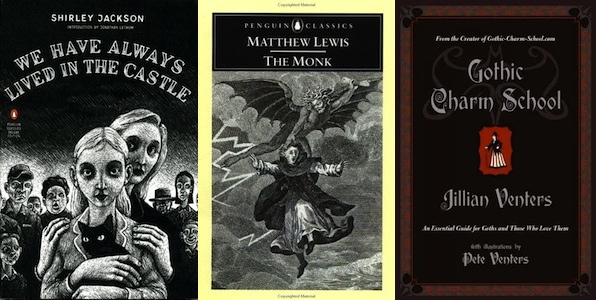
We Have Always Lived in the Castle by Shirley Jackson – Just like Notes on a Scandal, the prose and characterization and tone of this book are all brilliant! (And I would have included that cover in my best covers this year IF it had been the cover of the version I read. Sadly, I read one with a really ugly cover…but happily, my mom got me a copy with this wonderful cover for Christmas, yay!)
The Monk by Matthew Gregory Lewis – This was pure sensationalism, but so much fun that I still find myself giggling over it months later.
Gothic Charm School by Jillian Venters – Nonfiction that hit really close to my heart, with all my gothic aesthetic tastes!! 😀

Good Omens by Neil Gaiman and Terry Pratchett (audio) – This is probably the funniest and most fun (funnest?) book I’ve read all year. I can see myself rereading it multiple times in the future, picking out new little references every time I read.
If Not, Winter by Sappho – Second book of poetry I ever liked! I love how this made me think so much about writing in general, and prodded my imagination in ways I never expected. It made me want to write again, and gave me a lovely look at enduring beyond death.
Lolita by Vladimir Nabokov (audio) – A reread. I listened to the wonderful audio by Jeremy Irons, and once again, the writing just captured me!
Honorable Mentions (because I can’t help at least mentioning the ones that sadly got cut!): The Rock and the River by Kekla Magoon, Returning to Haifa by Ghassan Kanafani, Harry Potter Film Wizardry, Crossed Wires by Rosy Thornton (reread), Kindred by Octavia Butler, A Doll’s House by Henrik Ibsen, The Tapestry of Love by Rosy Thornton, Mockingjay by Suzanne Collins, and The Invention of Hugo Cabret by Brian Selznick

 After a rough divorce, Elizabeth Gilbert set off on a year’s journey through Italy, India, and Indonesia. This book is her memoir of that year.