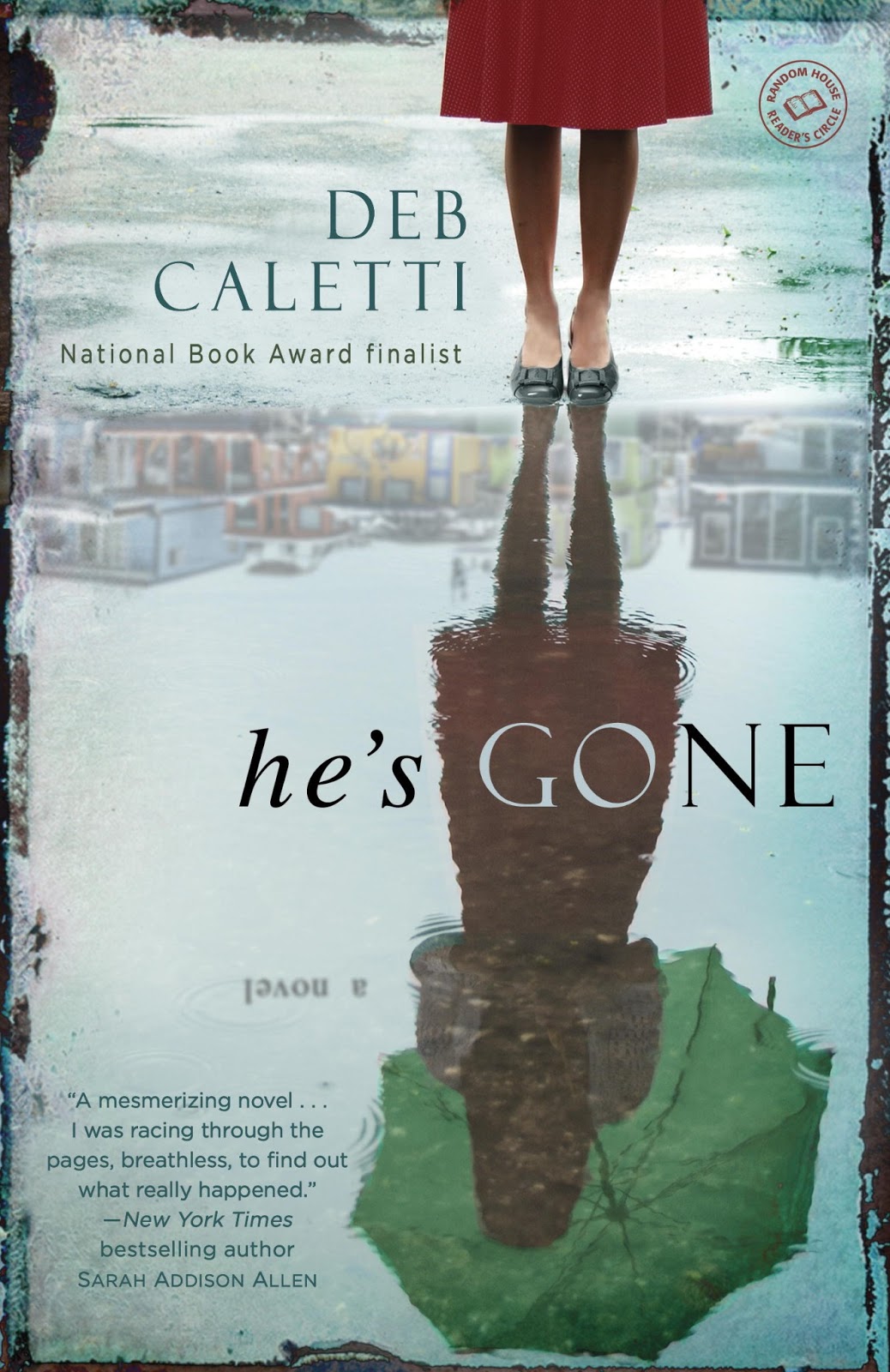
He’s Gone, by Deb Caletti

Caletti_Hes-Gone1Dani wakes up, and her husband, Ian, is not beside her. At first, she thinks he’s just out, but as time passes, she knows he is gone. She doesn’t know if he left voluntarily, or if something has happened to him, and she has no memory of certain parts of the previous night. In this book, she thinks over her history with him and struggles to deal with the uncertainty of not knowing.

I love Deb Caletti. Her books are so soft and quiet. This is her first adult novel, and I knew it would be good. I still can’t say that any of them that I’ve read thus far have been as good as The Nature of Jade, but they’ve mostly been super high quality, and this one was no different. The only real difference was the age and life experience of the narrator. It was good to see a narrator who was older (about 40) and who has lived through a bad marriage, a nasty divorce, an affair, single momhood, and a second bad marriage. There was a lot to learn here, and a lot to feel.

Interestingly, Dani is a very quiet narrator. There isn’t a lot of action in the book, and Dani doesn’t do much but recount and remember. Back in November, for NaNoWriMo, I wrote my third draft of a novel of mine called Summer Rain, and I remember being frustrated because my narrator was so quiet, and all she did was sit around and remember stuff. But Dani was just the same. The difference? Dani still had to interact with people, whereas my narrator pretty much just interacted with her immediate family. Even a quiet person still has neighbors, grocery store clerks, doctors, bank tellers, etc. It’s actually made me wonder if my current draft or the NaNo draft will be better in the long run to work with. I did like the NaNo draft, and it carried more emotion in it than I expected. It might be possible to shape it up into something decent.

But that’s beside the point and has nothing to do with He’s Gone.

I enjoyed the book. Despite the fact that nothing really happens, action-wise, I couldn’t put it down. I empathized with the characters, even when I hated them. I loved that Dani doesn’t end up reaching out to Nathan for rescue (and specifically says she’s avoiding that particular thing at the end). I loved that she’s not a hero, and her husband was not a saint. I love that her relationship with his ex-wife and daughters is never improved, but actually worsened. It was all so real, which is something Caletti always does so well.

My only real quibbles were the few instances of “I need to make this super real so let me talk about farts” sorts of moments, the mandatory “there’s lots of emotions so let’s vomit” scene (which at least wasn’t too graphic), and surprisingly, actually finding out what happened to Ian at the end. I liked the not-knowing. It would have been far more interesting if no one ever knew what happened to him. It’s the sort of book I’d like to write – exploring what happens in the years after a disappearance, never knowing. I understand why we had to find out, given that Dani was about to confess to her blackouts and possible motive for killing him (which she keeps seeing herself do in dreams). But still, I wish the book hadn’t gone that direction.

Otherwise, I was very happy with the book. And I loved that I might understand my own writing a bit better now.

Posted in 2013, Adult, Prose | Tagged , | Leave a comment

We Are All Completely Beside Ourselves, by Karen Joy Fowler

16176440Major spoilers.

The synopsis of this book doesn’t really say much. It’s about a dysfunctional family. Pretty typical, no? This book is anything but typical, and the only way for me to review it is to go through my mental process while reading it, step by step. Major spoilers to follow.

The book sets up immediately as a quick, easy read. Right away, we hear that Rosemary, our narrator, is starting her story “in the middle,” in 1996, when she hasn’t seen her brother in ten years, or her sister in seventeen years. Right away, I assumed this was part of the dysfunctional family thing, and that both her siblings were much older than her, and maybe ran away as teenagers. I knew Rosie’s mother had some breakdowns, and her father was a behavioral psychologist who wasn’t in any way empathetic. They didn’t seem super bad or anything, but I was waiting to hear what they had been like before their other two children ran away.

The book shifts backwards in time, to when Rosie is five and her sister has disappeared. Throughout this section, I started to realize that Fern (the sister) wasn’t a whole lot older. In fact, she seemed to be very near Rose in age, perhaps even a twin. I got the impression that something bad had happened, but not that she had died. I wondered if, perhaps, she had Down Syndrome or some other issue that convinced her parents to put her in an institution, or to let her become a ward of the state.

Then, however, came the twist: Fern was a chimpanzee, raised nearly from birth alongside Rosemary.

The narrator tells us that perhaps we have already guessed. Maybe if I’d been reading the little section headers from a Kafka story told from an ape’s point of view, I would have, but I have a tendency to skip those sorts of things. I didn’t have a clue. I hadn’t really noticed the monkey on the cover art, either. This came completely out of the blue to me, and I wasn’t sure how to feel about it. Rose tells us that she didn’t say this right away because, “I tell you Fern is a chimp and, already, you aren’t thinking of her as my sister. You’re thinking instead that we loved her as if she were some kind of pet.” And that’s exactly right, because I can’t even begin to imagine thinking of a chimpanzee as a sibling. It is so far beyond my comprehension, that it nearly fell out of my possible suspension of disbelief. But I kept reading.

I’d enjoyed the book, up until the twist. After that, the book was temporarily knocked into a place of mediocrity. I doubted it could recover, that I could ever really feel that these characters actually thought of Fern as a sister, much less think of her that way myself. I’m not really an animal person, and never have been. Karen Joy Fowler deserves some credit, though, because not long after this, she actually did make me believe that the one character, at least, saw Fern as his sister – Rose’s brother, Lowell. In his last year of high school, Lowell discovered that Fern was not at a nature preserve farm, but in a cage in South Dakota, forced to integrate into chimp society against her upbringing. His girlfriend was with him when he found out, and she didn’t understand. He screamed at her, “Don’t effing talk to me about responsibility. … That’s my sister in that cage.” And just like that, I could see things a bit better.

That’s not to say I could ever really understand, myself, the relationship Fern had with the various members of the family. The situation was so alien to me, that I felt there was a wall between me and the book. But that one line helped me to understand better, understand enough, that I ended up liking the book in the end. Sure, it got a little overexuberant at times, a little stuffy and preachy, but it was a good book. Like nothing I’ve ever read before.

Posted in 2013, Adult, Prose | Tagged | Leave a comment

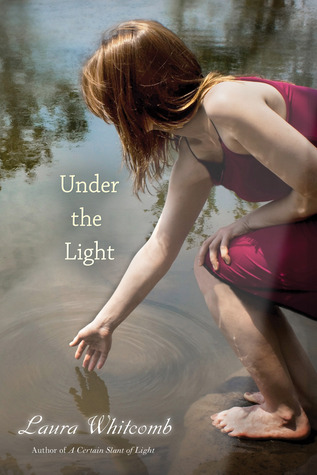
Under the Light, by Laura Whitcomb

9677397Spoilers.

Helen and James have left Jenny and Billy’s bodies, while Jenny and Billy have both returned. But Helen comes back, guilty about the mess she left behind in Jenny’s life. She’s determined to help Jenny readjust to her life again.

This is the sequel to A Certain Slant of Light.

I enjoyed A Certain Slant of Light, but I read it so long ago that I barely remembered it. Still, when the sequel popped up at the library, I decided to give it a chance. The sequel was, as I’d expected, not as good, but it was still an okay read. I’ll list out good and bad points.

Good: I didn’t remember much of the first book, and this book reintroduced me to all the characters and story without me ever feeling lost. I don’t know if it would feel repetitive if I’d read the two back to back, but going in the way I did, this was good.

Bad: The Helen sections were incredibly boring. They seemed like an excuse to show part of the story from first person POV (Jenny) and third person POV (Helen). I would have rather just had Jenny’s after-story without the Helen-related interruptions. I saw no point to the Helen sections.

Good: I liked the development of Billy and Jenny’s relationship.

Bad: Their spiritual relationship when they were both out of body was very farfetched and too quick.

Good: The book was fast-paced and easy to read in a single gulp.

Bad: It was way too short, and left out too many details. Too surface-level.

Good: I loved seeing Jenny progress throughout the book, though I did find some parts stilted.

Bad: Helen’s dialogue and speaking was so stilted and fake-old-fashioned, it drove me crazy. I’m not sure how I didn’t notice that in the first book. (Or maybe I did and just don’t remember.) (Or maybe it was just done better in the first book.)

Would I read a third installment, should one ever come out? Not sure. This book left a little bit of Helen’s story open, and I really don’t want to read any more of her part. And a lot of Jenny’s resolution ended a bit too neatly. (Dad just walks away? Exorcism group just lets her go? Yeah…) The book was a fun read, but very, very shallow, and I’m just not sure it would be worth reading another volume. Maybe, if I just needed something to fill my time.

Posted in 2013, Prose, Young Adult | Tagged | Leave a comment

The Rithmatist, by Brandon Sanderson

rithmatistJoel would love to be a Rithmatist, but he missed his opportunity. Now, with his father dead and his mother constantly working to pay off family debts, Joel constantly tries to sneak ways to study Rithmatic theory at the prestigious school of Armedius. When an upstart Rithmatic professor unseats an established professor, Joel befriends the fallen professor and is taken on in a special project: investigating why Rithmatic students have started disappearing from their homes at night.

Well, Brandon Sanderson is one of my very favorite authors, and this book didn’t disappoint. It was fun and well-crafted. I enjoyed the characters and the magic system. I loved figuring out the mystery along with Joel, Professor Fitch, Melody, and Inspector Harding. I was impressed by several twists and turns, especially near the end. I like that the book flew in the face of convention – particularly in that Joel’s suspicion from the beginning turns out to be right, and Melody was a strong female character while also being a very girly character. (This last point, I read about in an interview with Sanderson, and know that he purposely created her to be this way, because all too often, strong female characters fit too much into a specific stereotype in today’s literature.)

On the other hand, I will say that there was one disappointing aspect of the novel, and that’s to do with the age group it was written for. In that same interview, one of the things Sanderson said was that with writing YA, he didn’t have to spend as much time building the world or magic system, that some things could just be understood without being explained. That’s a great concept, but I feel like it’s flawed, and the lack of development definitely showed in this book. It felt far more shallow than other Sanderson novels, and definitely more shallow than some well-written YA novels. Having just finished Siege and Storm, I can say without a doubt that a well-developed world and magic system just makes a novel richer, not more “adult.” I felt like The Rithmatist would have been much better if it hadn’t been quite so surface level. It skimmed across the top of things too much. In fact, I would go so far as to say it felt more middle-grade than YA – though again, shallow middle-grade, rather than thick middle-grade.

Still, it was an enjoyable read. I read through it twice, looking through all the twists and turns after knowing them the second time. I would guess all three of my boys would love to read this one, especially Morrigan. And, I’m definitely looking forward to the sequel! I will say that Sanderson once again excelled at creating a first book without leaving too hard a cliffhanger. Yes, there is more to come, but there was also a good closure to this book and story, and characters I would love to see again. Perfect.

Note: Illustrations were done by Ben McSweeney. I wasn’t particularly impressed with them, honestly. They did fine for the book, but they weren’t really my style, and they didn’t really convey the (somewhat thin) steampunk feeling that was in the book.

Second note: Later in the summer, Jason and I read this book aloud to our three boys. That made the experience even more enjoyable, and made the book more memorable than it would have been otherwise.

Posted in 2013, Prose, Young Adult | Tagged , , | 3 Comments

Siege and Storm, by Leigh Bardugo

Siege and StormSpoilers.

Second volume of the Grisha trilogy, following Shadow and Bone.

I had so many thoughts and ideas about this book. It was literally my most anticipated book of 2013. Even though I rarely buy books these days, I went out and bought this one the day it came out, and then I read it all in a single day. Then I read it again the next day.

There were a lot of good parts to the book, but I can’t say it was quite as good as Shadow and Bone. Mostly, I think, this was because I was disappointed by a few minor things:

  • There is still no real confirmation of Baghra’s story. Alina is 100% certain that the Darkling is the Black Heretic, but he has never confirmed it, and every time she brings it up, he talks about lies and treason. She is taking the word of a woman she barely knows, and just assuming Baghra is right and truthful. There is no proof, and it’s possible Alina is destroying so many things by believing those lies with all her heart. At this point, I’m really worried that those things will just turn out to be true, with no real proof. Nothing in this book contradicts it, even as nothing confirms it. No new information, no new knowledge, and that’s frustrating!
  • We rarely see the Darkling in this book at all. I really wanted to know more about him and his motivations. He’s obviously not a good guy, but for some reason, I still want to trust him. I still don’t believe Baghra’s allegations, especially after her admission that her motivations were less than altruistic. I also still believe he really loves Alina, even if he’s forcing himself to shove that down, and even if he really doesn’t want love her. I don’t believe he’s a good person, or can be a good person, but I do believe he’s more human than he’s presented.
  • I got frustrated with all the things that remain unsaid between Alina and Mal. Alina never explains to him that for years, she held her power inside, checked, even though it was destroying her, just to stay with him. Maybe if he’d known that, he’d be a little more forgiving of her plan of action in this book, and understand that she has no intention to leave him even after getting all her amplifiers. There are more examples, but that’s one of the most frustrating for me.
  • I want MORE. Some of this is just the nature of a trilogy, but I’m frustrated that a full second book in, and I still know nothing more about the Darkling’s motives, about the Apparat, about Baghra, etc.

Those are the big ones. Still, that’s not to say I didn’t love the book. I gobbled it up. I especially loved Nikolai/Sturmhund – he’s one of my favorite characters so far, and I love that Alina now has three supposed love interests even though she’s only really interested in one. Nikolai was just so much fun to read. I also love that all the Grisha came together, and watching Alina grow – in both good and bad ways – as a leader.

Lastly, there are a lot of little silly references in this book that make me wonder if the author likes a lot of the same things I do. Nikolai seems in many ways like Captain Jack Sparrow. Mal’s fistfights remind me of Far and Away. The Zemeni jurda trade/use is nearly identical to the Yemeni qat trade/use. There are lines that are reminiscent of lines from Harry Potter, and the good/evil way that the Darkling is presented reminds me of how Rowling presented Snape. Lots of things like that. It makes me wonder how many other things, from Bardugo’s own life, are scattered throughout the novel. I adore that!

So even though this wasn’t as great as the first book, I am really looking forward to Ruin and Rising. And frustrated that I have to wait at least a year to get it!!!

ETA: WAIT!! I have a theory – not sure why I didn’t see this before! Maybe the Darkling IS the Black Heretic, but he wasn’t trying to get some dark power when he created the fold. It said, in this book, that the fold was created when the Black Heretic tried to recreate Morozova’s amplifiers. Maybe, the Darkling was once a Sun Summoner – a very rare form of Grisha. Maybe he was trying to unite the amplifiers, or recreate them, or something, and the fold was formed. Maybe he lost his power to summon the sun, and instead gained the power to gather darkness. The sun in eclipse – his symbol. He keeps telling Alina they are unique. At the end of the book, Alina can no longer call forth light, despite her amplifiers. I think she has become another Darkling, just as he was once a Sun Summoner. Not sure how Baghra fits into it, being able to cast darkness as well, or why Alina hasn’t considered that if the Darkling is hundreds of years old, how old Baghra must also be, and I would still love to see proof of whether or not the Darkling is actually the Black Heretic, but I’m almost sure he was a Sun Summoner at one point.

Posted in 2013, Prose, Young Adult | Tagged | 2 Comments

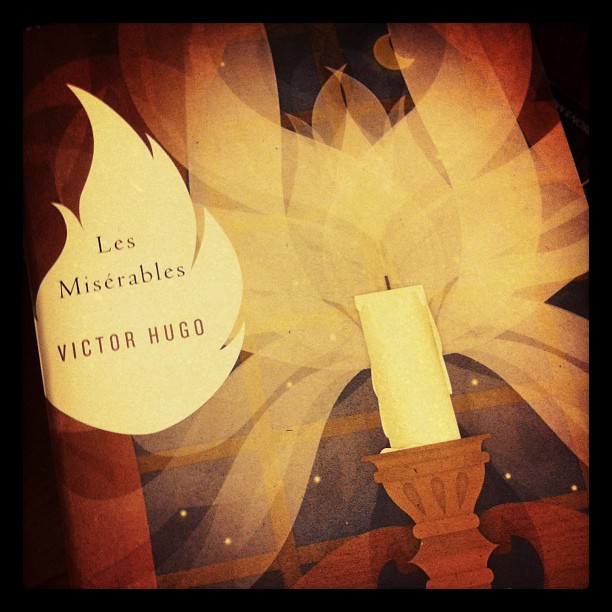
Les Miserables, by Victor Hugo (audio)

lesmisThis is an incredibly difficult book to review, for multiple reasons. I won’t even begin to try to summarize it. I spent two months and two days listening to the audiobook of Les Miserables, so that the experience stretched out for a very long time. Between that length of time and the massive epic-ness of the story, a synopsis and review both become a bit impossible. Instead, I’ll just leave a few of my impressions. (Spoilers included.)

1. Jason (my husband) thought I would hate this book. I did not. I didn’t even mind all the tangents that Victor Hugo went off on. Some were rather interesting.

2. The translation I read was by Julie Rose, and it was really good. I can’t say how it compares to the previous translations, but I thought it was great. The audiobook I listened to was read by George Guidall, who for the most part did a fantastic job. There were a few characters with whom he got overly dramatic, but he did well pronouncing his French, and I liked most of his vocal acting.

3. I did not like Enjolras. All the political and revolutionary sections bored the pants off of me.

4. I was surprised how different Eponine was in the book versus in the recent musical movie (my first ever exposure to the story of Les Miserables). She was much more sympathetic. I do wonder if she ever realized who Cosette was, though.

5. I adored Gavroche in every way. He reminded me too much of my son Laurence. The only time I cried was at his death.

6. I really wanted Cosette and Marius to find the two younger Thenardier siblings and adopt them the way Jean Valjean adopted her. That would have been a perfect ending to the book. I was sad and a bit disappointed when the book ended so suddenly with Jean Valjean’s epitaph.

7. I found Javert very interesting, especially in the end, and I would love to be able to read this book in the original, to see how he changes from tu-form to vous-form. I’ll bet there isn’t an explanation of that in the French version.

8. I think Victor Hugo understood the poor classes far more than someone like Dickens. It’s interesting to see how much realism there was in here, despite the serious romantic streak. It reminded me a bit of Zola, except that Zola didn’t have any rose colored glasses to look through.

9. Still not sure exactly how Thenardier figured out that it was Jean Valjean he saw in the sewers. I kept waiting for him to explain, but he never did.

10. It’s interesting to see just how much of Jason’s personality and writing style was carved from this book…

There’s probably more, but that’s what comes to mind right away. Again, it’s hard to keep track of a book that took over two months to listen to! I’m glad I listened in audio form, though, both because it was a good recording and because I doubt I would have made it through the book in print. It was a good book. Not mindblowingly wonderful, but a solid read. I’m less afraid of Victor Hugo now, and I also need to see the movie again, knowing all the things I know now.

Posted in 2013, Adult, Prose | Tagged , , , , , | 3 Comments

Salt Sugar Fat, by Michael Moss

ssfSubtitled: How the Food Giants Hooked Us.

Michael Moss is an award-winning journalist who takes us through years of research into the way processed food has evolved, how it has changed the patterns of our eating, and its impact on obesity. The book is split into three sections: sugar, fat, and salt (ironically in that order, rather than title order).

I can’t really review this book, because there was just so much in it. I did learn a lot, and it was a fascinating look at what really causes some of those addictions we have. Unlike when I read The Omnivore’s Dilemma, I didn’t spend this whole book getting more and more disgusted by processed food. In fact, I found myself actually craving stuff I hadn’t had in years. I wanted to go out and eat all those crappy Little Debbie snack cakes and premade cookie dough and a ton of different kinds of chips and even those crappy lunchables. I even set up a make-our-own-junkfood project for my kids this summer. Now, part of this was just that I was craving junk anyway, but part of it was also just reading about the addictive properties of certain elements of food.

Honestly, in some ways, I do wish it had had more of an effect the way the Pollan books did. For a very long time after The Omnivore’s Dilemma, I wasn’t in the least bit interested in processed food. Now, I find myself wanting to incorporate more of it in my life, and that seems to be the opposite of what this book was trying to accomplish. Probably the reason for it is that while Moss certainly does state his opinion from time to time, the journalism itself was very unbiased. Clinical, almost. It presents facts, without saying whether those facts are good or bad. It presents both sides of the story. It was definitely a different way to read about this kind of food. I was horrified quite often by what happens in the industry, but not terribly shocked, either.

This is a terrible review but I’m not sure I can do much better. There was just so much in here. It was a difficult book to read – would have been better in audio – and I had to cut it down to 7 days or fewer because it was an express-check-out book from the library. I think I would have better thoughts if I’d taken several weeks to read (or listen) to it. Still, despite the bad review, I did learn a lot from the book, and I have a lot of respect for the author. Soon I’ll be listening to another book on processed foods (Pandora’s Lunchbox), and it’ll be interesting to see how the two books compare.

Posted in 2013, Adult, Prose, Wellness | Tagged , , | 1 Comment

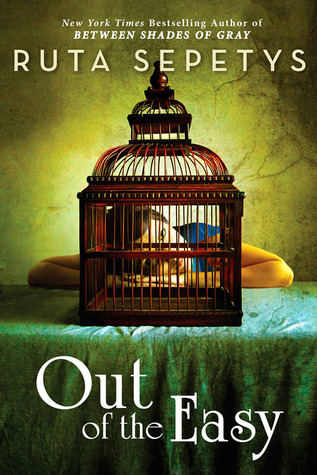
Out of the Easy, by Ruta Sepetys

outoftheeasySpoilers.

New Orleans, French Quarter, 1950s. Josie is the daughter of a neglectful prostitute, and is being raised mostly by the house Madam (named Willie) and a quarter-black taxi driver named Cokie. Josie is smart and dreams of escaping New Orleans and going to college one day, but then her mom gets mixed up in a murder, and Josie’s plans start to fall down around her.

I have tried, several times, to read Ruta Sepetys’ first book, Between Shades of Gray. The subject interests me, but the book seems to be too intense for me (I dread from the very beginning what will come next). I’ve never made it more than a few chapters in, on audio or in print. Initially, I worried I’d have the same problem with Out of the Easy, but I was drawn in immediately, despite this being historical fiction (not a favorite of mine). I loved the characters and the setting. I love that we were able to see a different side to the lives of prostitutes, especially given the circumstances some of these women were in. I loved the contrast of French Quarter with uptown New Orleans. I loved that Sepetys didn’t take the easy way out all the way through the book.

It was this last point that really stood out to me. Three instances in particular showed this. First, there was the fact that Josie’s mother not only got away with murder and theft from the man she killed, but she also stole all of Josie’s money and possessions, she was never caught, and she stayed with a man who kept beating her. Second, Charlie never recovers from his illness, despite Josie’s hope that he might be trying to communicate at one point. Third, when Patrick admits to Josie that he’s in love with James, she flat-out doesn’t understand, and assumes he means he’s in love with Kitty (James’ girlfriend, in her mind) and that he’s worried James will be angry with him. It never even crosses her mind, until much later, what Patrick really means. All of these things are fantastically realistic, and unusual in a YA book.

The book wasn’t perfect. Some of the end, after Willie’s death, was a bit too easily wrapped up. I can’t buy, for instance, Charlotte not only forgiving Josie for her lies, but accepting her 100% even after knowing her history. There wasn’t enough information given about this. A lot of the ending is left very unclear. I would have preferred another couple chapters to flesh it all out. But other than that, it was a really well-rounded and well-constructed novel.

Posted in 2013, Prose, Young Adult | Tagged , | Leave a comment

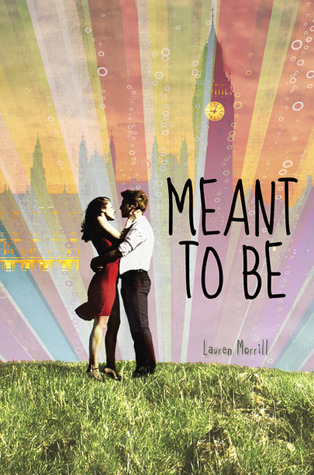
Meant to Be, by Lauren Morrill

meant ot beSpoilers.

Julia is a quiet, uptight swimmer/bookworm with few friends and a lot of idiosyncrasies. Jason is a popular, loud, obnoxious lacrosse player whom Julia despises. Unfortunately, the two of them are paired up for the duration of their 10-day junior class London spring break field trip. Fortunately, there’s more going on for both of them than they originally think.

This is YA chick lit, plain and simple. I’m not normally a huge fan of chick lit, but this book was a lot of fun. And actually, I think that I like YA chick lit more than adult chick lit – the characters aren’t quite as obnoxious and unrealistic yet! Sure, Julia is a little caricatured, but in a way, I recognized a lot of me in her: swimmer, with over-chlorinated curly hair; uptight control freak; a complete klutz; hugely romantic when it comes to love. This last one – Julia believes in “meant to be” (hence the title), that fate will take her to her perfect match (she already knows who that is), that love will triumph and will end with a perfect fairytale story. This, of course, makes her blind. She has no idea that her supposed MTB is an asshole, or that Jason is obviously in love with her from page 1, or that she is slowly falling in love with him, too.

It was a cute story, though I admit that Jason was a bit over-the-top for me personally. He really is obnoxious. I’m not quite sure how he thought some of the things he was doing were going to endear himself to Julia. Flicking scone bits at her chest like she’s a soccer goal, getting her clothes full of junk? Belting himself to a wall in a prison museum and loudly begging her to flog him in front of everyone? Yeah… I’m also not quite sure how anyone thought some of the things he did were funny. But then again, I’m more like Julia, so maybe I’m just too uptight to see the humor.

The book was light, but it did give me one thing to really think about. As a teenager, I was also a control freak who naively believed in fate and “the one true love.” Jason makes a statement in here that he can’t believe Julia believes that fairytale, because she’s too smart for it. He also makes an unrelated statement about how maybe Julia wants to be dominated (in sex) because she’s such a control freak in every other facet of her life. It made me wonder if the reason I – and so many other control freaks – believed so hard in fate bringing about the one true love is because then it’s out of our hands. We want something that someone else controls, something that will be perfect without us having to arrange it. Even as an adult, my cynicism about perfect loves has roots in control, ie I accept nothing will happen without me going out and making it happen. Just a thought.

I’m glad I read the book. It has a really great first kiss scene, and some really sweet lines. I thought it was predictable the whole time through (re: Chris and the phone thing) but it turned out I was wrong the whole time. The twist at the end took me by surprise, and I had to go back and reread the whole book. It was just as fun the second time around, and that’s saying something, for chick lit!

Revisited in Jan 2017: I had just as much fun with this book all these years later as the first time. Plus, there was the added bonus of discovering that these characters are students at Newton North High School in Newton, MA, which is where my family lived in 2014-2015. If we’d stayed in Newton, my kids would have gone to Newton North, and I used to pass the high school every time I walked to the library. Ha!

Posted in 2013, 2017, Prose, Young Adult | Tagged , , , , | 2 Comments

Protected: Beautiful Darkness, by Kami Garcia and Margaret Stohl

This content is password-protected. To view it, please enter the password below.

Posted in 2013, Prose, Young Adult | Tagged | Enter your password to view comments.