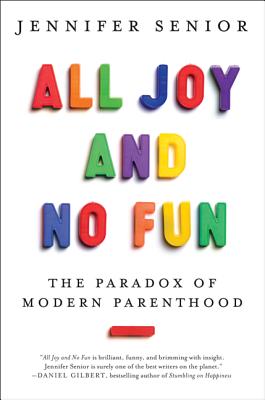
 Subtitled: The Paradox of Modern Parenting.
This book is a sociological look at the ways parenting has changed over the last hundred or so years. It is not a how-to or advice book about parenting, and it focuses on the effects of parenting on parents rather than children. Using her own on-the-ground research, as well as others’ scientific, psychological, sociological, and philosophical publications, Senior puts together a fairly comprehensive look at the nuances of modern parenting from infancy through adolescence. She discusses everything from gender splits with regards to time and technique, to marital struggles, to modern expectations of parental roles. If I recall correctly (as I can’t exactly look back in audio form to check), Senior states in her introduction that her research is focused primarily on the middle class.
I want to first say that I rarely read nonfiction, and therefore don’t have a good grasp of what is good and not-good in this area. Furthermore, I haven’t read much on family psychology or sociology since my days as a psych major in college, so I cannot say how this book compares to others on similar topics. My opinions on this book will be fairly uninformed because of those things, and will come from my personal view as a mid-30s stay at home mom of three boys aged 10 to 14.
And that uninformed opinion is: This book is brilliant.
I cannot say just how much this book made me feel like I wasn’t alone. Everyone I know talks about the joys of motherhood, how much they love spending time with their kids, how easy and rewarding parenting is (especially of young children). They’ll complain about something difficult, and then smile and say that those difficult moments are few and far between, and outweighed by all the easy, happy moments. I always felt like I was wrong somehow, because I didn’t feel like this. I didn’t enjoy pregnancy or have an instant bond with my children at birth. I found infancy and toddlerhood the most difficult time of childhood (far more so than their current adolescence). Sometimes I felt like getting in my car and driving away. I never learned to cope with lack of or broken sleep (to the point where Jason pretty much got up with the kids at night, because I was sick all the time). Being a stay at home mom for the last decade has been the most difficult thing I’ve ever done, and I sometimes feel like I have no identity beyond that. I’m constantly questioning myself and my role as a parent.
The very first thing I learned from this book is that I’m not alone. It seems that all of these feelings I have are very common, when people are honest about them. Senior discusses the title paradox, how parenting can leave us feeling not very happy on a moment-to-moment basis, but simultaneously bring us joy in the longer view. She discusses the difficulties of parenthood – as a parent, as a spouse, as an individual – with no sugar-coating. My kids are in the adolescent stage, and it’s amazing how much of the trials for every stage of childhood that she discussed were familiar to me. The most difficult times for parents individually, for marriages, for parents together, for the children themselves, etc, reflected back exactly on the things I’ve experienced in my own fifteen years as a parent. I loved the contrast of happy vs joyous, because I’ve often felt like this: day to day trudging along, and as I look back, those wonderful moments. A child’s comment that has everyone laughing for fifteen minutes. The day a child completes – all by himself – a task he was struggling with. Long hugs. A child standing up for the rights of another person. Playing board games together. Silly family traditions. And more.
The look at the sociological history of parenting was fascinating as well. I could not say whether the conclusions Senior draws about why parenting feels so different today as opposed to a century ago are accurate, but they make a lot of sense, and helped me to understand a lot more about parenting in general. Same thing for the sociological history of childhood itself (in terms of how it was viewed/treated, and how long it lasted, etc). I just felt like I learned so much from this book, both about myself and about the modern-day family structure. I wish I could better express just how much I feel my mind has been opened by this book. Furthermore, I felt Senior did a great job at staying very neutral. This is a research-based book, and there was no bias towards one kind of parenting versus another. It was simply a look at the way things were then compared to the way they are now, and no judgement about either.
The audio performance was fantastic as well. Senior read the book herself. I don’t usually like books read by the author, to be honest, but this one was different. It was if – and I know this sounds stupid – Senior knew her own inflections in voice/writing and was therefore able to read the book exactly how she would have spoken it aloud if she hadn’t written it down first. Very few people can match their vocal voice to their writing voice, which is why I don’t tend to like author-read audios. Senior did it very well, and it’s especially impressive given the vast amount of statistics, quotes, and references in this book.
So yes. I highly recommend both the book and the audiobook, especially for parents.