
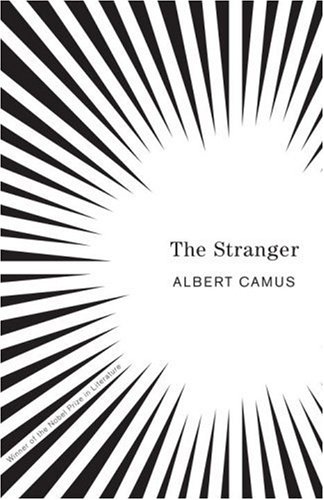
 The Stranger is a tiny novel (my translation is 123 pages) by Albert Camus published in 1946. It is a tale of a man, Mersault, who lives life completely and utterly without morals. By that, I don’t mean that he’s going out to do drugs or hook up with prostitutes. I mean that he does not acknowledge universal truth, and he does not abide by social norms. He recognizes that all rules are transient and socially-based, and because he acknowledges this, he does away with everything. He does this absently, not consciously, and lives pretty much how an animal might live. He has stripped away the layers of humanity and become only the creature he really is.
Mersault’s mother dies at the beginning of the novel. He attends her funeral but doesn’t want to look at her in the casket. He smokes, drinks coffee, and dozes a bit during her wake. He doesn’t cry. He’s uncomfortable walking out in the heat during the funeral procession. The next day, he meets up with an ex-coworker and they end up starting a relationship. Throughout the book, this is basically how Mersault’s life goes. He lives according to his present, immediate needs. His feelings are muted or nonexistent. There is no self-reflection. Midway through the book, he’s out on the hot beach, with the sun glaring down on him painfully, and in his extreme discomfort, he shoots a man. Throughout the rest of the book, he is put on trial, where he is condemned not because of his crime, but because he displayed less than adequate behavior with regards to his mother’s death. The prosecutor and jury are far more concerned with his lack of emotion than his crime.
Albert Camus explores in this book what the world is like to someone who views life as utterly meaningless. Someone who lives life according to sensory input rather than emotions; someone to whom religion means nothing. Some people have labeled the book existentialist, others absurdist. Both probably have some elements of truth to them.
I find this book fascinating because when I was a lot younger, I once tried to live in total indifference to my surroundings. For several years, I observed everything from the point of view of meaninglessness. I was never as extreme as Mersault by any stretch of the imagination, but certainly the world looked a whole lot more absurd from that point of view. Social norms – shaking hands, small talk, who stands where in an elevator – all became ridiculous. To this day, I hate small talk, though it doesn’t disgust me the way it did when I was a late teenager. I think my period spent in semi-indifference helps me to connect with this book, which I know many people don’t like. Many people don’t want to see what the world looks like from an existential or nihilistic point of view. But to me, this is fascinating.
I did want to make a note here with regards to my review on The Handmaid’s Tale. This book, though Mersault is condemned to die and has no access to someplace to write his tale, is told in first person. Camus, unlike Atwood, allows suspension of disbelief to carry his story. We hear the book on an intimate level with the narrator, with no thoughts about why or how this story got told. It isn’t written to be like a diary or memoir. It tells of experience, and leaves it like that. Though it would be utterly impossible in reality for such a story to get out, that doesn’t matter. This is what I wish Atwood had done. I felt much more connected to Mersault than Offred. I wish Atwood would have allowed her reader to just experience, rather than trying to reason with them. But I digress…
I read The Stranger first many years ago. It was far more enlightening this second time around. My translation is done by Matthew Ward and I think he does a brilliant job. Highly recommended.
Note: Review date is only an approximate of when this book was read/reviewed in 2008.
Note: Originally read in 2001. (?)




 The Zen Leaf
Pingback: Catcher in the Rye, by JD Salinger | The Zen Leaf
Pingback: The Belly of Paris, by Émile Zola | The Zen Leaf