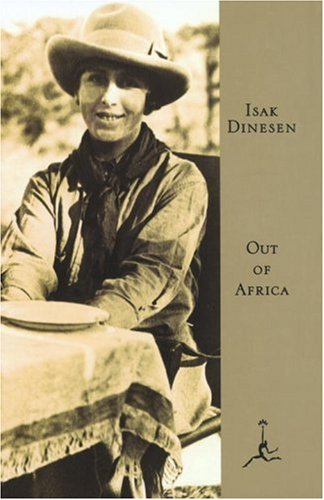
Out of Africa, by Isak Dinesen

out of africaOut of Africa is Karen Blixen’s memoir (under a pseudonym) about her years in Africa. I’ve wanted to read this for a long time, and finally checked it out a month or so ago. In the last couple months, I’ve been very fascinated with non-western cultures. I know it’s not possible to fully experience any culture or country without actually being there, and even then, a visit is far less than a longterm stay for experience. Because I’m probably not going to Africa any time soon, I thought maybe I could see the world through Baroness Blixen’s eyes for a moment.

I didn’t expect it to take me several weeks to read. It’s a lot drier than many novels, which would normally turn me off right away (and nearly did with this one, but I persisted long enough to get caught up), but it really did pull me into the experiences she had. I began to see people, cultures, landscape, and wildlife through her eyes. The culture of the various tribes and religions she had contact with on her coffee farm began to make sense to me, so that halfway through, things that wouldn’t have phased me before suddenly became funny or sad or wistful.** I tried a couple times to describe moments to Jason that were hilarious to me, and he stared at me blankly when I did. They just aren’t funny outside the eyes of this world. I see animals differently now as well (never had any idea before how vicious zebras are). While nothing can substitute for actual experience, this book did a great job of taking me into the world it’s about. It was definitely worth the weeks of reading.

**Note: I didn’t mention this in my original review, but one of the things that struck me about the book was the bit about women and shaved heads. The culture she lived in thought it was vulgar for women to have hair, which is very different from what I’m used to. About halfway through the book, however, I had a weird experience where I read about a woman with long hair, and it automatically repulsed me for an instant. I was drawn so far into the culture of the book that for a moment, I viewed things differently, and that made the book extremely powerful.
Posted in 2008, Adult, Prose | Tagged , , , , , | 3 Comments

The Memory Keeper’s Daughter, by Kim Edwards

memorykeepI read very little current fiction, but I decided to pick something up I’d never heard of at the library this weekend. This seemed interesting, and it ended up being a captivating book. At the beginning of the book, Norah Henry has twins, delivered by her husband David during a blizzard. He’s a doctor, and recognizes right away that the second baby has Down’s Syndrome. The birth takes place in 1964, when there was a lot of negative stigma about people with Down’s, and the doctor worries about the girl’s heart. His own sister died of heart problems, and he remembers the grief the family went through. He makes a bad decision, and asks his nurse, Caroline, to take the baby to an institution. He tells his wife that the girl, named Phoebe, was stillborn (Norah was under gas when the baby was born). Caroline doesn’t leave Phoebe at the institution, however; she instead takes her as her own, leaves town, and raises her. The book follows the parallel lives of the Henrys and Caroline, and the way that this one lie, this one secret, touches everyone.

I liked this book. It wasn’t my favorite book ever, nor do I think it was particularly high literature, but it was fun, interesting, and at the end, ultimately hopeful. For a pretty depressing subject, Kim Edwards does a good job not making you feel absolutely miserable all throughout. This is her debut book, and it’s pretty good. My only real problem with it (besides some editor screw-ups like saying “David’s guitar instructor” instead of “Paul’s guitar instructor”) was her use of cliched metaphors and similes. I also, on my own, didn’t like the fact that I read it straight through for a day and a half, but that says more about my own self-control than about her writing. Obviously her writing was captivating enough and the story was engaging enough to keep me going on. I would recommend The Memory-Keeper’s Daughter for anyone who is looking for a fast, fun read without any deep thinking. Not something I would want to read on a permanent basis, but certainly nice for a light break in my serious reading, especially after Little Women and Madame Bovary.

Posted in 2008, Adult, Prose | Leave a comment

Madame Bovary, by Gustave Flaubert

madamebovarySpoilers.

Well this was definitely my pointless read of the month. I read half of Madame Bovary in off moments in Palestine, times when Becky was stressed or out shopping alone because of her stress, hours spent in airports, etc. I had to force myself to begin it, because the book itself didn’t look too inviting – I have an old hardback copy with withered pages and completely faded gold lettering. I don’t mind old books usually, I actually like them, but this one looked particularly unappealing. I was determined not to let that affect me, and set out in a valiant effort.

Unfortunately, I had to read this one, in order to moderate my book club on it in March, otherwise I would have given it up long before my final reading in Palestine. Partly it was the extremely dry translation, partly it was just the 1800s writing style I’m not fond of, partly it was the story itself. It reminded me, more and more, of Anna Karenina, which is one of the worst books I ever forced myself through. I just had no patience for Anna in 2001, and the feeling stayed the same for Emma Bovary. A perpetual whiner, never satisfied, she wants to live in a fairy tale. She lives out of absurd notions of romance and emotion, and when they fail her, when passion can’t continue and becomes mundane – like things really are in life – she moans about and has “nervous fits.” I was so relieved when she finally killed herself! No sympathy whatsoever.

Now, Madame Bovary is considered one of the best books written of all time, a master specimen of realism, and the perfect example of the modern novel. That’s what people say about it. I suppose I’m not all up on what literature periods are, but if “realism” is anything like what the name implies, I don’t know why this qualifies in any way. There is nothing “real” about it except perhaps the statement of “people are perpetually unsatisfied.” All the rest of it is just fancy. Jason and I talked about the book a bit last night. He hasn’t read it, and I went on about how dull the prose and subject matter are, how Emma annoyed me, how the whole thing was just like Anna Karenina. Jason started doing some research on it, while I pecked away at the book, trying to get through it as fast as possible, and suddenly he started laughing. Apparently there’s some poll out there of the top 10 literary influences of modern writers, and Madame Bovary comes in second only to Anna Karenina. Beyond that, he read that Gustave Flaubert’s friends were trying to cure him of his romanticism, so they purposely chose the dullest, dreariest, most mundane subject possible, and challenged him to make a book about it. Yep. That’s Madame Bovary in a nutshell.

I wish I could have put this book down way before the end. I’m glad I finally pushed through to the end and can go onto something more interesting, more stimulating. Despite the book being on every top list that ever existed, I personally don’t recommend it. I hope the people in my book club like this book much more than I do!

Posted in 2008, Adult, Prose | Tagged , | 5 Comments

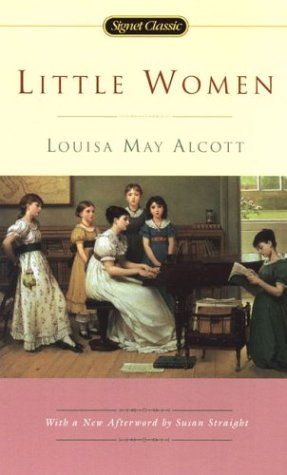
Little Women, by Louisa May Alcott

littlewomen“the Kraft Macaroni and Cheese of literature”

Jason said to me, before I began reading Little Women by Louisa May Alcott, that the book was good – as long as I didn’t mind that the characters aren’t in the least bit believable as real human beings. Well, I’m not sure I fully agree with him that the book was all that good, but the latter half of the statement is certainly true. The characters are flat, like the author had created little personalities for dolls. She took what could have been real people and snipped out everything that made them round, so they look like little bundles of virtue, rather than like they actually lived. Paintings, with all the rosy glow around the edges so we see no imperfections. Life works out wonderfully neat.

Normally, a book this size takes me a week to read, and only that long because of all my writing, editing, mothering, etc. This one, I started a week or so before I left for Israel on the 31st. I expected to finish it before I left, so I packed some other books to take with me for reading in the airport, on the plane, and at Becky’s apartment, if there were lulls. I was about halfway through Little Women when I left, and I think my opinion about the book is obvious by the fact that I didn’t change out one of the packed books for this one. Not that I hated the book, I only found the characters unbelievable, the storyline pasted together, and the prose extremely tiresome. I learned some things reading it, and I enjoyed it to some degree. And, as usual, I kept going even when tired, because there are few books that I’ve simply given up on (only two that I can recall ever).

I spent the last couple days reading during naptimes, instead of writing, just to get it done with. In the end, I’m glad I read it, but I’ll stick with the movie after this. And because of Jason’s expressive description of the book, I’ll always associate it with boxed mac & cheese, something which is good as long as you don’t mind that it isn’t real macaroni and it isn’t real cheese.

Note: This was my first-ever book review, and incredibly snarky. I wrote it humorously, for a handful of friends who knew my voice. Looking back, it came out more rude than humorous…

Posted in 2008, Adult, Prose | Tagged | 1 Comment