
 A couple of people remarked on my last few posts that they didn’t know how I keep my TBR so under control. The truth is, I didn’t always. Years ago, I had a huge TBR, both physical and virtual. I’d throw book recommendations onto Goodreads from the hundreds of book bloggers I followed in those days. I acquired books everywhere – book stores new and used, library sales, book swap sites, gifts, Amazon deals, blog contests, etc. I had an entire bookshelf devoted to unread books. I was drowning in them.
Honestly, I didn’t mind so much in the beginning. I was reading around 200 books per year, so if I had 400 unread books on my shelf, that didn’t seem too unreasonable. Periodically I’d put myself on a book-buying-ban and proceed to completely ignore said ban. I wanted ALL THE BOOKS. Then one day, I reached a tipping point. The piles became overwhelming. I had too many books, and I suddenly didn’t want any of them. Books that had once sounded so interesting now bored me when I tried to read them. The waste of money, time, and space weighed on me. When I realized I had several books on the shelf that I didn’t even recognize, that was the final straw. This is when I decided to get my TBR down as close to zero as possible.
How I achieved this:
The process was daunting at first. I started work on both physical and virtual TBR piles simultaneously. First, I divided each into three categories: books by authors I loved and would likely want to read; books that sounded exciting when I first heard of them but I really knew nothing about; and books that I didn’t even recognize. In the following process, I began with the third category and worked my way in.
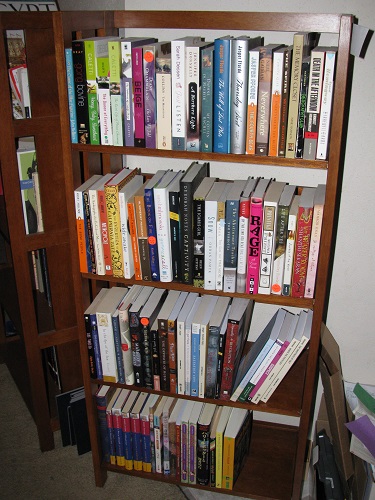
(my TBR shelf, after I’d culled and donated over half my unread books)
For the virtual pile, I put 15-20 books on hold from my library at a time. I also pulled 15-20 books off my shelves. With these piles of 30-40 books at my feet, I picked up books one by one, and read the first five pages of each one. From there, they went into three more divisions: books I definitely want to read, books I definitely don’t want to read, and books I need to investigate further. In the latter division, I read a further five pages before putting them in the yes or no pile. In hundreds of books, there were only a handful that I had to read a further five pages to make a decision, and none that needed more than ten. (As a writer, this really reinforced for me how important those opening pages are, not just for future readers, but to get the attention of agents/editors in the submission process!)
The whole process took about two years, but I whittled my pile from the too-many-hundreds-to-count to a much more reasonable number made up entirely of books I’d previewed and verified that I wanted to read. Notably, not all of those books ended up being great. Some, after the initial pages, ended up being real duds, and I’m sure some of the books I culled would have ended up being wonderful. I have no regrets, though. Sure, there’s always the what-if: what if I missed something truly wonderful by culling? But honestly, if I still had hundreds of books on my shelves, I probably never would have gotten to them anyway, and I’d’ve missed other wonderful books because I’d feel obligated to read from my TBR. Plus, I know my tastes very well, and I can guess pretty quickly if a book is going to appeal to me.

(yesterday’s library pile)
These days, I have protocols in place to prevent my TBR from growing out of hand again. With few exceptions, I read books from the library before buying them. When a book catches my eye, I add it to a “to investigate” list on Goodreads instead of to my TBR. I then follow the same procedure to decide if those books should be deleted or moved to my TBR. Finally, when I begin a book that previously survived the process, I have no qualms about giving it up the moment it no longer appeals to me. This system works well for me, and actually, I went through the process yesterday. My to-investigate list had grown to about 40 (way too high!), so I spent several hours at the library. I gathered the books pictured here and previewed each one. Only four survived the process, and I feel good knowing that the books waiting on my TBR are ones I know I want to read.




 The Zen Leaf
Ahh, so clinical! Then again, you make a great point: there are far more books in the world than you have (or anyone else has) time to read. Even if you only read 5-star, written-for-you work for the rest of your life, you STILL wouldn’t finish. A system for picking those few only makes sense!
I do admit to my heart breaking a little for those books that didn’t make the cut. 😉
Also, you’ve inspired me to create a “to-be-investigated” GR shelf. So much more organized than having an enormous TBR. Mine has something close to 200 on it right now—eek!
Happy reading in 2015. 🙂
LikeLike
Hahah, yeah, I’m generally pretty clinical and methodical about the way I do things when I’m really determined to do them NOW. 😀 I figure other people will read and love the books that didn’t work for me.
It was another blogger that inspired my “to investigate” shelf on GR. I don’t even remember who. I saw it and it was a total lightbulb moment!
LikeLike
I really, really need to do this. I am drowning in unread books, especially since I read so much less now than before. I’m sure I have around 500 unread books on my shelves, if not more. It’s daunting.
LikeLike
It’s SO daunting, and can make picking books daunting as well! It’s so much easier with it being small.
LikeLike
Pingback: Sunday Coffee – When Enough is Enough | The Zen Leaf