
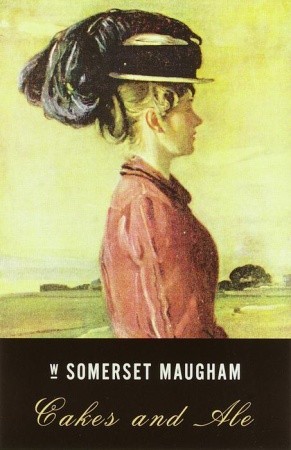
 I have read quite a few books by Maugham in the last decade or so, maybe 15-16 in all. He’s one of my favorite authors. Having said that, I must admit that Cakes and Ale didn’t live up to his normal standard. The book is very muddled. The back of the book description says that this is about a writer named Alroy Kear who is tasked with writing a biography of the late author Edward Driffield, with the complication that Driffield’s second wife is determined to wipe away all trace of his first wife in the process. Instead, this book is about Willie Ashenden, a colleague of Kear’s, who knew Edward Driffield and his first wife in his youth. Kear and the second Mrs. Driffield are hardly in the book at all, there’s no real hint of wife #2 trying to eliminate wife #1, and most of the story is told in a series of flashbacks.
Normally Maugham is very straightforward and to the point, but not so in Cakes and Ale. There are long sections of the book that meander pointlessly, that have nothing to do with the central story, especially in the beginning, almost as if Maugham wasn’t quite sure where he was going yet. There are sections in the middle when the story is interrupted in order for the narrator (ie Maugham) to question whether he’s gone about writing this novel the right way. The book lacks Maugham’s normal confidence and surety. The result was unsatisfactory, and downright boring in many places.
On the other hand, I will give Maugham credit where it is due. Even at his worst, he always gives me something to think about. Hidden in all the muddle here was an interesting discussion on appearance and judgement. All sorts of people were judged by their appearances and reputation, rather than on their behavior. Take, for instance, a man by the nickname of Lord George. In reality, he’s a poor coal merchant, not a lord, but he wears suits and hats, and he treats everyone equally no matter what their station. People despise him because they think he ought to stick to his place in society, rather than acting “above his station.” Despite the fact that he is kind, generous, and friendly, people shun him. One quote about him in particular stood out to me:
They could not forgive him because he had always been so noisy and boisterous, because he had chaffed them and stood them drinks and given them garden parties, because he had driven such a smart trap and worn his brown billycock hat at such a rakish angle.
Whereas the one person who really sees Lord George for who is he says the following:
He was always such a perfect gentleman.
The issue of appearance is also brought up via the book Kear is supposed to write about Driffield. Driffield had many faults, and Kear is keen to cover them all up. There is a difference, he says, between private life and public image, and it’s important to keep the private faults hidden so that the public image can remain untainted and unflawed. He says to Ashenden:
Of course, all this is between ourselves; I’m merely telling it to show you that in writing his life I shall have to use a good deal of tact…I don’t want to say anything that’s untrue, but I do think there’s a certain amount that’s better left unsaid.
Maugham explores the question of appearances all throughout Cakes and Ale, and it was the one thing that really kept me interested all the way through. Otherwise, I’m afraid, the book just didn’t impress me. It certainly won’t be added to my favorites among Maugham’s works.




 The Zen Leaf