
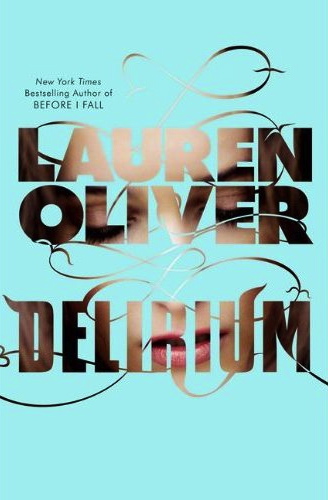
 The world has changed. Love has been identified as a disease, and everyone receives the cure for it around their eighteenth birthday. Lena is nearly eighteen and very excited that she will finally be safe, until she meets Alex and falls victim to the disease.
I’m in two minds about this book. On the one hand, I thought certain elements were very well done, and I think Lauren Oliver is a brilliant writer. On the other hand, there were parts of this book that just did not win me over. Let me start with those.
I had a very hard time with believability factor. That this is a dystopian world where love is considered a disease, no problem. I can believe that. It felt a little iffy that familial love and romantic love would be considered under the same umbrella, but okay. I’ve read lots of dystopias and I’m used to stretched realities. I can deal with that. However, there were other elements to the governmental and cultural structure that made absolutely no sense. In a world where government can simply eradicate whole classes of literature, music, art, and history, it makes no sense that they would, for instance, rewrite biblical history. You’d think they’d just do away with the Bible altogether. Many of the “wrong” things felt pointless, like it being wrong to like the color orange. Why should the government care? Those are just two of the many things that made me scratch my head a little bit.
Then the book was really, really predictable. I can’t say how without spoiling things, so let me just give an example of the type of predictable. Picture, for instance, an old horror film. In that film, you know that the girl is going to walk into a dark house and be unable to turn on the lights. You know she’s going to hear a noise and instead of running away, she’ll go to investigate. You know that once she finds the killer, she’ll run straight to a place where she can’t escape. Then if she’s a side character, she’ll get killed, or if she’s a main character, she’ll find some miraculous escape at the last second, either through the stupidity of the killer or because a boy shows up to save her. You know these things. Well, for 3/4ths of Delirium, I could tell you exactly what was going to happen next, every page.
On the flip side, and this is where I start talking about good things, despite it being predictable, I couldn’t put the book down. Lauren Oliver wrote it so well that even when I knew what was coming next, the book was suspenseful and I was tense reading it. I had to know what was going to happen, even if I already knew what was going to happen. That almost never happens to me, so I give a lot of credit to Oliver’s writing on that point. If it had not been written well, I would have been bored by the predictability and would have started skimming.
I also liked the characters. I liked Lena, her best friend Hana, and Alex. I liked Gracie and I even liked the rest of Lena’s braindead family. Even if I couldn’t believe a lot of what was happening in the book, I could believe the relationships and character development. Reading about interesting people helped me to overcome that whole unbelievability factor. By the last quarter – which I admit threw some curveballs that I wasn’t expecting – I was really into the book. I can’t say this was the best book ever, or that it lives up to other dystopias I’ve read. It actually felt a bit like a cross between Matched and Uglies, only not as good as either. Despite that, though, I might actually pick up the sequel when it comes out. Delirium’s characters won me over by the end, and while I may not believe everything about the world-building, I still want to know what happens next to Lena et al!




 The Zen Leaf