
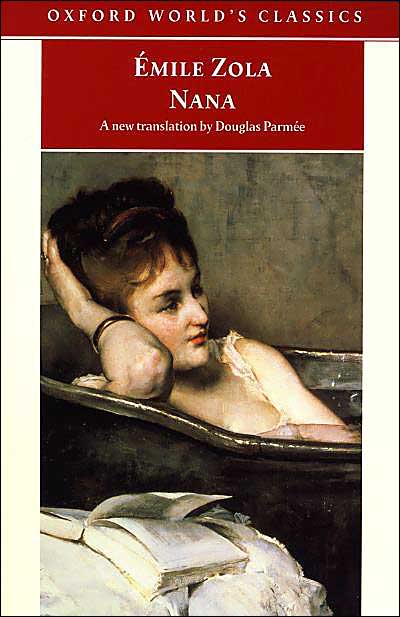
 Nana doesn’t really have a plot I can describe. It involves a woman named Nana, a cheap “tart” as she’s called who sells her body for money but not on the streets like a prostitute. She’s picked up by a theatre even though she can’t act or sing, simply because she is so seductive that men can’t resist her. Through the theatre, her world grows, until she becomes one of the richest women in Paris, with many men at her feet. Her wealth is unsatisfying, though – she can never be satisfied. One want leads to the next, ever growing, ever more greedy.
I have to say first off that my second foray into Zola was not nearly as satisfying as my first. While Germinal was a brilliantly-written novel, full of passion and pain and hope and despair, Nana was just sort of blasé for most of the book. Part of it, I could tell, was the translation, which was far dryer than that of Germinal. Oh how I wish Leonard Tancock had translated all of Zola’s books! But it wasn’t just the translation. Part of it was the story itself.
I get really bored of classic novels about rich people. Maybe I’ve just read too many of them, but this book struck me as, “Yep, they’re rich, they’re depraved under their fine suits, and they’re destined for downfall, what’s new?” The details of the theatre production, which went on for 30 pages, felt like 200 pages of detail. Tedious, long-winded, boring. So many characters were introduced – I think that’s one of Zola’s signatures – that I couldn’t keep them straight, though by the end of the book I knew everyone intimately. And this is where I can say that Zola truly shines: his characters aren’t like characters. They’re people. Even if at the beginning it’s so confusing – it’s so hard to keep them straight, without ever describing those people – by the end of the book you know who is who and exactly their personalities. Zola is the ultimate voice in show-not-tell. He’s a wonderful example of what an author can put into a reader’s brain without ever saying a word.
I did end up enjoying the book, not nearly as much as Germinal, of course, but enjoyable anyway. I would think I was getting tired of it and I’d put it away, only to have an almost nostalgic feeling of wanting to go back to the story and see what happens next. When I wasn’t reading it, it felt like an old friend I wanted to go revisit. I could tell that Zola was carving open new paths in my brain and filling them with stuff, even if I didn’t necessarily see all that stuff at the time. It was fabulous. This is another thing that Zola seems to be brilliant at.
At some point while I was reading the novel, I read somewhere that Nana is Zola’s most challenged/banned book, and I kept wondering why. Germinal is far more racy, both in sex and violence, even though Nana is essentially a book about a high-class prostitute. But then came the scenes when Nana suddenly starts having an affair with her friend Satin, another prostitute, and then I understood. Because of some vaguely-worded allusions to lesbian sex, this book is more banned than the one where…well, I won’t say, for spoiler’s sake, but yeah. Germinal. It’s…racy. Far more racy than Nana. But Nana? Well, it has a bisexual character, that means we should ban it, right? Ugh.
There was another thing that struck me as I read through Nana. During the Classics Circuit Zola tour, I saw several people mention that they thought Zola made derogatory comments toward women, and I think nothing could be further from the truth. There were certainly lots of derogatory comments towards women made in this book; those comments reflected not on Zola, however, but on the male characters about whom he was writing. For instance, at a party where several men are scheming to get a big dinner party together which will include Nana, Zola says:
However, under his breath he contrived to whisper to Fauchery that they’d be getting Tatan Néné – the finest tits going in Paris that winter – and Maria Blond, the one who’d just made her début at the Folies Dramatiques.
Comments like this are dropped a lot – both about men and about women – and I can see some people getting real reactionary to them. However, the reaction is misplaced if it is against Zola, who obviously finds the people who think this way absolutely disgusting. He presents this sort of talk to get a reaction, to make people see just how horrible, base, and degrading this way of thinking is. He wants you to think this is disgusting. He wants you to think the people who speak like this are disgusting. It’s no secret that Zola is fairly negative about many of the people he presents in his books, both men and women. It’s important to see that it isn’t Zola himself who thinks this way, but the people he despises that do, and I think that’s a point often missed by readers.
Even though Nana wasn’t as good as Germinal, I’m still looking forward to more Zola. Next up will probably be Thérèse Raquin, La Bête Humaine, or Le Rêve.




 The Zen Leaf
Pingback: Thérèse Raquin, by Émile Zola | The Zen Leaf
Pingback: La Bête Humaine, by Émile Zola | The Zen Leaf