
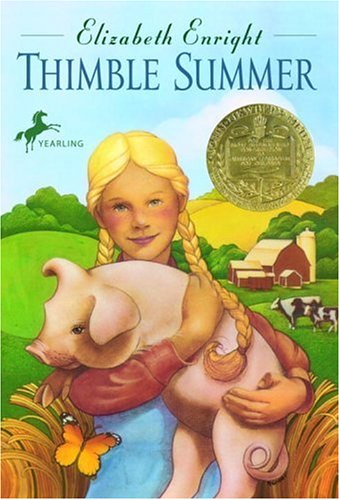
 Thimble Summer was published in 1938 and won the Newberry Medal in 1939. It’s about a 9-year-old girl named Garnet growing up on a farm in rural Southwestern Wisconsin. The book takes her through several months during one summer, through a drought, a silly runaway trip, and a fair.
Reading this book was like reading a book about a foreign country I know nothing about. Seriously. Imagine a sappy, more childlike version of Steinbeck’s The Red Pony. The American Midwest was a completely different place 70 years ago than it is now, and not necessarily a place I would want to visit. I lived in rural Southwestern Wisconsin for five years, only moving back south 4 years ago. I guess I didn’t live on a farm, but still, it was not at all the same. Take for example, this line from near the beginning of the book:
She could whistle between her teeth like a boy.
The gender divisions in here were eye-opening, a little scary, and make me understand my grandparents’ attitudes towards men and women a bit better. Once again, I am so glad I don’t live back then. People can say all they want that it was a better, simpler time, but I’m still going to say no thanks. Besides gender roles, there were a lot of things that just seem wrong by today’s standards. For example, Garnet is constantly thinking about her “fat” best friend next door, and that fat friend’s fat family who eat sweets all the time, which is probably why they’re so fat. Every time any of these people are mentioned, the book has to talk about how fat they are.
Did she imagine it, or did she really see that Ford sink down a little on its springs, as if it sighed under a great weight.
 Ironically, the illustrations (done by Enright herself) show a scrawny little girl for Garnet and an only slightly bigger girl for the neighbor. (Spot the “fat girl” in the picture to the right!) I wonder how badly people felt back then about their weight. I know I can’t judge the book by today’s standards, of course, but it still jarred me every time the rude remarks were made.
There were a lot of things like that in here. Once again, this is a book that was interesting to read from a historical point of view, but I don’t know how much more I can learn from it. It certainly speaks to how much children’s books have changed, in additional to culture in general. From an academic level, I could appreciate it, but on a personal level, it wasn’t really my taste.




 The Zen Leaf