
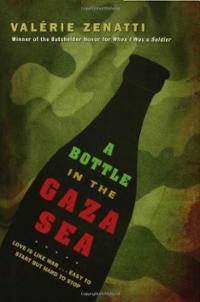
 When a bomb goes off in a cafe near Tal’s home in Jerusalem, she begins to write. At first, it’s just like a journal entry. Then, it becomes a letter to an as-of-yet unknown Palestinian. Tal has this idea that if she can connect with someone on the other side of the conflict, it’ll prove that peace is possible between their two nations, and she wants peace more than anything else. She places her letter into a bottle and asks her brother, who is serving in Gaza, to toss it in the Gaza sea, to hopefully be found by a girl about her age, with whom she can correspond by email. It’s not a Palestinian girl who finds the bottle, however, but a man who for a time refuses to give his name or age. Over the course of six months they write, and through events which change their lives, an unlikely friendship begins to grow.
This book was another impulse grab from the library. It’s been on my TBR list for awhile, and I saw it yesterday and decided to check it out. The majority of the book is written in the form of emails and chat logs, with a couple chapters in between for normal narrative, alternating points of view between the two characters. It was touching, and though at first I wasn’t sure if I would like either of the two correspondents, I ended up caring for both of them.
The situation in Israel/Palestine is very personal to me. I visited the West Bank last year for my sister’s wedding to a Palestinian refugee. Before that time, I knew next to nothing about the conflict, and what I did know came from reading a couple books about Israel before flying out. I didn’t expect to come away from the situation with very strong opinions. I’ll admit, I am unlike most of America in that I think the Israeli government is not good. I’ve seen what they do to the Palestinians, I see how much money they have and how poor the Palestinians are, I know about the torture techniques and the unfair jail roundups. I’m not saying I think everything the Palestinians do is right – I in no way condone violence – but in America, there’s very little talk about Israeli terrorists, and they are certainly out there. I worried about this book when I started reading, because it’s primarily from Tal’s point of view, from the point of view of an Israeli. I also knew the author spent part of her childhood in Israel, and I didn’t know how that would color her writing. I didn’t want to find out this was another book about how awful Palestinians or Muslims were. Thankfully, it wasn’t. I think the author did a fairly good job at being unbiased. There was violence and pain on both sides of the border. The characters were human, just people. And I learned a lot about Gaza that I didn’t know (I didn’t visit Gaza when I was in Palestine last year).
For example, Naim (Tal’s correspondent) says at one point, “Here’s the Gaza Strip. Fifteen miles long, six wide. All around the outside, barbed wire with seven ‘crossing points.’”
15 miles long, 6 miles wide. The population of Gaza in 2007 was about 1.5 million people. Now, according to Wikipedia, the strip is actually 25 miles long and 6-12 miles wide, depending on which section, for a total of 139 square miles. But even so, that is so tiny. Population is over 10,500 people per square mile! Just as a comparison, San Antonio, where I live, has a population of 1.3 million people, 412 square miles, and less than 3000 people per square mile. I can’t imagine my entire city area condensed into almost a quarter of its size, plus adding more people. That’s insane. And that doesn’t even begin to touch on the amount of poverty or violence that exists there.
It was very eye-opening. Despite the fact that I support the Palestinians and have seen conditions on the West Bank, I had no idea just exactly how bad life in Gaza was.
But the book didn’t focus only on the negative. In the end, there was hope. I don’t know when, if ever, there will be peace in Israel. But I’m happy that some people, like Zenatti, are doing their best to make both sides of the story known, to promote sharing and communication and peace. I love what she put in the beginning of the book:
Ce n’est pas parce que les uns ont raison que les autres ont tort. Il faut garder les reves intacts. Les reves, c’est ce qui nous fait avancer.
(roughly translated: It is not because some people are right that others are wrong. All of our dreams must remain intact. Our dreams keep us moving forward.)




 The Zen Leaf