
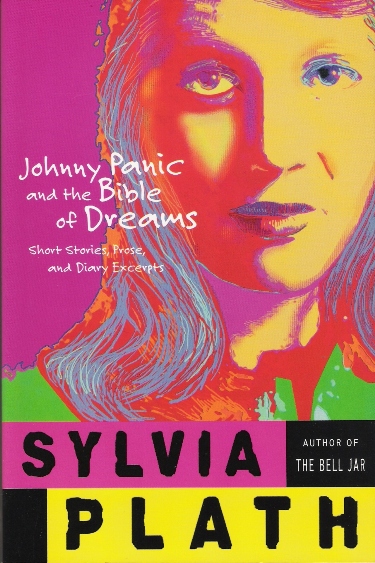
 Johnny Panic and the Bible of Dreams is a collection of short stories, essays, and journal entries by Sylvia Plath. Altogether, 20 stories, 5 essays, and 5 journal collections grace this book. I must say that it’s extremely difficult to read a short story collection in a timely matter. It took quite a bit of effort to read this one in 10 days, averaging 3 pieces a day, about 32 pages. Why? Because each time I finished a story, I had the immensely satisfying “I’m finished” feeling that comes at the conclusion of a piece, and it’s difficult to just run straight into the next one, especially since Plath really makes you feel as if you are IN the story, and that’s hard to let go of to enter a new atmosphere. I had to space them out throughout the day.
What can I say about this? I don’t want to go into each individual work. I must say the journal entries were the most difficult part to read. According to the introduction, written by Plath’s husband Ted Hughes, Plath was trying to write in the “Flaubertian” style, a scary statement in itself as I couldn’t stand Madame Bovary. What that amounted to, from what I could see, was huge passages about every minor detail of a person’s clothes or home decor, and reading two pages on the pattern of wallpaper really bugs me. The essays, on the other hand, were fantastic. They were autobiographical (well, to be fair, most of Plath is transparently autobiographical, but the essays at least didn’t put on a veneer of fiction) and brilliantly written.
Which leaves the 20 stories. Wikipedia says Plath is known for “her uncanny use of metaphor” and I would have to say that’s a very accurate statement. Plath is a brilliant writer. I haven’t read her poems because I’m the most incompetent idiot when it comes to poetry, but The Bell Jar is one of my favorite novels of all time and it is superbly done. Reading through these stories and essays, I can see over and over again how great a writer she was. Every sentence is rich and powerful. Not overly done. Perfect tempo, perfect visual aid. For example, from one of her essays about public school:
…full time guidance counselors jogged our elbows at ever-diminishing intervals to discuss motives, hopes, school subjects, jobs–and colleges.
Wow. If I could write half that well, I wouldn’t have anything to worry about. That’s all I can say about that.
But in spite of the beauty in her writing, Ted Hughes’ remark in the introduction about the stories’ “obvious weaknesses” really does ring true. Many of the stories fall short of the mark. I found this extremely frustrating, knowing that every sentence was a work of art, not being able to find a single flaw, and yet feeling a letdown at the end, as if the story just didn’t quite get to the pinnacle of what it could be. Like it didn’t come together at the end. And usually the frustration was so vague and abstract that I’d never be able to put it into words. Plath would have needed one heck of an editor to help her. Like I said, the words themselves are virtually flawless.
There were several stories I didn’t like, and several I really loved. I’ll start with the bad ones. One of my two least favorites was “Stone Boy With Dolphin,” which was like a drunken splatter based on journal entries from her Cambridge years. It was an attempt at stream-of-consciousness of a drunk girl which just didn’t work for me. It made no sense, the internal narrative was disjointed, and the story wasn’t that interesting. If, perhaps, she had taken it out of the SOC style and expanded it, so we weren’t introduced to 40 characters in a short number of pages, it would have read less like a diary entry and more like a cohesive novella. The other of the two I heartily disliked was “Johnny Panic and the Bible of Dreams.” This one was apparently her most famous short story, and appeared in Atlantic Monthly. For some reason, though, I just didn’t like it. Maybe it’s because the ending felt obvious to me, because that sort of end has been redone so many times in our culture that I’m just sick of it. Perhaps it’s also because Plath feels like she’s writing almost objectively, cold, completely detached from the narrative, and the thing I like most about her writing in general is the amount of herself poured into the page. This story felt boring and pointless without that little bit of the author embedded in it.
As for the good ones, my favorites were the essay, “America! America!” (the guidance counselor quote above is from this one), “Above the Oxbow,” and “That Widow Mangada.” “Above the Oxbow” is a very tiny story that I love for its voice. I really feel like I’m reading something from an old man’s point of view, looking out over mountains and dealing with random tourists. The tourists are transient – you know there’s more to their story, but you never hear it – and it gives a great slice-of-life feel in this hour of the old man’s world. “That Widow Mangada” is based on actual events (there’s one journal entry entitled “Widow Mangada” that has almost everything from the story laid out in it) from a trip Plath and Hughes took to Spain one summer. I like this one because the characterization is done remarkably well, plus the description and irony of cross-culture clashes. The widow is a peculiar and realistic character (obviously, since she’s based on a real person) which gives so much life to the story. And the end is not too unrealistically depressing or triumphant (a trap fallen into in some of these stories). It was my favorite of all of them.
And of course, Plath does basically lay her life out in these stories and prose works, the same way she did in The Bell Jar and, from what I’ve heard other people say, her poetry. Some of these stories almost seem like earlier versions of parts of The Bell Jar, down to some lines I’m almost sure were copied over into the novel (or taken from it, I suppose, I don’t know which came first).
All in all, I really liked the book. I didn’t know Plath had written any prose other than The Bell Jar and was very happy to discover that she had, since she’s one of my favorite authors. And while these stories weren’t all perfect, I wasn’t in the least bit disappointed. She was a brilliant writer.




 The Zen Leaf
Pingback: Carlyle’s House and Other Sketches, by Virginia Woolf | The Zen Leaf