
 Spoilers.
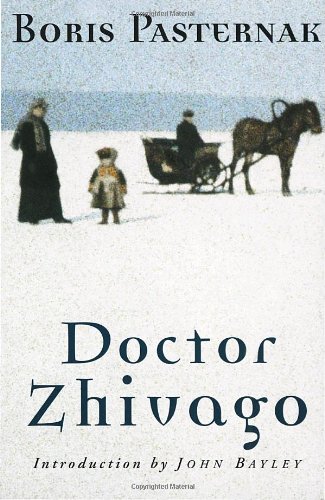
Ugh. What else can I say about this book? It’s nearly 550 pages of ugh.
Somewhere awhile back we** were talking about loss in translation. I think this book is the perfect example of that. Not just because it’s translated from Russian to English, but because the culture is so completely foreign to me that I just don’t understand the climate. This is steeped in Russian revolutionary history and chock-full of various philosophies. Unfortunately, I’m not real big into philosophy in straight doses, so I’ve read hardly any of the writers discussed (and thus don’t know their ideas), plus I don’t have a clue when it comes to Russian history and geography. I couldn’t tell you who the big army leaders were or what the Greens stood for or what cities were in Siberia or anything else. I think my total ignorance really gave me a disadvantage when reading this book.
That, and for the most part, I just don’t take well to the Russian style of classic literature. Tolstoy did the same thing – write one story, end it completely, start telling a completely unrelated story, then another, then another, come back to the first one, tie two stories together by a meagre thread, end the third story altogether, concentrate on the second for half a book, and then start another story which has nothing to do with the rest of the book before or after it’s told. I don’t get this sort of writing. I know that it’s classic, I know that it’s probably a great example of Russian style, but I flat-out don’t get it. It doesn’t help that everyone has 15 variants of their names and they’re all in a language I’m not in the least bit familiar with, so I can’t keep track of who’s who.
This could have been interesting. It had potential. Strip out all the philosophy and bantering about war, disentangle the millions of plotlines, and you’re left with a decent story. Not one I particularly liked, but one that was interesting and had plenty of literary value. It almost seemed as if Pasternak wanted to write a purely philosophical work and felt like he had to stir up a tiny bit of fiction to pass it off. I wish he hadn’t. I wish he’d stuck to one genre or the other. I don’t mind philosophy in books, gracious no, but it does well to unveil that philosophy through the plotline, not spent 100 pages listing all the popular theories and idealisms of the time and comparing/contrasting them. There isn’t even the illusion of fiction in some places.
Cutting all the baggage aside, the story is about Yurii Zhivago’s life. Well, as much as you can say this is about any one particular story. That was the one discussed the most. Zhivago grows up as an orphan, marries, has kids, helps in the war, meets a woman named Lara who he has no feelings for until his wife persuades him otherwise, later cheats on his wife with Lara but still loves her, is taken prisoner for awhile, escapes, lives with his lover for a long time, tricks her into leaving him, and spends the last ten years of his life turning into an unhealthy buffoon (including taking a third unofficial wife and having more kids). Then he dies. Then Pasternak tells an unrelated story from 20+ years after his death.
I wanted to like Zhivago (the person, not necessarily the book). He seemed like a nice guy, except that I never was clear what his position on the war was. Nice, but vacillating or vague. His treatment of his family, however, really irked me, and especially the way he ended up. There’s a lot of talk about predestination and fate in the book, but not enough so that I think Pasternak was taking a stance on it one way or another. In any case, that’s probably the only really interesting thing I found in it – the odd contrast of old-world superstitions and modern-day jaded attitudes. But since Pasternak didn’t take the juxtaposition far enough, it ends up being a mildly interesting sidenote that, like many other things in the book, really has nothing to do with the book at all. Sigh. I’ve got a week before I have to present this book to my book club, and I think I’m going to have to do some major studying of critical texts to figure out what this book was supposed to be about. I was – am – completely lost.
**the members of 5-Squared, where this review originally appeared




 The Zen Leaf
Pingback: Fathers and Sons, by Ivan Turgenev | The Zen Leaf
Pingback: Crime and Punishment (graphic novel), by Fyodor Dostoyevsky | The Zen Leaf
Pingback: Jane Eyre, by Charlotte Bronte | The Zen Leaf