
 Spoilers.
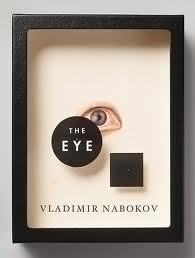
The Eye is Vladimir Nabokov’s fourth novel (more of a novella, really). It is told from the point of view of a tutor, who, towards the beginning of the book, is beaten up and humiliated in front of his students by the jealous husband of his mistress. He then goes home and attempts suicide. Now, whether the suicide is successful can be debated; suffice to say that he “recovers” and thinks of himself as dead, afterwards forming a new life among people he hasn’t known before. Most of these people are familiar with each other – family or old friends – all except one: Smurov. The narrator, who considers himself now to be nothing more than an all-seeing “eye,” initially describes Smurov as a gentleman. Smurov is intelligent, witty, comfortable in society, handsome, mysterious, well-mannered, and well-dressed. The narrator assumes that Vanya, the single lady within the group, will fall in love with Smurov.
It becomes clear fairly quickly (though it is never said directly until the end) that the narrator and Smurov are the same person, and that he is speaking of himself in third person. It is clever on Nabokov’s part, because Smurov is a classically unreliable person – not only in his judgment of himself, but in his dealings with others. Through the story, the narrator watches Smurov (at one point he says of himself, “In respect to myself I was now an onlooker”) and those around him, attempting to discern Vanya’s feelings for him. As he watches and snoops (going so far as to steal someone’s mail to find out their opinion of Smurov), he discovers that those around Smurov think of him as shabby, self-absorbed, absurd, and deceitful, also as a fraud, a “sexual lefty,” a spy, and a thief. The only person who thinks well of Smurov, in fact, is the demented old uncle who has actually confused him with Vanya’s fiancé. While the narrator suffers each of these opinions as personal blows, the reader doesn’t need the narrator’s snooping to discover these things – they are apparent simply by the double narrative. While the narrator may think he speaks well of Smurov, or himself, he reveals at the same time his blundering, petty nature.
Towards the end, the narrator makes a grand (and ridiculous) declaration of love to Vanya despite the fact that she is engaged. He runs off afterwards and hides in a flower shop with a mirrored wall, and when he leaves, Nabokov writes, in my opinion, the most poignant and meaningful description in the book:
As I pushed the door, I noticed the reflection in the side mirror: a young man in a derby carrying a bouquet, hurried toward me. That reflection and I merged into one. I walked out into the street.
From this moment on, the narrator is referred to as Smurov, whereas he never has been before. After this, he is called by name for the first time. The “eye” has integrated back into the body. Smurov no longer sees himself only in reflection (the mirrors being the people he associates with). After this, all he sees is what he wants to see. The last two passages are mere fantasy, grossly obvious to the reader even if Smurov does his best to convince us otherwise. He is as unconvincing in the lie to the reader as he has been in all his previous lies to other characters. No reader would believe him at the end when he proclaims how happy he is:
I swear, I swear I am happy. I have realized that the only happiness in this world is…to be nothing but a big, slightly vitreous, somewhat bloodshot, unblinking eye. I swear that this is happiness. What does it matter that I am a bit cheap … What more can I do to prove it, how to proclaim that I am happy? Oh, to shout it so that all of you believe me at last, you cruel, smug people…
Nabokov’s gift is his prose. Often, in fact, he seems to go too far, sacrificing content and substance for style, structure, and color. Every sentence is a play of [sic] words. On first reading The Eye, I was dissatisfied, and I decided to take a day to think about it before writing up a review. There are so many layers to a Nabokov book that it takes time to sift through them. What Nabokov has presented in this book is a strong criticism of first person narration. First person narration is often thought of as reliable simply because the world is seen directly through the narrator’s eyes. People, however, are notoriously unreliable in their judgment of themselves and the world around them. Through a many-layered narrative, a separation for most of the book of Smurov and narrator, the reader comes to see Smurov for what he is, the same way that the group he mixes with comes to see him. Smurov discovers this viewpoint of himself, but too late to save himself from the reader’s judgment. I read an essay that quotes Wayne Booth as saying this is a “Secret communion of the author and reader behind the narrator’s back,” and I think that’s a very apt description for this book. I don’t believe The Eye is anywhere near as masterful as some of Nabokov’s other works (Lolita, for example, is superb), but it is amusing, well-written, and worth reading.




 The Zen Leaf